
Direct answer: Choose time-fill when vehicles reliably park for several hours and can be connected to fueling posts during that period. Choose fast-fill when vehicles arrive unpredictably or must return to service quickly. A combination station can serve overnight vehicles and urgent turnaround vehicles at one site. The decision depends on the hourly fueling profile, available gas supply, vehicle tank characteristics and operating schedule, rather than fleet size alone.
What is the practical difference?
At a typical time-fill station, gas is compressed and delivered to connected vehicles over an extended parking window. The vehicles usually fill directly from the compressor. A small buffer vessel may stabilize operation, but high-pressure storage is generally not the main source for each fill.
At a typical fast-fill station, compressors charge high-pressure storage so gas is ready when a vehicle arrives. The dispenser controls transfer into the vehicle. The compressor and storage must recover fast enough for the next arrivals. The U.S. Department of Energy’s Alternative Fuels Data Center (AFDC) identifies a third arrangement, combination fill, which provides both operating modes.
These descriptions are starting points, not a universal bill of materials. A project may use pipeline gas or delivered CNG, and the inlet pressure, compressor design, storage arrangement and local code requirements can change the detailed scheme.
Comparison for a fleet buyer
| Question | Time-fill | Fast-fill | Combination |
|---|---|---|---|
| Vehicle availability | Long, predictable parking window | Short or irregular stops | Both schedules exist |
| Typical transfer path | Compressor to connected vehicles | Storage and/or compressor to dispenser | Both paths |
| Vehicle connection points | Often many parking-position posts | One or more drive-through dispensers | Posts plus dispensers |
| High-pressure storage role | Limited or site-specific | Supports quick delivery and peak arrivals | Supports fast-fill side |
| Main operating risk | Insufficient overnight window or unavailable parking positions | Queues and slow recovery after peak arrivals | Controls and operating priorities need careful design |
| Best starting data | Vehicles parked together, energy per vehicle and hours available | Arrivals per hour, fuel per arrival and maximum wait | Separate overnight and urgent demand |
This table is a screening tool. Neither mode guarantees a particular fill time or delivered quantity. Vehicle receptacles, tank pressure rating, ambient conditions, temperature compensation and station pressure all matter.
When time-fill fits
Time-fill is often attractive for buses, refuse vehicles or service fleets returning to a depot.
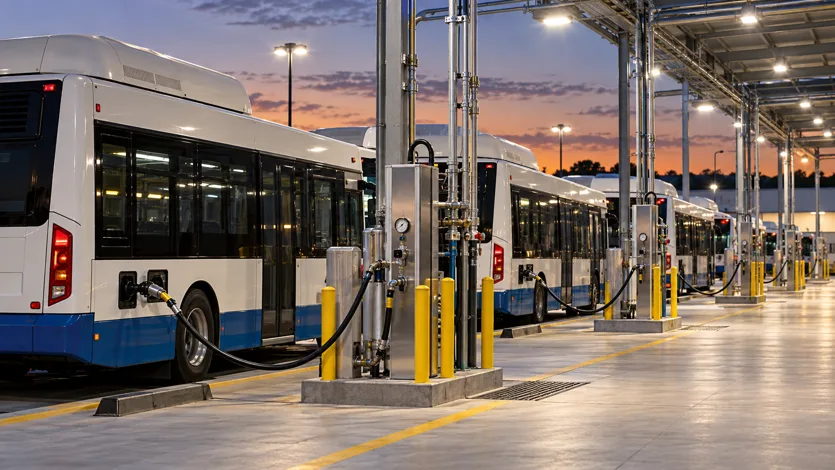
One driver parks, connects the hose and the vehicle receives fuel while parked. The key benefit is that the station can spread delivery across hours rather than meet the entire day’s demand in one short burst.
However, a long nominal parking window can hide a short usable window. Maintenance staff may move vehicles, cleaning may occur before fueling, or the last bus may return much later than the first. Site planners should map the actual time each vehicle can remain safely connected. They should also check parking geometry, hose routing, pedestrian access and how a failed post or compressor is handled.
The slower fill can reduce temperature rise in the vehicle tank compared with a rapid fill, potentially helping achieve a fuller settled fill. This is a physical effect described by AFDC, not a promise for any particular station. The final quantity still depends on vehicle and ambient conditions.
When fast-fill fits
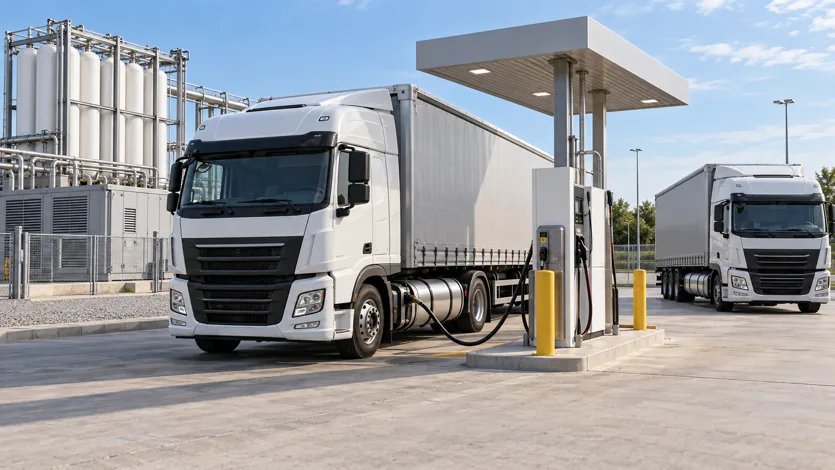
Fast-fill makes sense for fleets with short turnarounds, shared vehicles, mixed routes or arrivals throughout the day. A truck can enter a fueling lane, use a dispenser and depart without remaining connected for hours. For a procurement team, the important number is not just the dispenser’s advertised maximum flow. It is how many vehicles can be served in the busiest period, including storage depletion and recharge.
Consider the queue as a system: arrival pattern, average quantity per fill, number of dispensers, compressor capacity, useful storage and allowed wait time. If ten vehicles arrive close together, a dispenser that fills the first vehicle quickly may still leave the last vehicle waiting if storage cannot recover. Conversely, a large compressor and storage bank can be unnecessary if arrivals are spread across the day.
Vehicle tank temperature also rises during a rapid transfer. Temperature compensation and dispensing controls are relevant to the settled quantity. Operators should compare real operational outcomes, rather than assuming a nozzle’s peak rate translates into guaranteed vehicle range.
When a combination station is justified
A mixed bus and truck depot may park most vehicles overnight but need a few vehicles to fuel between shifts. A combination layout can assign the predictable demand to time-fill and reserve fast-fill capacity for short stops. This may improve flexibility, but it adds equipment, controls and design coordination. The operating priority between branches should be defined: will the fast-fill dispenser be available during the time-fill period, and what happens when both call for compressor capacity?
Do not assume that “containerized” means either fast-fill or time-fill. Containerization is a packaging choice. A containerized daughter-station concept can be part of a delivered-gas project, while the vehicle fueling pattern is a separate decision.
A simple sizing example
Illustrative assumptions only: A depot has 40 buses. Each requires an average of 55 standard cubic metres of gas after a route. All can be parked and connected for an effective seven-hour window. The daily target is 2,200 standard cubic metres. Dividing by seven hours gives an average delivery requirement of about 314 standard cubic metres per hour before allowing for compressor availability, simultaneous connection patterns, losses or design margin.
That arithmetic does not specify a compressor model. “Standard cubic metre” must first be defined by agreed reference temperature and pressure, such as 15°C and 101.325 kPa absolute, or another contract basis. Compressor capacity must then be evaluated over its actual inlet-pressure range. If gas arrives by trailer, pressure declines during unloading; if a pipeline supplies the site, the utility’s minimum guaranteed pressure matters.
Now assume only two hours of effective parking. The same daily quantity would imply 1,100 standard cubic metres per hour on a simple average basis. A time-fill design may become much larger, or staggered schedules, fast-fill or a hybrid arrangement may be more practical. This is why the fueling window is as important as the vehicle count.
Data to collect before requesting a quotation
- List each vehicle type, tank service pressure, receptacle type and expected fuel quantity per return.
- Record arrival and departure times by hour for a representative busy day, not just daily totals.
- State the maximum acceptable queue and any vehicles that must fuel immediately.
- Describe the gas source: pipeline pressure range and flow commitment, or delivered CNG trailer data and replacement schedule.
- Identify available electrical power, site footprint, traffic circulation and parking positions.
- Specify the required availability, maintenance access, metering needs and planned fleet growth.
- Ask suppliers to state capacity at minimum inlet pressure, usable storage assumptions, simultaneous fueling assumptions and exclusions.
If comparing proposals, normalize units and reference conditions. A figure in Nm³/h, Sm³/h or GGE/min may use a different basis. Ask each supplier to state the reference conditions, gas composition and whether pressure values are gauge or absolute. Avoid comparing headline flow rates until these definitions agree.
Questions to ask about the equipment scope
For time-fill, ask how many hoses and posts are included, how flow is shared across connected vehicles, and what happens if a vehicle disconnects or a line is damaged. For fast-fill, ask for the compressor, cascade/storage logic, dispenser pressure and temperature compensation, and performance during a defined peak sequence. For either type, confirm gas treatment, filtration, emergency shutdown, leak detection, venting, electrical classification, safety distances, controls, commissioning and operator training against the applicable local requirements.
A quote should distinguish factory-mounted equipment from site work. Foundations, utilities, piping beyond skid limits, permits, testing and civil works may be outside the equipment price. That boundary affects budget and delivery schedule.
FAQ
Is time-fill always cheaper?
No. It often needs less high-pressure storage and can spread compressor demand, but the number of parking posts, piping runs, electrical work and site layout also affect cost. Compare complete installed scopes and the operating duty.
Does fast-fill mean every vehicle receives a full tank in minutes?
No. Actual time and settled quantity depend on vehicle tank size and starting pressure, storage pressure, compressor recovery, gas temperature, ambient temperature and dispenser controls.
Can one station offer both?
Yes. Combination fill can serve overnight vehicles at posts and quick-turn vehicles at dispensers. The controls and compressor allocation must be sized for simultaneous demand.
Is delivered CNG only suitable for fast-fill?
No. Gas supply mode and vehicle filling mode are separate choices. Trailer supply, unloading behavior and pressure changes must be engineered for the chosen station layout.
What should be stated in a supplier performance guarantee?
Define vehicle types, starting tank conditions, gas composition, inlet pressure range, ambient conditions, number of concurrent fills, delivery quantity, time window and measurement basis. Have the supplier identify any assumptions or exclusions.
Request a project-specific concept
If your fleet is evaluating CNG, send us your vehicle schedule, fuel demand by shift, gas source information, available parking window and site location. HMZ can discuss a preliminary station configuration and define the information needed for a tailored technical and commercial proposal.
Related HMZ CNG solutions
Explore the CNG fueling station for fleets, compare trailer-fed projects with our containerized CNG daughter station, and review the fleet CNG station selection guide before requesting a configuration.
Technical sources
- U.S. Department of Energy, Alternative Fuels Data Center, “Compressed Natural Gas Fueling Stations”: https://afdc.energy.gov/fuels/natural-gas-cng-stations
- U.S. Department of Energy, Alternative Fuels Data Center, “Filling CNG Fuel Tanks”: https://afdc.energy.gov/vehicles/natural-gas-filling-tanks
- U.S. Department of Energy, Alternative Fuels Data Center, “Costs Associated With Compressed Natural Gas Vehicle Fueling Infrastructure”: https://afdc.energy.gov/files/u/publication/cng\_infrastructure\_costs.pdf
