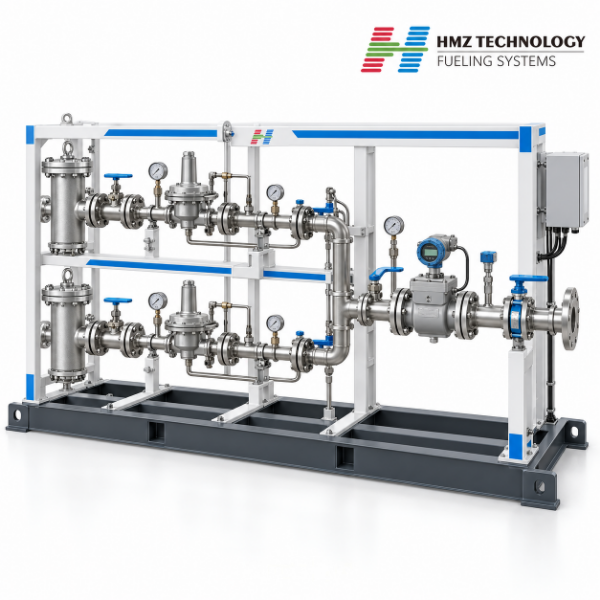
A CNG fleet fueling station supplies compressed natural gas to vehicles operating from a depot or a defined service base. Its compression, storage, and filling equipment are selected around fleet fuel demand, vehicle return times, and the available fueling window. Pipeline-fed and tube-trailer-fed arrangements require different gas supply and compressor configurations.
HMZ coordinates project-based selection and supply proposals for integrated CNG fleet fueling station equipment. Share your operating schedule and gas supply conditions so we can develop a proposed equipment scope for your bus depot, logistics fleet, or municipal vehicle base.
The vehicles must be equipped and approved for CNG. A fueling station does not convert diesel or gasoline vehicles to natural gas operation.
| Arrangement | Typical Operating Pattern | Configuration Considerations |
|---|---|---|
| Fast-fill | Vehicles need to refuel during short stops or shift changes. | Compressor output, usable cascade storage, dispenser flow, and back-to-back filling duty must be reviewed together. |
| Time-fill | Vehicles remain parked for a longer period, often overnight. | The compressor supplies selected filling posts over the available window. Parking layout, simultaneous connections, and controls are important. |
| Combination-fill | A fleet needs both scheduled depot filling and short-stop refueling. | A coordinated design combines time-fill posts and fast-fill dispensers with suitable controls and capacity allocation. |
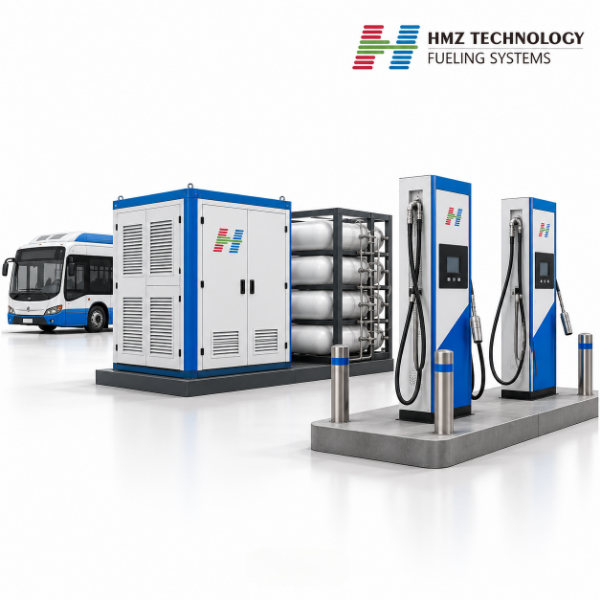
There is no single filling arrangement that suits every fleet. Fast-fill is not selected solely by dispenser count, and time-fill is not selected solely by the daily gas total. The vehicle schedule and gas supply must be assessed together. The concept image illustrates one possible fast-fill arrangement.
| Gas Source | Selection Basis | Items to Confirm |
|---|---|---|
| Natural gas pipeline | Compress the available pipeline gas to the specified vehicle fueling conditions. | Minimum and maximum inlet pressure, available hourly flow, gas quality, utility connection, and required treatment. |
| CNG tube trailer | Receive high-pressure gas delivered from an external supply source; review boosting requirements as trailer pressure declines. | Trailer pressure profile, usable delivery quantity, transport schedule, changeover arrangements and unloading interface. |
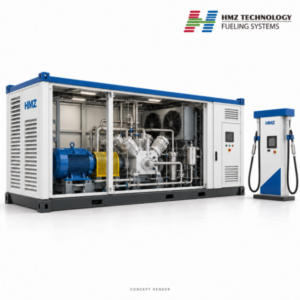
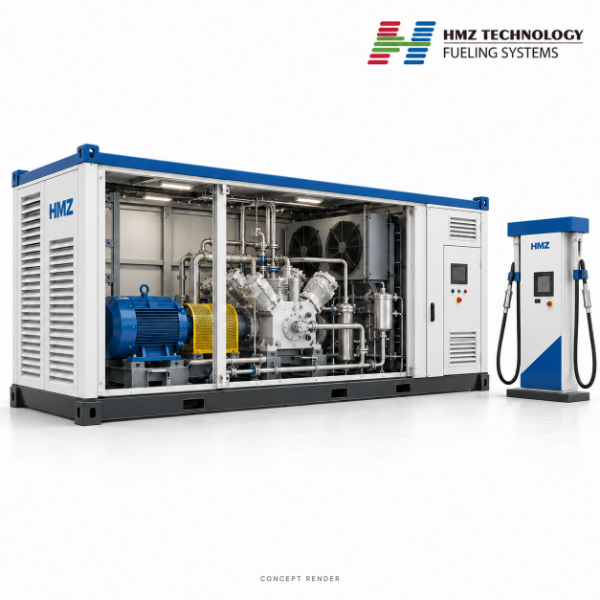
A pipeline compressor package and a daughter-station booster package are not automatically interchangeable. Equipment selection must use the actual inlet conditions. For a trailer-fed package centered on an enclosed booster module, see our containerized CNG daughter station offering.
| Equipment or Function | Project Configuration |
|---|---|
| Gas inlet equipment | Pipeline connection interface or tube-trailer unloading interface. |
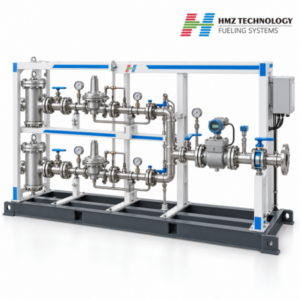
| Gas conditioning | Filtration, separation and drying requirements based on gas quality and equipment limits. |
| Compressor package | Selected technology, cooling, inlet range, capacity and motor power. |
| Storage cascade | Capacity and arrangement selected for fast-fill duty; not assumed necessary for every time-fill configuration. |
| Filling terminals | Fast-fill dispensers, time-fill posts or a combined arrangement. |
| Controls and protection | Operating controls, pressure protection, emergency shutdown and gas detection as specified by the engineered design. |
| Fleet data functions | Vehicle identification, access control, fueling records or remote monitoring can be evaluated; availability and compatibility require confirmation. |
| Operational resilience | Duty/standby compressors, maintenance access and future expansion interfaces where justified by the operating plan. |
“Integrated” means a coordinated equipment solution. It does not imply that all equipment is installed on one skid or inside one container. Storage, dispensing, power distribution, and vehicle circulation may occupy separate areas.
| Parameter | Information Needed |
|---|---|
| Fleet composition | Vehicle types, number in operation and planned expansion. |
| Daily consumption | Total daily gas demand with units and reference conditions. |
| Peak demand | Vehicle return times, required fuel per visit, and simultaneous filling demand. |
| Fueling window | Available hours, shift patterns, and maximum acceptable vehicle turnaround time. |
| Vehicle compatibility | Vehicle filling pressure, receptacles and manufacturer requirements. |
| Gas source and pressure | Pipeline availability or trailer supply; minimum/normal/maximum inlet pressure, stated as gauge or absolute. |
| Gas composition | Gas analysis, moisture/dew point and contaminants. |
| Utilities and environment | Voltage, phases, frequency, available power, temperature range and altitude. |
| Site and documents | Plot dimensions, parking layout, access, local approvals and required standards. |
| Supply boundary | Required equipment, installation responsibilities, testing and documentation. |
Consider an illustrative fleet of 40 vehicles requiring 30 Nm³ each per day. The total is 1,200 Nm³/day. Dividing by an eight-hour filling window gives an average demand of 150 Nm³/h; delivering the same quantity within two hours gives 600 Nm³/h.
These are demand averages, not compressor ratings or a promise of vehicle filling time. Final sizing must also account for the inlet pressure, vehicle arrival pattern, usable storage, compressor availability, filling behavior, and operating margin. Where Nm³ is used, the reference temperature and pressure must be agreed.
It is a station configured to refuel CNG vehicles around a fleet’s depot location and operating schedule. Its gas source, compression, storage, and filling arrangement are selected together.
Fast-fill may suit short turnaround windows, while time-fill can suit vehicles parked for longer periods. Some depots need both. Vehicle schedules and gas demand determine which arrangement should be evaluated.
A tube-trailer-fed configuration can be evaluated where a reliable CNG delivery chain is available. It requires appropriate unloading, pressure management, and trailer changeover arrangements.
No. Storage is selected for the fueling strategy. Fast-fill commonly uses a storage cascade, while some time-fill arrangements feed vehicles from the compressor without a large fast-fill storage bank.
No. Fuel consumption per vehicle, arrival patterns, filling windows, vehicle pressure, and gas supply conditions are also needed. Fleet count alone is insufficient for selecting compressor capacity.
Expansion can be considered during planning through available site space, utility capacity and equipment interfaces. Future capacity is not guaranteed unless it is included in the approved design.
Only where expressly included in the quotation. Confirm the responsibilities for utilities, foundations, piping, electrical work, installation, commissioning, and approvals before ordering.
The gas supply conditions, peak duty, compressor arrangement, storage, filling terminals, controls, documentation, and supply boundary determine the proposal. Price and delivery time are confirmed after project review.
Send your destination country, fleet size, vehicle types, daily gas demand, shift schedule, available filling window, vehicle filling pressure, gas source, inlet pressure range, gas analysis, power supply, and site layout. Identify any required standards and whether you need equipment supply only or additional project services.
Request a Fleet Fueling Proposal or email hmzfuelstation@gmail.com.
We’ll reply within 1 business day. Please check for emails from an ‘@gmail.com‘ address.