
A CNG mother station takes natural gas from a pipeline or other suitable upstream supply, conditions and compresses it, and loads high-pressure transport modules or tube trailers. A CNG daughter station receives that delivered compressed natural gas, manages unloading and pressure decline, and normally supplies vehicle fueling at the destination. The names describe positions in a supply chain, not two interchangeable equipment packages. A mother station may also fuel vehicles, and a daughter station may serve a fleet or public vehicles. Specify the gas source and required outlet before choosing either.
Follow the gas, not the label
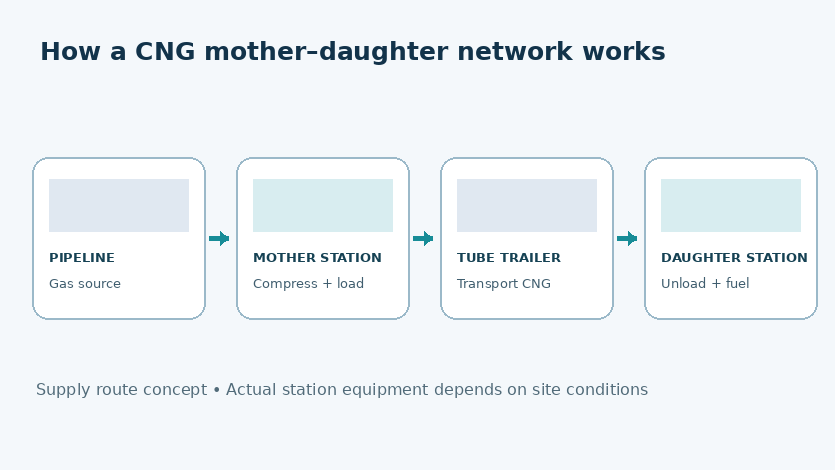
A common supply chain is: pipeline or processing source → mother station → CNG transport trailer → daughter station → CNG vehicle. See HMZ’s containerized CNG daughter station guide for the downstream equipment and operating sequence. The mother station creates a transportable high-pressure inventory. The daughter station uses that inventory where direct pipeline access is absent, impractical or delayed. A project may need both sites, only one site as part of an existing network, or a pipeline-fed vehicle station that is neither a trailer-loading mother station nor a trailer-fed daughter station.
The US Department of Energy’s Alternative Fuels Data Center explains that pipeline-fed fast-fill stations normally use on-site compression and storage, while time-fill stations often feed parked vehicles from a compressor over a longer period. These are fueling methods, not substitutes for the mother/daughter distinction. A trailer-fed daughter station can still be designed around a particular vehicle fueling window.
What a mother station does
A mother station is usually placed where a suitable gas supply and adequate electrical capacity are available. Incoming gas is evaluated for composition, pressure, moisture and contamination. Project-specific filtration, drying or other treatment may be required before high-pressure compression. Compressors then raise the gas to the pressure specified for the transport equipment and applicable rules. A loading manifold, isolation valves, instruments, controls and safety systems connect the station to approved trailers or cylinder modules.
The key product leaving a mother station is delivered gas inventory. Its capacity must cover more than one downstream site’s theoretical daily consumption. Trailer filling time, actual usable trailer capacity, fleet of trailers, loading availability and the customer’s supply schedule all affect how much gas can be delivered. A station rated only by compressor nameplate flow may still create a bottleneck if one loading bay or trailer turnaround is inadequate.
Depending on its design, a mother station can include a separate vehicle dispensing function. That should be explicitly stated in the equipment scope. A trailer loading post is not a vehicle dispenser, and a vehicle dispenser is not a substitute for a properly designed loading post.
What a daughter station does
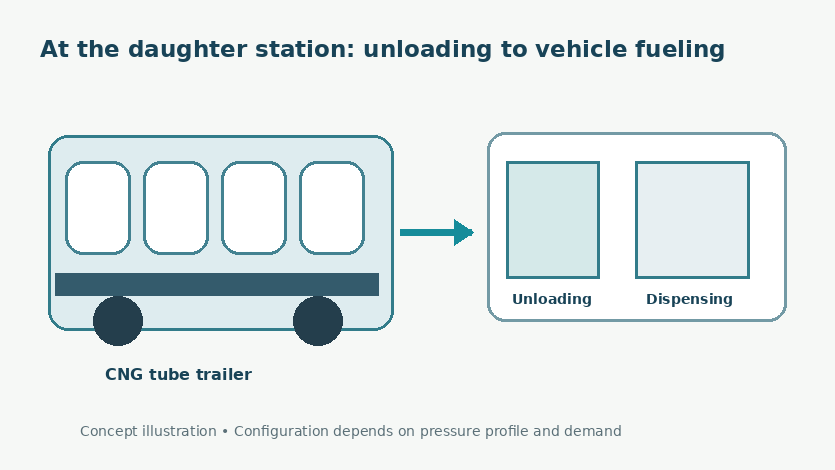
At a daughter station, the arriving trailer is connected through an approved high-pressure unloading interface. Gas can flow to vehicles or stationary storage by pressure difference when pressure permits. As gas is withdrawn, trailer pressure falls. A daughter compressor or booster may help recover more usable gas and maintain the required dispensing performance. Whether one is necessary depends on the full pressure range, fueling pattern, trailer arrangement and desired residual gas.
A daughter station may include unloading hoses and manifold, pressure and temperature instruments, filtration, compression, cascade storage, priority sequencing, dispensers, metering, emergency shutdown, leak detection and electrical/control systems. The exact set is project-specific. A compact or containerized daughter station is an integration format; it does not remove the need to define safe trailer parking, access, ventilation, hazardous-area classification and local permits.
Where the destination supplies industrial burners rather than vehicles, the downstream equipment is usually a pressure reduction and metering system with a different outlet-pressure and safety philosophy. It should not be described simply as a vehicle daughter fueling station.
Side-by-side procurement comparison
Gas inlet: A mother station receives pipeline or upstream gas; a daughter station receives CNG by trailer.
Main function: The mother station conditions, compresses and loads transport modules; the daughter station unloads gas and fuels local vehicles.
Critical interface: Check upstream gas quality and trailer loading at the mother station; check trailer unloading and dispensing at the daughter station.
Capacity risk: Mother station compression and loading throughput may constrain delivery; daughter station peak fueling demand and falling trailer pressure may constrain dispensing.
Logistics: Both depend on trailer availability; the daughter station also needs reliable delivery and changeover planning.
This table shows the dominant role, not a fixed bill of materials. A specific network may combine functions or use shared support systems.
How to decide which your project needs
Start with the upstream connection
If a site has a suitable natural gas pipeline and its role is to load trailers for other sites, start with a mother-station study. Confirm supply entitlement, minimum and maximum inlet pressure stated as gauge or absolute pressure, composition, water content and available hourly volume. The compressor cannot be selected responsibly from a single nominal inlet pressure.
If the fueling site has no direct gas line and will receive CNG in mobile modules, start with a daughter-station study. Ask the gas supplier for trailer vessel specifications, maximum arrival pressure, expected departure pressure, usable delivered mass and delivery frequency. The trailer’s gross water volume is not the usable gas quantity.
Then define the final customer
A network serving several towns may need one mother station and multiple daughter stations. For fleet fueling choices, see our CNG fleet station guide. A single fleet depot with a reliable pipeline may instead use an ordinary pipeline-fed fast-fill, time-fill or combination-fill station. A factory using delivered CNG for heat or process gas needs unloading, pressure regulation, metering and possibly temperature management, but no vehicle dispenser unless vehicle fueling is separately required.
Test the logistics
A daughter site can stop dispensing even when installed equipment is healthy if trailers arrive late. Determine round-trip travel time, loading and unloading time, driver hours, reserve trailers and demand variation. Plan changeovers so the station does not depend on a single trailer arriving at an exact minute. For a mother site, check whether the planned loading throughput can support every daughter site during their overlapping peaks.
Hypothetical planning example
Illustrative assumptions only: A distributor has one pipeline-connected location and two fleet depots without pipeline access. The combined depots require 8,000 kg of CNG per day. Each transport trailer is assumed to deliver 2,000 kg of usable gas under the chosen operating pressure limits. Purely as an inventory calculation, the network needs 8,000 ÷ 2,000 = four full trailer loads per day. That does not establish a final fleet size. Travel, loading, unloading, standby and maintenance may require additional trailers and loading capacity.
The pipeline site is the candidate mother station because it must compress and load gas. Each depot is a candidate daughter station because it receives trailers and fuels vehicles. Engineers must next check the hourly dispensing peaks, trailer pressure decay and unloading arrangement. A total of four loads per day says little about whether both depots can fuel all vehicles during a two-hour evening return window.
This example deliberately uses mass. If a vendor quotes flow in standard cubic metres per hour, require the reference temperature, reference pressure and gas composition before comparing it with kg/day. “Nm³” conventions can differ; do not assume an unstated reference condition.
Questions to settle before requesting quotations
- What are the gas supply and delivery points for each site?
- What are the minimum, normal and maximum inlet pressures, and are they gauge or absolute?
- What is the gas composition, moisture specification and required treatment?
- Which approved trailer or mobile storage models will be used?
- How much gas is actually usable per trailer within the permitted operating range?
- What are average daily demand, busiest-hour demand and seasonal peaks?
- How many vehicles must fuel simultaneously, and within what time window?
- Must the mother station fuel vehicles as well as load trailers?
- What are the site power, ambient temperature, altitude and space limits?
- Which local permitting, fire-safety and pressure-equipment requirements apply?
Use these answers to align the compressor, loading bay, trailer fleet, daughter unloading skid, storage and dispensers. Request an interface list showing what the supplier provides and what the site owner must arrange.
Common questions
Can a daughter station work without its own compressor?
Sometimes. Direct pressure transfer may be feasible during part of the trailer discharge, depending on vehicle tank pressure, available cascade storage and fueling demand. A compressor may be needed to maintain performance or recover more of the trailer’s contents. Calculate the complete trailer pressure profile rather than assuming either configuration.
Is a mother station simply a larger daughter station?
No. The mother station’s defining task is to take upstream gas and prepare it for transport loading. A daughter station’s defining task is to receive delivered CNG and serve local demand. They have different inlet conditions and interfaces.
Does a containerized package make the entire project turnkey?
A container can integrate substantial equipment, but it does not automatically include civil works, trailer bays, electrical supply, upstream gas connection, local approvals, commissioning or vehicle traffic design. Define the battery limits in the quotation.
Is a mother–daughter network always cheaper than a pipeline to each site?
No general answer is reliable. Compare delivered-gas cost, trailer fleet and labor, compression power, site installation, reliability and expected operating life against the pipeline alternative. The practical choice depends on distance, demand and permitting.
Which station should I specify for an industrial boiler?
If CNG arrives by trailer and the boiler needs lower-pressure gas, ask for an industrial CNG unloading, pressure reduction and metering package. Vehicle fueling equipment is only needed if vehicles are also to be served.
Request a project-specific configuration
Share the site locations, upstream gas data, trailer model, expected daily and peak demand, vehicle mix and desired fueling window. HMZ can then discuss the appropriate mother, daughter or pipeline-fed station scope and identify the interfaces that need engineering confirmation.
Related HMZ CNG solution
Explore the HMZ containerized CNG daughter station for a project-specific trailer-supplied fueling configuration.
