
A containerized CNG daughter station is a modular vehicle refueling system that receives compressed natural gas from tube trailers instead of a local gas pipeline. It combines selected unloading, compression, cooling, control and dispensing equipment. A booster compressor helps maintain the required fueling duty as trailer pressure falls.
For an investor or fleet operator, the practical question is whether the gas supply chain and equipment can meet the vehicles’ actual refueling schedule. A compact enclosure alone does not answer that question. This guide explains the operating concept, package boundaries and first decisions to make before requesting a quotation.
What makes it a daughter station?
In a mother–daughter distribution arrangement, the mother station fills transport trailers. Trucks then deliver this gas to a receiving site called a daughter station. This road-based supply chain is often described as a virtual pipeline. CMD’s mother–daughter station overview describes this distribution model and the use of on-site compression at receiving facilities.
Here, “daughter station” means a station supplying CNG vehicles. Industrial receiving stations may also receive trailer-delivered gas, but their downstream duty is different: reducing pressure for a boiler, furnace or other industrial user.
“Containerized” describes equipment packaging. It does not specify the gas capacity, the vehicle filling arrangement or the entire station footprint. Similarly, “fleet station” describes an application; a trailer-fed daughter station can serve a fleet.
How does a containerized CNG daughter station work?
- Tube trailer: delivers compressed gas from the mother station.
- Unloading manifold and conditioning: connect, isolate and route the gas.
- Booster and cooling: raise pressure and manage compression heat.
- Dispensing: supply compatible vehicles, with storage where specified.
Concept only, not a piping and instrumentation diagram. An engineered direct-fill bypass and storage cascade may be included where required.
1. Receive gas from a tube trailer
The trailer connects to an unloading interface selected for its pressure rating, connection arrangement and operating procedure. The process design determines isolation, filtration and routing. Operators need an approved connection, disconnection and trailer-changeover procedure.
2. Route the gas through the selected process
Where pressure conditions permit and the engineered control system includes it, a direct-fill path may transfer gas without operating the booster. This is a project option, rather than a feature to assume in every package. The process diagram should show which flow paths are available and how they are controlled.
3. Boost pressure when required
As gas leaves the trailer, its pressure declines. A suitable booster compressor raises gas pressure for the specified fueling duty. Ask for the usable inlet-pressure range and capacity across that range, rather than a single maximum flow figure. A rating at high inlet pressure does not establish performance near the end of an unloading cycle.
4. Deliver gas to compatible vehicles
The selected arrangement supplies dispensers directly, through an external storage cascade, or through a combination of routes. The vehicle system, filling protocol, connectors and metering requirements must match the destination project. A storage cascade is a design choice with its own cost and site-space implications.
5. Supervise operation and change trailers
Controls monitor the conditions defined in the design and act on protective signals. Meanwhile, the operator manages trailer replacement so that gas availability keeps pace with demand. Equipment capacity and delivery logistics therefore need to be assessed together.
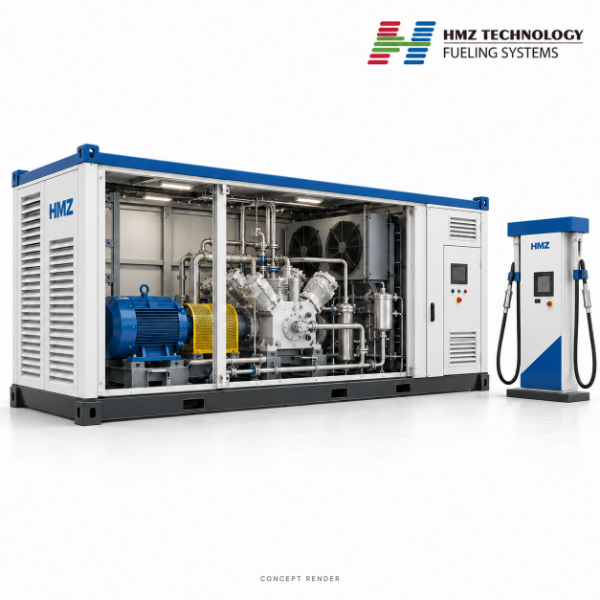
What equipment belongs in the package?
Use the following as a scope-review checklist, not a universal bill of materials. The engineering proposal and quotation should identify each item separately.
| Equipment or interface | Purpose | What the buyer should confirm |
|---|---|---|
| Trailer unloading manifold | Connects and isolates the trailer supply | Trailer compatibility, pressure rating and changeover arrangement |
| Gas conditioning | Addresses specified filtration or separation needs | Gas analysis, moisture and treatment responsibilities |
| Booster compressor | Raises pressure for the selected filling duty | Capacity curve, minimum inlet pressure and duty cycle |
| Cooling and enclosure ventilation | Manages equipment heat and enclosure conditions | Ambient design basis, utility requirements and service access |
| Routing controls and optional storage | Coordinate gas delivery and any storage banks | Flow paths, storage scope and replenishment assumptions |
| Dispensing equipment | Meters and transfers gas to vehicles | Hoses, connectors, simultaneous filling and local metrology |
| Instrumentation and protective functions | Monitor operation and initiate designed protective actions | Shutdown logic, detection, pressure protection and documentation |
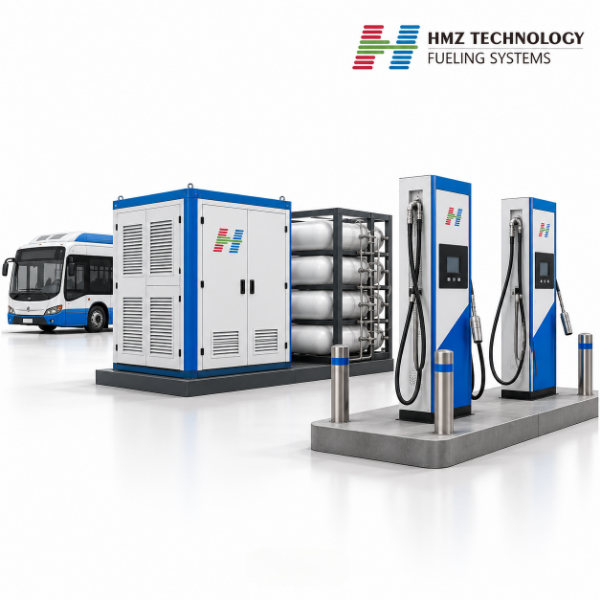
The trailer, storage cylinders and dispensers may stand outside the compressor enclosure. Civil works, electrical infrastructure, installation and commissioning may also be separate contracts. Review HMZ’s containerized CNG daughter station page for the project configuration information used during an inquiry.
Where does this type of station fit?
A daughter station is worth assessing where suitable pipeline access is unavailable and a dependable mother station can supply trailers. Possible applications include regional vehicle fueling, bus depots and logistics yards. Road distance alone is insufficient to judge suitability: loading queues, transport turnaround, usable trailer payload and receiving-site operating hours all affect supply reliability.
A modular package may also support phased development, provided the layout and utilities allow the intended expansion. Equipment relocation still requires transport planning and a fresh review of the receiving site’s installation conditions.
| Project situation | Decision to investigate |
|---|---|
| No pipeline; dependable trailer supply | Evaluate a daughter station against delivered-gas cost and service requirements |
| Suitable pipeline already available | Compare pipeline-fed compression before choosing trailer supply |
| Vehicles have scheduled depot parking | Match the filling arrangement to the available fueling window |
| Boilers or furnaces need lower-pressure gas | Assess an industrial pressure reduction and metering system instead |
For a depot project, also consider HMZ’s CNG fleet fueling station options. For industrial consumption, see the CNG pressure reduction and metering skid.
Why daily demand is only the starting point
A daily consumption figure is useful for estimating supply requirements. It cannot, by itself, determine compressor capacity or acceptable vehicle waiting time.
Illustrative planning example—not an HMZ delivery case: suppose a fleet uses 1,200 kg of CNG per day. Dividing by 12 operating hours gives an average of 100 kg/h. If 600 kg must be delivered during a two-hour return-to-depot window, the average delivery requirement within that window becomes 300 kg/h.
These are demand calculations, not recommended compressor ratings. The engineer still needs to consider vehicle arrival patterns, concurrent filling, gas already available in storage, storage recovery, changing trailer pressure and equipment availability. A station sized only around the 100 kg/h daily average may fail to meet the concentrated window.
Specify gas demand in a consistent unit. If a supplier quotes Nm³/h, ask for the reference temperature and absolute pressure, along with gas composition. Converting between mass and standard volume requires an agreed gas basis. Do not compare a mass-flow demand with an undefined standard-volume rating.
Which conditions must be confirmed before equipment selection?
- Trailer pressure profile: maximum arrival pressure, normal operating range and intended residual pressure, with gauge or absolute pressure clearly identified.
- Vehicle demand: vehicle types, quantities, consumption, filling pressure, arrival pattern and acceptable turnaround.
- Gas quality: composition, moisture or dew point and relevant contaminants, together with treatment responsibilities.
- Power and environment: voltage, phases, frequency, available capacity, ambient temperature, altitude and exposure conditions.
- Supply logistics: mother-station availability, usable delivered quantity, round-trip time, replacement trailers and disruption allowance.
- Site and documentation: layout, trailer movements, maintenance space, destination requirements and agreed equipment boundaries.
Ask bidders to state their assumptions against the same operating duty. Comparing quotations with different inlet pressures, storage allowances or installation scopes can create a misleading price comparison.
What containerization can—and cannot—simplify
Grouping selected equipment in a modular enclosure can make equipment interfaces, transport arrangements and installation responsibilities easier to define. It can also support an organized maintenance layout when access requirements are considered early.
It does not make the station ready to operate immediately on delivery. Foundations, utilities, external piping, trailer access, installation checks, commissioning and applicable approvals remain project tasks. Nor does the enclosure itself establish compliance of the complete installation.
The U.S. Department of Energy’s CNG fueling infrastructure guide explains that compressor and storage choices depend on the application. Its examples are useful background, but destination-specific requirements must govern an overseas project.
Frequently asked questions
Does a CNG daughter station need a natural gas pipeline?
A trailer-fed daughter station receives its gas by road. It still needs reliable deliveries, suitable site access, utilities and the required installation approvals.
Does every daughter station use a booster compressor?
Not every unloading arrangement is identical. This guide focuses on a booster-equipped vehicle fueling package. Direct transfer may be possible under suitable pressure conditions, but the required fill duty and trailer unloading strategy determine the equipment.
Is a storage cascade always included?
No. Storage must be specified in the process design and quotation. Confirm its capacity basis, operating pressures, physical location and role in handling peak demand.
Can one container include the whole station?
Do not assume so. The enclosure may contain the compressor and selected auxiliaries, while trailers, storage and dispensers occupy separate areas. Request both a package layout and an overall station layout.
How much does a containerized CNG daughter station cost?
A useful quotation needs the pressure range, demand profile, supply boundaries and destination requirements. Compare equipment, logistics, site work and operating expenses together. A container size or vehicle count alone is not a reliable pricing basis.
Start with the gas supply and vehicle schedule
To discuss a project with HMZ, prepare your destination, daily and peak gas demand, vehicle details, trailer pressure range, gas analysis, electrical supply and site layout. Identify whether trailers, storage, dispensers, installation and commissioning should be included.
Request a project-based CNG daughter station proposal. HMZ can review the available information and coordinate a proposed package and quotation, with any remaining selection assumptions identified for confirmation.
