
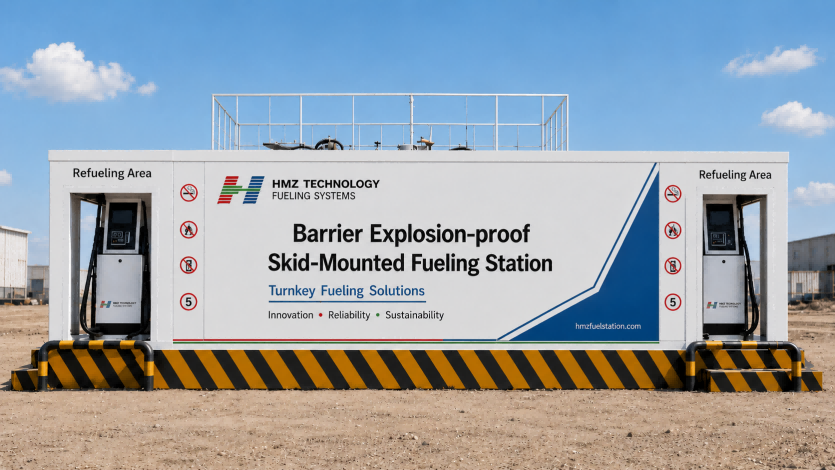
The Complete Buyer’s Guide for Industrial Fuel Storage & Dispensing Projects (2026)
Choosing a skid-mounted fuel station is far more complex than simply selecting a storage tank and a fuel dispenser. For engineering contractors, mining companies, logistics operators, government agencies, and industrial enterprises, the right fuel station can significantly improve operational efficiency, reduce fuel losses, increase safety, and lower long-term operating costs.
Unfortunately, many buyers focus only on the purchase price while overlooking the factors that truly determine the success of a fueling project. Tank capacity, dispensing efficiency, local regulations, explosion-proof requirements, transportation limitations, future expansion, maintenance costs, and digital fuel management all have a direct impact on the performance of the entire system.
This guide has been prepared to help procurement managers, project engineers, EPC contractors, and fleet operators make informed purchasing decisions. Instead of promoting a single product configuration, this article explains the engineering principles behind selecting a skid-mounted fuel station and provides practical recommendations that can be adapted to different industries and project conditions.
Whether you are planning a fuel station for a mining project in Africa, a logistics fleet in the Middle East, an infrastructure project in Southeast Asia, or an industrial facility in South America, the following steps will help you select a solution that matches your operational needs both today and in the future.
Every fueling project is different. Instead of starting with equipment specifications, begin by understanding your operational requirements. The following decision process can help narrow down the most suitable configuration.
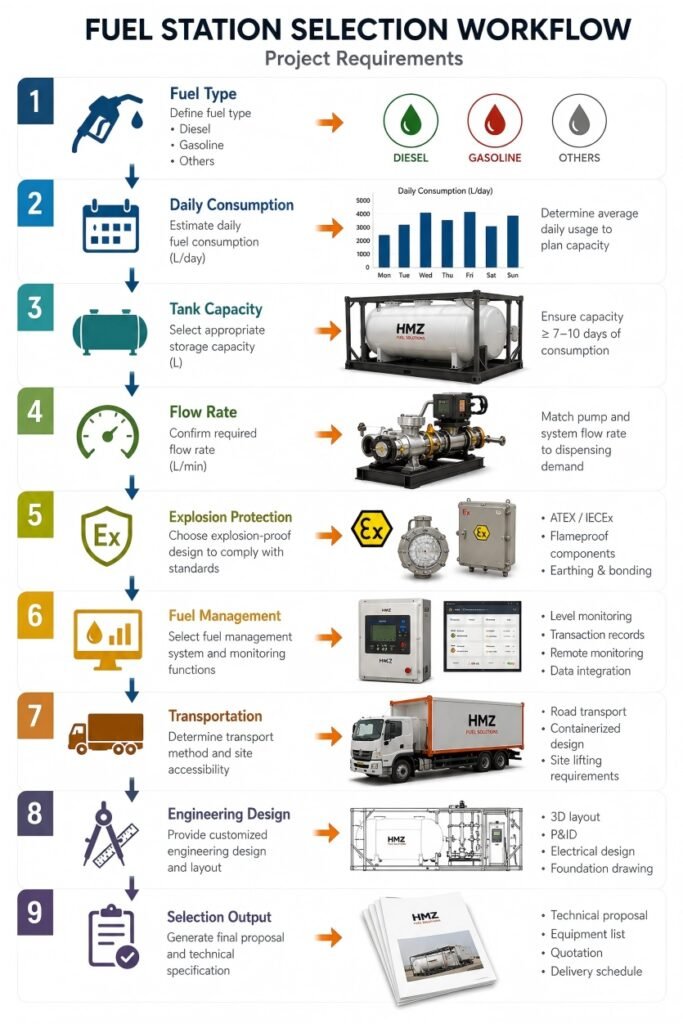
Start
│
▼
What fuel will be stored?
│
├── Diesel
├── Gasoline
├── Aviation Fuel
├── Biodiesel
└── Multi-Fuel
│
▼
How much fuel is consumed each day?
│
▼
How many vehicles require refueling?
│
▼
Permanent installation?
│
Yes ──────► Fixed Industrial Station
│
No
│
▼
Need future relocation?
│
Yes ─────► Modular Skid Solution
│
▼
Explosion-proof required?
│
Yes
│
▼
Determine certification requirements
│
▼
Choose tank capacity
│
▼
Choose a dispensing system
│
▼
Choose pump
│
▼
Choose fuel management
│
▼
Engineering Design
Why This Decision Process Matters
Many procurement teams begin by requesting quotations without fully understanding their operational requirements. This often leads to unnecessary redesigns, increased project costs, or equipment that does not match the intended application.
Following a structured decision process helps ensure that the selected system is technically appropriate, operationally efficient, and scalable for future business growth.
Why More Companies Are Choosing Skid-Mounted Fuel Stations
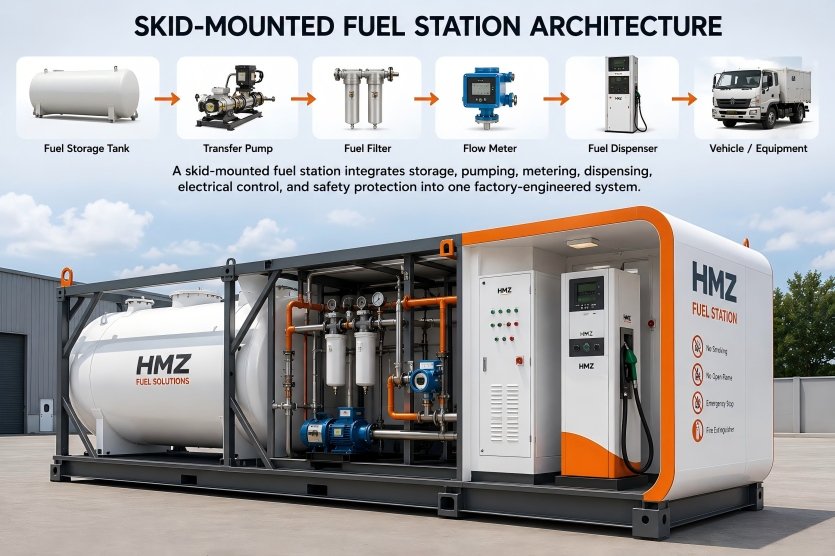
Traditional fuel stations require extensive civil construction, long approval procedures, and significant installation time. In contrast, skid-mounted fuel stations are factory-engineered, pre-assembled systems that combine fuel storage, dispensing equipment, pumps, pipelines, electrical controls, and safety systems into a single integrated unit.
Because the entire system is manufactured and tested before shipment, installation on-site becomes significantly faster and more predictable.
Today, modular fuel stations are widely used in:
- Mining operations
- Construction projects
- Oil & gas fields
- Government facilities
- Bus depots
- Logistics companies
- Ports
- Airports
- Military bases
- Emergency fuel supply projects
- Remote industrial facilities
Compared with conventional fuel stations, modular systems offer several important advantages:
- Shorter project delivery time
- Lower civil construction costs
- Easier transportation
- Faster commissioning
- Flexible relocation
- Reduced environmental impact
- Simplified maintenance
- Expandable modular design
For companies operating in remote locations or on projects with limited construction schedules, these advantages often translate into measurable financial savings throughout the project’s lifetime.
Step 1 – Understand Your Project Requirements Before Comparing Equipment
One of the biggest mistakes buyers make is requesting quotations before clearly defining their operational requirements.
A supplier can only recommend the most suitable configuration after understanding how the fuel station will actually be used.
Before discussing equipment specifications, answer the following questions:
What fuel will be stored?
Different fuels have different physical and safety characteristics.
Typical options include:
- Diesel
- Gasoline
- Aviation fuel
- Biodiesel
- Kerosene
- AdBlue/DEF (when integrated)
Some projects require only diesel, while others need multiple fuel products within the same station. This decision affects tank design, piping configuration, dispensing equipment, safety requirements, and future maintenance.
Who will use the station?
The daily users determine many equipment specifications.
For example:
- Mine trucks
- Excavators
- Wheel loaders
- Forklifts
- Passenger vehicles
- Government fleets
- Commercial trucks
- Marine equipment
- Agricultural machinery
Large mining trucks require much higher fueling speeds than passenger vehicles. Choosing an oversized system for light-duty applications unnecessarily increases investment costs, while undersized equipment may create long queues and reduce productivity.
Is the station permanent or temporary?
Some projects operate for only two or three years before relocation, while others remain in service for decades.
Temporary construction projects usually prioritize:
- Mobility
- Fast installation
- Easy transportation
Permanent industrial facilities generally focus more on:
- Long-term durability
- Automation
- Digital fuel management
- Future expansion capability
Defining the expected project lifespan helps determine whether a standard modular configuration or a customized solution is more appropriate.
Step 2 – Calculate Your Daily Fuel Consumption
Fuel demand underpins every engineering decision.
Selecting tank capacity without calculating fuel consumption often results in either excessive investment or insufficient storage.
A simple approach is to estimate:
Daily Fuel Consumption = Number of Vehicles × Average Daily Fuel Use
For example:
- 20 mining trucks × 350 L/day = 7,000 L/day
- 15 excavators × 180 L/day = 2,700 L/day
- 10 generators × 120 L/day = 1,200 L/day
Total daily demand:
10,900 liters
However, this calculation alone is not enough.
Procurement teams should also consider:
- Fuel delivery frequency
- Local transportation conditions
- Seasonal demand fluctuations
- Emergency reserve requirements
- Future fleet expansion
Many operators prefer maintaining three to seven days of fuel inventory to reduce operational risks caused by delayed fuel deliveries.
In remote mining regions where fuel trucks may travel hundreds of kilometers, larger storage capacity often provides a more economical and reliable solution than frequent replenishment.
How to Estimate Daily Fuel Consumption
One of the simplest methods is to calculate fuel demand by equipment type.
| Equipment | Quantity | Daily Consumption | Total |
|---|---|---|---|
| Excavator | 8 | 180 L | 1,440 L |
| Wheel Loader | 6 | 160 L | 960 L |
| Dump Truck | 15 | 300 L | 4,500 L |
| Generator | 5 | 120 L | 600 L |
Estimated Daily Fuel Consumption
7,500 Liters
Recommended Tank Capacity
| Days of Storage | Recommended Capacity |
|---|---|
| 1 Day | 7,500 L |
| 3 Days | 22,500 L |
| 5 Days | 37,500 L |
| 7 Days | 52,500 L |
This calculation provides a practical starting point for determining storage capacity. Actual sizing should also consider delivery schedules, emergency reserves, seasonal demand, and future fleet expansion.
Recommended Tank Capacity
| Days of Storage | Recommended Capacity |
|---|---|
| 1 Day | 7,500 L |
| 3 Days | 22,500 L |
| 5 Days | 37,500 L |
| 7 Days | 52,500 L |
This calculation provides a practical starting point for determining storage capacity. Actual sizing should also consider delivery schedules, emergency reserves, seasonal demand, and future fleet expansion.
Step 3 – Selecting the Right Tank Capacity
Once daily fuel consumption has been determined, the next step is selecting an appropriate storage capacity.
Common tank capacities include:
- 10,000 L
- 20,000 L
- 30,000 L
- 40,000 L
- 50,000 L
- 60,000 L
There is no universal “best” capacity.
Instead, the ideal size depends on balancing operational efficiency, transportation costs, installation space, local regulations, and fuel supply logistics.
For example, a construction contractor operating a small fleet of excavators may find that a 10,000-liter station is sufficient for several days of operation.
By contrast, a large open-pit mining project may require multiple interconnected tanks with capacities exceeding 100,000 liters to ensure uninterrupted production.
When evaluating tank size, buyers should also consider future business growth. Expanding an existing modular station is generally easier and more economical when expansion has been incorporated into the original engineering design.
| Daily Fuel Demand | Recommended Tank |
|---|---|
| Under 2,000 L | 5,000–10,000 L |
| 2,000–5,000 L | 10,000–20,000 L |
| 5,000–10,000 L | 20,000–40,000 L |
| 10,000–20,000 L | 40,000–60,000 L |
| 20,000–50,000 L | 60,000–100,000 L |
| Over 50,000 L | Customized Multi-Tank System |
Engineering Tip
Tank capacity should never be selected solely based on daily fuel consumption. Delivery frequency, emergency reserves, transportation conditions, and planned business expansion should all be considered during the engineering design process.
Step 4 – Choose the Right Fuel Dispensing System
The fuel dispenser is the interface between the storage system and daily operations. Its performance directly influences refueling speed, vehicle turnaround time, fuel measurement accuracy, and overall operational efficiency.
Several factors should be evaluated before selecting a dispenser:
Number of fueling positions
Single-nozzle systems are suitable for small fleets or low-frequency operations.
Dual-nozzle or multi-nozzle dispensers allow multiple vehicles to be served simultaneously, reducing waiting time and improving site productivity.
Flow rate
Different applications require different fueling speeds.
Passenger vehicles generally require lower flow rates, while heavy-duty mining equipment, fuel bowsers, and industrial machinery often benefit from high-flow dispensing systems capable of significantly reducing refueling time.
Measurement accuracy
Accurate metering minimizes commercial disputes, improves inventory control, and supports transparent fuel management. Selecting a high-quality metering system is especially important where fuel is issued to multiple departments, contractors, or external users.
Compatibility with fuel management systems
Modern dispensers can be integrated with RFID, IC card, PIN code, vehicle identification, cloud platforms, and remote monitoring systems. These functions enable operators to track fuel consumption by vehicle, driver, department, or project, providing valuable data for cost control and operational planning.
| Vehicle Type | Suggested Flow Rate |
|---|---|
| Passenger Car | 40 L/min |
| Pickup Truck | 60 L/min |
| Medium Truck | 80 L/min |
| Heavy Truck | 120 L/min |
| Mining Equipment | 150–200 L/min |
Should You Always Choose the Highest Flow Rate?
Not necessarily.
Higher flow rates improve refueling speed but also require larger pumps, larger pipelines, higher electrical capacity, and increased investment costs.
Selecting a flow rate that matches actual operational needs generally provides the best balance between performance and project cost.
Step 5 – Choosing the Right Fuel Pump
The fuel pump is the heart of every skid-mounted fuel station. It determines how efficiently fuel is transferred from the storage tank to the dispenser and ultimately to the vehicle or equipment.
Selecting the wrong pump can lead to slow fueling speeds, excessive wear, increased maintenance costs, and reduced operational efficiency.
When evaluating pumps, buyers should consider several key factors.
Required Flow Rate
The first question is simple:
How fast do you need to refuel?
A small construction company with several pickup trucks has very different requirements from a large mining operation servicing haul trucks throughout the day.
Typical applications include:
| Application | Recommended Flow Rate |
|---|---|
| Passenger vehicles | 40–60 L/min |
| Light commercial vehicles | 60–80 L/min |
| Heavy trucks | 80–120 L/min |
| Mining equipment | 120–200+ L/min |
Higher flow rates reduce vehicle waiting time but also require larger piping, more powerful pumps, and appropriate electrical systems.
Oversizing a pump unnecessarily increases capital and operating costs.
Pump Type
Several pump technologies are commonly used.
Self-Priming Pumps
Widely used for diesel transfer.
Advantages:
- Simple maintenance
- Reliable operation
- Cost-effective
- Good suction capability
Centrifugal Pumps
Suitable for large transfer volumes.
Advantages:
- High flow
- Continuous operation
- Low vibration
Gear Pumps
Often selected when precise flow stability is required.
Advantages:
- Stable output
- High pressure
- Suitable for viscous fuels
The final selection depends on fuel type, pipeline length, required pressure, and project operating conditions.
Step 6 – Explosion-Proof Requirements
Safety should never be treated as an optional feature.
Fuel is a hazardous material, and every country has regulations governing its storage, transfer, and dispensing.
Understanding explosion-proof requirements at the beginning of a project can prevent costly redesigns later.
Why Explosion Protection Matters
Fuel vapors can form explosive atmospheres under certain conditions.
Potential ignition sources include:
- Electrical equipment
- Static electricity
- Hot surfaces
- Sparks
- Switching devices
- Improper grounding
A properly engineered skid-mounted fuel station minimizes these risks through certified electrical systems, grounding, ventilation, emergency shutdown systems, and explosion-proof components.
Understanding Different Certification Systems
Depending on the destination country, buyers may require different certifications.
Common certification systems include:
- ATEX
- IECEx
- CNEX
- Local national certifications
Different markets recognize different standards.
Before placing an order, buyers should confirm local regulatory requirements with their engineering consultant or relevant authorities.
Certification requirements may also vary depending on whether the station is installed:
- Above ground
- Underground
- Inside industrial plants
- Mining sites
- Hazardous chemical facilities
- Government projects
Selecting compliant equipment from the beginning avoids delays during inspection and commissioning.
Step 7 – Choosing the Right Fuel Management System
For many years, fuel stations simply dispensed fuel.
Today, they also generate valuable operational data.
Modern fuel management systems help companies answer questions such as:
- Which vehicle consumed the fuel?
- Which driver performed the fueling?
- What time was fuel dispensed?
- How much fuel remains in storage?
- Is abnormal fuel consumption occurring?
- Are there possible fuel losses?
Without digital management, companies often rely on handwritten records that are difficult to verify and prone to errors.
Basic Fuel Management
Suitable for small fleets.
Typical functions include:
- Fuel transaction records
- Total fuel issued
- Daily reports
- Meter readings
Advanced Fuel Management
Larger organizations usually require additional features such as:
- RFID vehicle identification
- Driver authentication
- PIN authorization
- IC card management
- Cloud platform
- GPS integration
- Fleet management integration
- ERP connectivity
- Remote monitoring
- Automatic reporting
These features improve transparency while helping reduce unauthorized fuel usage.
For companies operating hundreds of vehicles, digital fuel management often delivers substantial operational benefits.
Step 8 – Selecting the Right Power Supply
Every skid-mounted fuel station requires a reliable power source.
However, not every project has access to a stable electrical grid.
Selecting the appropriate power solution depends on the installation environment.
Grid Power
Suitable for:
- Industrial parks
- Permanent facilities
- Government projects
- Bus depots
Advantages include:
- Stable operation
- Low operating cost
- Easy maintenance
Diesel Generator
Often used for:
- Mining
- Construction sites
- Remote camps
- Temporary projects
Advantages include:
- Independent operation
- Flexible deployment
- No reliance on public utilities
Solar Hybrid Systems
As renewable energy technologies become more affordable, hybrid power solutions are attracting increasing attention.
A hybrid system may combine:
- Solar panels
- Battery storage
- Diesel generator
- Utility grid
Such systems reduce fuel consumption while improving power reliability.
Although the initial investment is higher, long-term operating costs may be significantly reduced in remote locations.
Step 9 – Consider the Installation Environment
No two project sites are identical.
The surrounding environment influences almost every engineering decision.
Before selecting equipment, evaluate:
- Available installation space
- Ground bearing capacity
- Ambient temperature
- Wind conditions
- Rainfall
- Flood risk
- Seismic requirements
- Corrosive atmosphere
- Dust levels
- Accessibility for fuel tankers
For example, desert environments require protection against high temperatures and sand intrusion, while coastal installations require enhanced corrosion resistance.
Ignoring environmental conditions can shorten equipment life and increase maintenance costs.
Step 10 – Transportation and Logistics Planning
Transportation is often underestimated during procurement.
Many buyers finalize equipment specifications before confirming whether the station can actually be transported economically.
Important questions include:
- Can it fit inside a standard container?
- Will oversized transport permits be required?
- Is lifting equipment available on site?
- Can local roads support the equipment’s weight?
- What unloading equipment is available?
Modular design offers significant logistical advantages because the system is manufactured, tested, and prepared for shipment before leaving the factory.
Proper transportation planning reduces installation delays and minimizes the risk of damage during delivery.
For international projects, transportation planning should also include:
- Export packaging
- Marine transportation
- Customs documentation
- Destination regulations
- Site access planning
Consider these factors early in the project, not after manufacturing has begun.
Common Mistakes Buyers Make
After supporting industrial fueling projects across different applications, several purchasing mistakes appear repeatedly.
Understanding these common issues can help buyers avoid unnecessary costs and operational problems.
Choosing the Lowest Price
A lower purchase price does not necessarily mean lower project cost.
Inferior components may increase maintenance frequency, shorten equipment life, and reduce operational reliability.
The total cost of ownership should always be considered rather than the initial equipment price alone.
Ignoring Future Expansion
Many projects expand within only a few years.
Designing the station with future expansion in mind often saves substantial modification costs later.
Additional tanks, dispensers, or automation systems can be integrated more easily when expansion has been anticipated during the original engineering stage.
Underestimating Fuel Demand
Many buyers calculate fuel consumption based only on current operations.
However, equipment fleets often grow.
Selecting a slightly larger storage capacity may reduce future operational constraints.
Overlooking Local Regulations
Import regulations, environmental requirements, fire safety rules, and electrical standards differ from country to country.
Confirming compliance before procurement helps prevent unexpected project delays.
Focusing Only on Equipment
A skid-mounted fuel station is a complete engineering solution rather than a collection of individual products.
The compatibility between tanks, pumps, dispensers, piping, electrical systems, and control systems is essential for reliable long-term operation.
A well-integrated system generally delivers better performance than independently sourced components assembled on site.
| Industry | Recommended Configuration |
|---|---|
| Mining | Large Tank + High Flow + Fleet Management |
| Construction | Compact + Mobile + Easy Relocation |
| Logistics | RFID + Fuel Management + Cloud Reports |
| Government | High Security + Accurate Metering |
| Oil & Gas | Explosion-Proof + Redundant Safety |
| Agriculture | Simple Operation + Low Maintenance |
| Airport | High Accuracy + Aviation Standards |
| Port | Corrosion Protection + High Capacity |
Real Project Examples
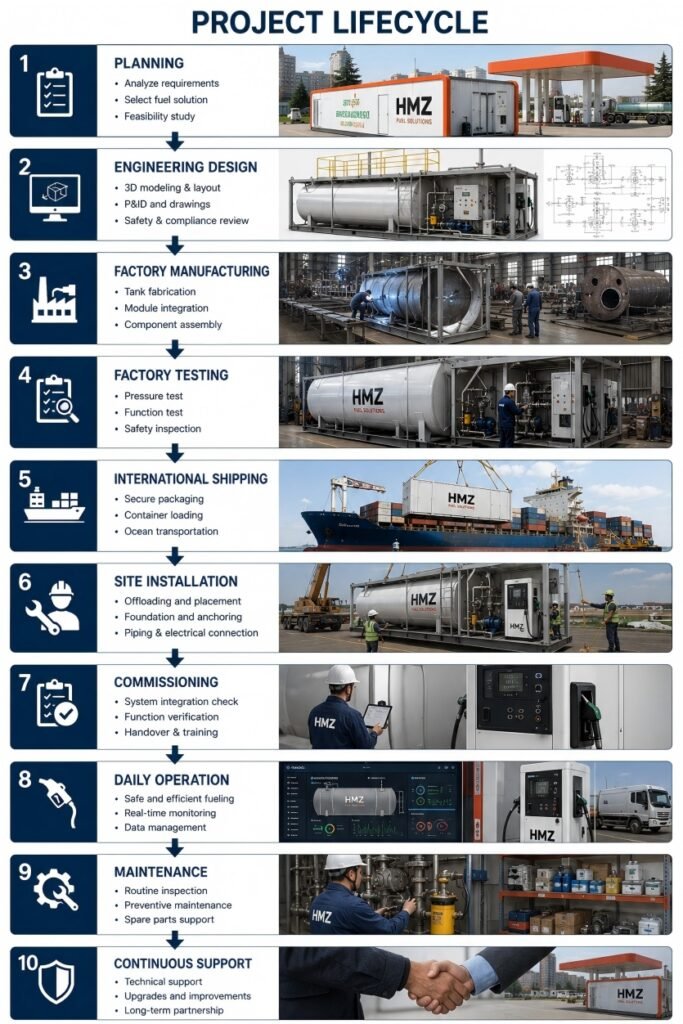
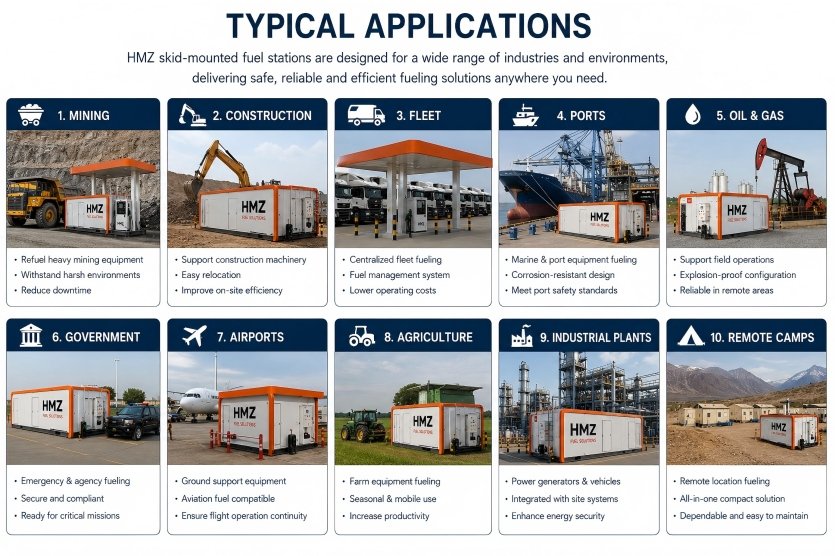
Every fuel storage and dispensing project is unique. However, most applications fall into several common scenarios. The following examples illustrate how project requirements influence the design of a skid-mounted fuel station.
Case 1 – Mining Project
Project Profile
A gold mining contractor operates a fleet consisting of:
- 18 haul trucks
- 12 excavators
- 8 wheel loaders
- 6 generators
The mine is located approximately 250 km from the nearest fuel depot, and fuel deliveries are scheduled once every five days.
Engineering Considerations
Based on estimated daily fuel consumption, the project requires a large storage capacity to maintain operational continuity even if fuel deliveries are delayed.
Recommended features include:
- Large-capacity storage tanks
- High-flow fuel dispensers
- Fleet fuel management system
- RFID vehicle identification
- Automatic inventory monitoring
- Double-wall tank construction
- Emergency shutdown system
The primary objective is to maximize equipment uptime while minimizing fuel logistics costs.
Case 2 – Construction Project
Project Profile
An EPC contractor is building a highway over two years.
Construction equipment will gradually move as different sections of the project are completed.
Engineering Considerations
Mobility becomes more important than permanent infrastructure.
Recommended configuration:
- Medium-capacity storage tank
- Compact skid-mounted design
- Easy lifting points
- Forklift pockets
- Fast installation
- Simple electrical connection
A modular station allows the contractor to relocate the entire fueling system with minimal interruption to construction activities.
Case 3 – Logistics Fleet
Project Profile
A transportation company operates more than 150 trucks from a central depot.
Fuel is dispensed every day before vehicles leave for distribution routes.
Engineering Considerations
The company requires:
- High fuel efficiency
- Accurate fuel accounting
- Driver identification
- Vehicle-based reporting
- Cloud-based management platform
The priority is reducing unauthorized fuel usage while improving operational transparency.
Maintenance and Preventive Inspection
A skid-mounted fuel station is designed for long-term operation, but like any industrial equipment, its performance depends on proper maintenance.
A preventive maintenance program reduces unexpected downtime, extends equipment life, and helps maintain measurement accuracy.
Daily Inspection
Operators should check:
- Fuel leaks
- Pump operation
- Hose condition
- Nozzle condition
- Emergency stop function
- Fuel inventory
- Electrical indicators
Any abnormal condition should be investigated before continued operation.
Weekly Inspection
Typical tasks include:
- Cleaning filters
- Inspecting valves
- Checking grounding connections
- Inspecting pipelines
- Verifying dispenser operation
- Reviewing fuel transaction records
Monthly Inspection
Monthly maintenance may include:
- Meter accuracy verification
- Pump performance testing
- Tank inspection
- Electrical cabinet cleaning
- Sensor inspection
- Alarm testing
- Software backup
Annual Inspection
For long-term reliability, a comprehensive inspection is recommended each year.
This may include:
- Calibration of measuring equipment
- Pressure testing
- Corrosion assessment
- Electrical testing
- Safety system verification
- Structural inspection
- Preventive replacement of wear components
Following a planned maintenance schedule generally reduces lifecycle costs compared with corrective maintenance after failures occur.
Frequently Asked Questions
1. Can a skid-mounted fuel station store both diesel and gasoline?
Yes. Depending on the project requirements, the system can be designed with separate compartments for different fuel products.
2. Can the station be customized?
Yes. Tank capacity, dispensing configuration, pumping system, fuel management functions, power supply, and overall dimensions can be customized according to project requirements.
3. Is the station suitable for remote locations?
Yes. Skid-mounted fuel stations are widely used in remote mining sites, construction projects, oilfields, islands, and infrastructure developments where permanent fuel stations are not practical.
4. How long does installation take?
Because the system is factory-assembled and tested before shipment, on-site installation is generally much faster than traditional fuel station construction. The exact duration depends on site preparation and local utility connections.
5. Can the station be relocated?
One of the major advantages of a modular design is that the entire station can be dismantled, transported, and reinstalled at another location when project requirements change.
6. Which industries commonly use skid-mounted fuel stations?
Typical users include:
- Mining companies
- EPC contractors
- Construction firms
- Oil & gas operators
- Logistics companies
- Government agencies
- Ports
- Airports
- Bus operators
- Industrial facilities
7. What safety systems are normally included?
Typical safety features may include emergency shutdown devices, grounding systems, overfill protection, ventilation, fire protection interfaces, leak prevention measures, and explosion-proof electrical components, depending on project requirements.
8. How do I determine the correct tank capacity?
Tank size should be based on daily fuel consumption, delivery frequency, future expansion plans, and local storage regulations—not simply the available installation space.
9. Can digital fuel management be integrated?
Yes. Modern systems can support vehicle identification, driver authorization, inventory monitoring, cloud reporting, and integration with fleet or ERP management platforms.
10. What should buyers prepare before requesting a quotation?
Providing the following information helps suppliers recommend a suitable solution:
- Fuel type
- Daily fuel consumption
- Number of vehicles or equipment
- Required tank capacity
- Preferred flow rate
- Installation location
- Power supply
- Local certification requirements
- Climate conditions
- Expected project duration
Final Buyer’s Checklist
Before making a purchasing decision, confirm the following:
✓ Fuel type has been identified.
✓ Daily fuel consumption has been calculated.
✓ Required storage capacity has been determined.
✓ Future expansion has been considered.
✓ Appropriate dispenser configuration has been selected.
✓ Pump flow rate matches operational needs.
✓ Explosion-proof requirements have been confirmed.
✓ Fuel management functions have been defined.
✓ Power supply is available.
✓ Transportation limitations have been reviewed.
✓ Local regulations have been checked.
✓ Maintenance requirements are understood.
✓ Supplier technical support has been evaluated.
✓ Spare parts availability has been confirmed.
✓ Total lifecycle cost has been compared—not just purchase price.
Completing this checklist before procurement significantly reduces project risks and improves long-term operating performance.
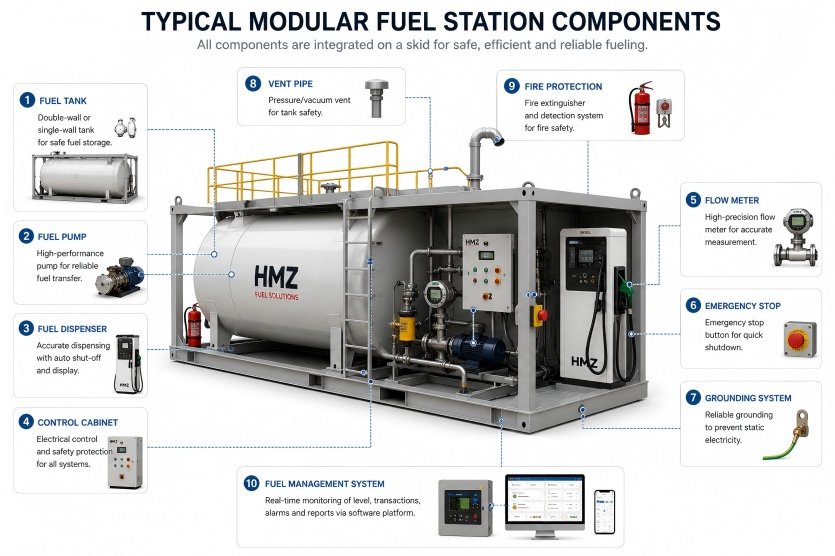
A standard skid-mounted fuel station normally consists of the following systems:
Fuel Storage System
- Storage Tank
- Tank Supports
- Level Gauge
- Vent Pipe
Fuel Transfer System
- Fuel Pump
- Filters
- Valves
- Piping
Fuel Dispensing System
- Fuel Dispenser
- Hose
- Automatic Nozzle
- Flow Meter
Electrical System
- Explosion-proof Control Cabinet
- Sensors
- Emergency Stop
- Lighting
Safety System
- Fire Extinguisher
- Grounding
- Overfill Protection
- Leak Prevention
- Emergency Shut-off
Optional Smart Functions
- RFID
- IC Card
- Vehicle Identification
- Driver Authorization
- GPS
- Cloud Platform
- Fuel Management Software
- ERP Integration
Conclusion
Selecting the right skid-mounted fuel station is not simply a matter of choosing a storage tank or comparing equipment prices. It requires a thorough understanding of operational requirements, fuel demand, safety standards, site conditions, logistics, automation needs, and long-term maintenance objectives.
A well-designed modular fueling system can improve operational efficiency, reduce downtime, strengthen fuel control, and provide the flexibility required for modern industrial projects. Whether the application involves mining, construction, transportation, oil & gas, or government infrastructure, investing time in the planning stage will help ensure that the final solution delivers reliable performance throughout its service life.
Rather than focusing solely on initial procurement costs, decision-makers should evaluate the complete lifecycle value of the system—including safety, scalability, operating efficiency, maintenance requirements, and future expansion capability.
The most successful projects are those where engineering decisions are driven by operational needs rather than short-term pricing.
Engineering Insight
At HMZ, every skid-mounted fuel station begins with understanding the customer’s operational objectives rather than simply selecting equipment from a catalog.
Our engineering approach focuses on balancing storage capacity, dispensing efficiency, safety, transportation, future expansion, and total lifecycle cost. This ensures that each solution is designed to support reliable long-term operation under the specific environmental and operational conditions of the project.
Whether the application involves mining, logistics, construction, oil & gas, or government infrastructure, careful engineering during the planning stage is one of the most effective ways to reduce project risk and improve operational efficiency.
Need Engineering Support for Your Project?
Every project has different technical requirements, operating conditions, and local regulations. Selecting the right configuration begins with understanding your application.
If you are planning a skid-mounted fuel station for a mining operation, construction site, logistics fleet, industrial facility, or government project, our engineering team can assist with:
- Preliminary technical consultation
- Equipment configuration recommendations
- Concept layout drawings
- Fuel storage capacity evaluation
- Fuel dispensing system selection
- Custom engineering solutions
Providing basic project information at the beginning of the discussion allows engineers to recommend a solution that is better aligned with your operational objectives and long-term project requirements.
Before requesting a quotation, prepare the following information:
✓ Fuel Type
✓ Daily Fuel Consumption
✓ Tank Capacity
✓ Number of Vehicles
✓ Refueling Frequency
✓ Fuel Delivery Schedule
✓ Required Flow Rate
✓ Power Supply
✓ Local Voltage
✓ Ambient Temperature
✓ Explosion-proof Requirement
✓ Local Certification
✓ Transportation Restrictions
✓ Installation Space
✓ Preferred Delivery Time
The more project information available during the early design stage, the easier it is to recommend a technically suitable and cost-effective solution.
