
Direct answer
A CNG daughter station quotation should be based on a defined operating duty, not a generic equipment list. Give the supplier your daily and peak vehicle fueling demand, trailer delivery and pressure profile, required vehicle fill standard, site and utility conditions, local approval basis, and exact supply boundaries. Ask every bidder to state its assumptions, guaranteed operating range, exclusions, tests and documents. This makes the proposals technically comparable and reveals missing civil, electrical or trailer interfaces before purchase.
What a daughter station is—and what this RFQ covers
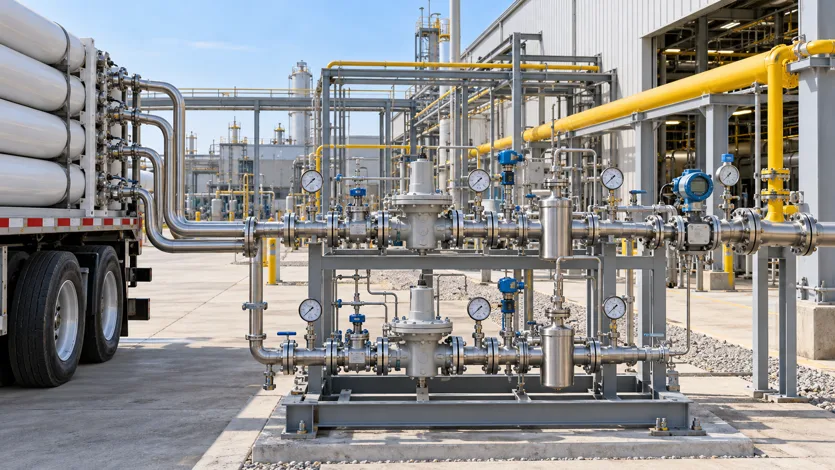
A daughter station receives compressed natural gas from transportable storage, commonly a tube trailer or mobile CNG module, and dispenses it to vehicles. Depending on the design, it may use pressure difference directly, compression, stationary buffer storage, or a combination. A containerized package can integrate equipment, but the container is a physical form, not a complete definition of station duty. The gas source, vehicle pattern and local requirements still determine the design.
This checklist addresses a delivered-CNG vehicle fueling project. A pipeline-fed fleet station needs different inlet and compression assumptions. An industrial pressure regulation and metering skid supplies process equipment rather than vehicle dispensers. If the project combines these duties, separate the branches and specify each outlet.
The U.S. Department of Energy’s Alternative Fuels Data Center explains that station designers must match compression, storage and dispensing to the vehicles and filling pattern. Its CNG planning guide also calls for estimating fuel demand and checking site access, utilities and local rules. Those principles are useful internationally, while the governing code and approval route must be confirmed for the actual country and site.
1. Define the fueling duty before choosing equipment
Start with a vehicle table. For each type, record vehicle count, onboard storage or typical refill quantity, service pressure and connector specification, daily mileage or consumption, return time, required fill window, and expected growth. Note whether the operator needs fast fill, overnight fill, or a mixture. Do not equate the average daily gas quantity with required peak dispenser throughput.
Ask the fleet operator for measured consumption where available. If only estimates exist, mark them as estimates and provide a range. State the requested reporting unit. Standard cubic metres or standard cubic feet require explicit reference temperature and pressure; a bare “Sm³/h” is incomplete. Ask the bidder to use one agreed basis and show any conversions to mass or gasoline gallon equivalent.
| RFQ input | What to state | Why it matters |
|---|---|---|
| Daily demand | Expected and high day, with unit and gas reference conditions | Trailer logistics and operating capacity |
| Peak fueling | Vehicles per hour and kilograms or standard volume per vehicle | Dispenser, buffer and compressor duty |
| Fill window | Arrival distribution and maximum acceptable queue | Effective capacity, not just nameplate capacity |
| Vehicle interface | Tank service pressure, receptacle and fill protocol | Compatible, safe dispensing |
| Growth | Initial and future fleet | Space and expansion allowances |
For example, a hypothetical depot with 30 vehicles, each taking 25 kg on an average return, needs 750 kg per day. If 20 vehicles return within two hours, the short window represents 250 kg/h before allowance for queuing, temperature effects or simultaneous fueling limits. That figure is an illustration, not a compressor specification. A supplier needs the actual time profile, dispenser arrangement and gas supply pressure before sizing equipment.
2. Specify delivered gas and trailer operation
Identify who supplies the gas, who owns the trailer, and who operates unloading. Provide the trailer or mobile module drawings and data sheet if available. Include number of trailers, internal gas volume or certified usable capacity, maximum allowable working pressure, delivery pressure range, connection size and type, isolation arrangement, and allowed residual or return pressure. Specify whether one trailer must continue feeding while another is changed over.
A trailer’s pressure falls as gas is withdrawn. Consequently, usable gas, flow and compressor performance change across the delivery cycle. Ask for a performance case at high, normal and minimum expected trailer inlet pressure, all labeled as gauge pressure or absolute pressure. A single maximum inlet pressure can make an attractive quotation that does not meet the final hours of the trailer cycle.
Confirm gas composition and quality: methane content, inert gases, moisture or water dew point, particulates, odorization and any known contaminants. Ask the supplier what limits its equipment requires, which treatment components are included, and where gas quality responsibility transfers. The required data depend on the gas source and local fuel specification; avoid assuming that every trailer delivers interchangeable gas.
| Trailer/interface question | Buyer-provided answer | Supplier response to request |
|---|---|---|
| Pressure cycle | Maximum, typical and minimum at station inlet, with gauge/absolute basis | Flow and fill performance at each case |
| Connection | Drawing, coupling standard, hose reach and orientation | Included hoses, breakaway/isolation and mating parts |
| Trailer exchange | Arrival frequency and overlap | Changeover steps, downtime and any dual-unloading scope |
| Usable inventory | Supplier’s measured or warranted basis | Residual pressure assumption and gas remaining |
| Gas quality | Composition and contaminants | Filtration/drying needs and exclusions |
3. Fix the station battery limits
Request a marked process flow diagram and equipment list. The common scope headings are trailer unloading, isolation and filtering, pressure control or compression if required, buffer storage if required, dispensing, instrumentation and controls, electrical distribution, and safety systems. These are possible elements, not a promise that each appears in every package.
For every item, ask whether it is included, supplied loose, installed by others, or excluded. Define the battery limits in practical terms: first connection at the trailer, last connection at the vehicle nozzle, power terminals, network interface, vent termination and civil anchor points. Ask whether hoses, foundations, canopy, fencing, lighting, remote monitoring, payment system, metering and calibration are part of the offer.
A containerized module may shorten factory assembly, but unloading space, vehicle movement, setbacks, foundations, electrical installation and local approvals remain site responsibilities unless expressly included. Ask for footprint, transport mass and dimensions, maintenance clearances, access doors, lifting points, noise estimate and required ventilation. The quote should list what must be completed before equipment arrival.
4. Establish pressure, flow and metering bases
Require a design basis sheet that names maximum allowable working pressure, normal operating ranges, minimum trailer inlet pressure, target dispenser outlet service pressure, design flow and units. Pressure values must explicitly say gauge or absolute. A quoted “250 bar” without that distinction is not a complete design input. Vehicle storage pressure also needs a stated temperature and applicable filling protocol.
Separate instantaneous dispenser flow from compressor capacity and daily delivery. High dispenser flow may depend on stored gas that must be replenished later. Request a simple duty simulation for the busiest operating period and the lowest trailer pressure case. Ask for recovery time, expected number of consecutive fills and any reduced-rate operating mode. If a supplier quotes standard volumetric capacity, state the reference conditions and gas composition used.
For commercial dispensing, identify the measurement and display units, calibration requirements, data export and local weights-and-measures obligations. Do not assume a flowmeter or billing feature is included merely because a dispenser is shown in a rendering. If the station is private fleet only, still specify the operating reports needed for reconciliation.
5. Capture site, utilities and approvals
Share a plot plan with boundaries, nearby occupied buildings, property lines, access routes, truck turning template and intended dispenser lanes. Indicate climate range, altitude, flooding or seismic conditions where relevant, and available utilities. Provide available electrical voltage, frequency, phase and power limit, plus backup-power expectation. A compressor or heater selection can change if these inputs change.
Identify the authority having jurisdiction and the code edition or national standard required by the project. The Alternative Fuels Data Center cites NFPA 52 as a U.S. design and installation reference for vehicle natural gas facilities; applicability elsewhere must be confirmed locally. Ask the supplier to provide a compliance matrix for the actual destination, plus a list of permits and third-party inspections assigned to the buyer, EPC or vendor. Do not request a generic claim of “international certification” as a substitute for model-specific documents.
6. Specify safety functions and evidence
The RFQ should require a cause-and-effect or safety-function description. Address emergency stop locations, automatic isolation, pressure relief, gas detection where applicable, ventilation interlocks, hazardous-area equipment selection, vent routing, earthing and lightning protection, and safe trailer changeover. The exact arrangement requires site-specific engineering and local review. Ask for component ratings and documents for the offered models, not certificate names copied from a brochure.
Set a document register: process and instrumentation diagram, general arrangement, hazardous-area classification basis, electrical single-line diagram, load list, control narrative, relief philosophy, pressure equipment records, operation and maintenance manuals, spare-parts list and training scope. State the required language and drawing format. Require a list of deviations and open design questions alongside the quotation.
7. Make commercial proposals comparable
Request a line-item price schedule for the base package and options. Useful options may include an additional unloading point, buffer storage, higher peak capacity, redundant compressor, remote monitoring, spare parts or site commissioning. Ask each bidder to identify design assumptions, exclusions, delivery point, Incoterms and version, packing dimensions and masses, lead time from the agreed drawing freeze, warranty start and exclusions, and service response arrangements. These commercial terms are project-specific; they should not be inferred from a headline price.
Define acceptance stages. Factory acceptance may confirm assembly, instrumentation, control sequences and pressure tests appropriate to the equipment. Site acceptance may include installed interfaces, functional safety checks and a witnessed fueling trial. Agree beforehand on test gas, vehicle availability, measurement method, pass/fail criteria and who pays for utilities and retests. A factory test cannot by itself demonstrate performance with the site’s actual trailer, power supply and vehicle mix.
A quotation comparison matrix should score demonstrated low-inlet-pressure performance, complete scope, documents, installation interface, safety evidence, delivery, life-cycle service and price. Keep “complies with conditions” separate from “lowest cost.” Two offers with different battery limits are not directly comparable.
Copy-ready RFQ data sheet
Send suppliers a short cover note plus the following fields:
- Project and duty: country, site, public or private use, initial/future vehicles, daily demand, busiest-hour profile and fill time target.
- Gas supply: supplier, composition/quality, trailer model and drawings, number of deliveries, maximum/normal/minimum inlet pressure with gauge or absolute basis, residual-pressure rule and changeover method.
- Vehicle filling: vehicle tank pressure rating and fill protocol, receptacles, nozzle count, simultaneous fills, payment and data reporting.
- Site: plot plan, traffic paths, climate, altitude, available power, communications, local authority and approval standards.
- Supply boundary: unloading hose to nozzle, civil works, power cable, vent, canopy, installation, commissioning, training and spare parts—mark included or excluded.
- Required proposal: PFD/P&ID concept, layout, equipment list, performance cases, power/load list, compliance matrix, document schedule, itemized price, lead time, warranty, options and deviations.
Frequently asked questions
Can the station be quoted before the trailer model is finalized?
A budget proposal may use stated assumptions, but a firm technical offer needs the trailer pressure cycle, usable inventory and connection details. Record the assumptions and a price/performance revision trigger. Do not silently treat a budget concept as final engineering.
Does every daughter station need a compressor?
No. Whether compression is needed depends on trailer pressure across the cycle, vehicle fill requirements, storage strategy and expected duty. Ask vendors to show the operating envelope and residual gas under the proposed arrangement.
Is a containerized station ready to operate immediately after delivery?
Usually it still requires suitable foundations, utilities, approved layout, trailer interfaces, site installation, inspection and commissioning. Define those tasks in the contract instead of relying on “turnkey” as an undefined term.
Which flow number should appear in the quote?
Require daily delivered mass or volume, peak dispenser throughput, compressor capacity if installed, and low-inlet-pressure performance. State standard-volume reference conditions whenever standard volume is used.
What is the quickest way to compare offers?
Issue the same RFQ data sheet to every bidder. Ask them to return a filled compliance and deviation matrix, itemized scope, three inlet-pressure performance cases and acceptance criteria. Review omissions before negotiating price.
Request a project-specific proposal
HMZ can review a daughter-station inquiry against the actual trailer, vehicle and site information supplied by the buyer. Share your vehicle schedule, gas and trailer data, site plan, utility details and required supply boundary. The first useful response should identify missing inputs and state design assumptions before fixing the package configuration.
Technical sources and editorial basis
- U.S. Department of Energy, Alternative Fuels Data Center, Compressed Natural Gas Fueling Stations: station types and the role of pressure, storage and vehicle duty.
- U.S. Department of Energy, Alternative Fuels Data Center, Planning and Installation Guide: CNG Station: demand, site access, utility and regulatory planning checklist.
- U.S. Department of Energy, Alternative Fuels Data Center, Natural Gas Fueling Stations: cost and design drivers, including NFPA 52 context.
- U.S. Department of Energy, Alternative Fuels Data Center, Filling CNG Fuel Tanks: temperature effects on vehicle filling.
Technical selections, safety functions and approval requirements must be verified for the actual project jurisdiction.
Related HMZ CNG solution
Explore the related HMZ CNG product page for a project-specific configuration.
