
Direct answer: There is no dependable single price for a CNG daughter station. The station’s capital cost depends on its fueling capacity, trailer unloading method, booster compressor duty, high-pressure storage, dispenser count, containerization, safety and control scope, and the work needed at the site. Its ongoing cost also depends on delivered CNG, trailer turnaround, electricity, maintenance and labor. A useful quotation compares clearly defined scopes and duty conditions rather than headline equipment prices.
A daughter station is normally supplied with compressed natural gas by road trailer, then uses unloading and, where needed, recompression and storage to fuel vehicles. It is distinct from a pipeline-fed station and from an industrial pressure reduction skid. A container is a packaging choice within the station design, not a guarantee of a fixed price or complete site scope.
Why published station prices are hard to compare
Published CNG infrastructure cost studies show that compressor size, storage, dispensers and installation all matter. However, most published price examples describe particular countries, years, inlet conditions and station arrangements. The U.S. Department of Energy’s 2014 CNG infrastructure cost report is useful for identifying cost categories, but its dollar figures should not be treated as a current quotation for an overseas, trailer-fed daughter station. Exchange rates, certifications, transport, civil works and gas logistics differ.
Even two proposals labeled “containerized CNG daughter station” can contain different boundaries. One may include only a compressor container. Another may include the unloading manifold, cascade storage, dispensers, controls, piping and commissioning. Neither figure tells the buyer whether a suitable trailer fleet, foundations, utility connection or local approvals are included.
The first step is therefore a common design basis and a common scope table.
Equipment that drives the capital budget
| Cost element | Why the price changes | What to request from suppliers |
|---|---|---|
| Trailer unloading interface | Number of bays, connector type, metering and isolation | Compatible trailer specification, connection quantity and included valves |
| Booster compressor | Required flow at the lowest inlet pressure, outlet pressure, duty cycle and redundancy | Performance curve across inlet-pressure range and power demand |
| High-pressure storage | Required peak delivery, cascade strategy, vessel type and usable volume | Vessel design basis and usable capacity, not only geometric volume |
| Dispensers | Hoses, metering, payment or fleet control, communication and temperature compensation | Number of simultaneous vehicles and stated fueling conditions |
| Gas conditioning | Gas composition, moisture, filtration and any required cooling | Inlet gas specification and treatment limits |
| Electrical and controls | Hazardous-area equipment, ESD, alarms, automation and remote monitoring | I/O list, control narrative and site interface |
| Container or shelter | Footprint, insulation, ventilation, access and transport limits | General arrangement and transport dimensions |
| Testing and documentation | Applicable local standards, inspection, FAT and certificates | Exact document and test list with exclusions |
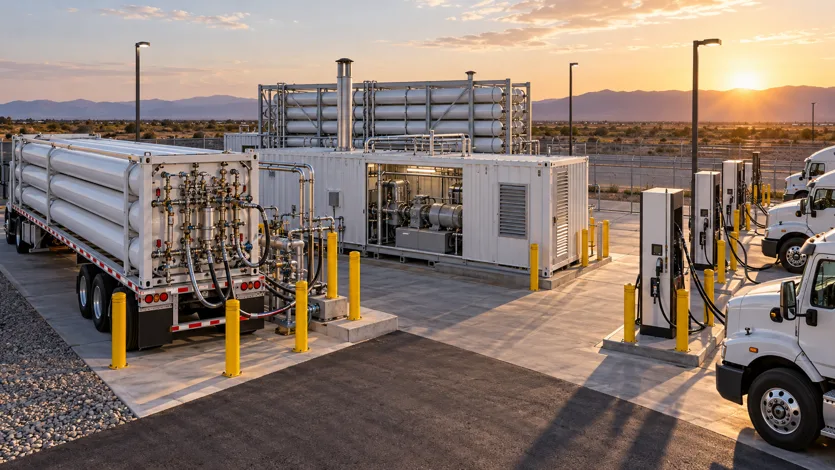
A daughter station may use trailer pressure to transfer gas into a buffer or vehicle tanks while pressure remains adequate, then call on a booster when the pressure differential becomes insufficient. A manufacturer description of a containerized daughter station shows this type of pressure-difference and compressor sequence. The actual operating sequence must be checked against the proposed trailer and demand profile; it should not be assumed from a generic product photo.
Compressor capacity depends on the changing trailer pressure
The compressor is often a major cost and power driver. A trailer does not present one constant inlet pressure: pressure generally declines as gas is withdrawn. A compressor advertised at a favorable high inlet pressure can deliver less flow near the end of unloading. Suppliers should show rated performance at the minimum, normal and maximum expected inlet pressures, with all values labeled as gauge or absolute.
For example, a manufacturer’s daughter-station compressor data may show a broad inlet-pressure range. That illustrates why the project range must be specified; it does not establish HMZ’s performance or a universal station rating. Ask what residual gas remains in the trailer when the station can no longer meet peak demand. That residual affects delivered gas cost as well as trailer turnaround.
Redundancy also matters. One duty compressor may have a lower initial price, while a duty/standby arrangement can improve availability for a station with strict service commitments. Compare the cost of the extra equipment against the cost of a fueling outage and the maintenance plan.
Peak fueling demand sets storage and dispenser scope
Daily gas sales alone do not determine the station size. A bus depot that fuels vehicles in a short return window has a different peak profile from a public site with arrivals spread across the day. More storage can help supply a burst, but it must be recharged before the next peak. Dispenser count and site circulation can create a queue even when the compressor has adequate daily throughput.
Define the busiest hour, fuel per vehicle, vehicle tank rating, arrival pattern, acceptable wait and simultaneous fueling requirement. The existing fleet CNG station selection guide explains why operating schedules matter when choosing the system. Ask suppliers to simulate or explain a representative peak sequence, including storage pressure and compressor recovery.
A quoted “fast-fill time” is meaningful only with stated starting vehicle pressure, target fill conditions, ambient temperature and number of consecutive vehicles. Storage volume alone is not a guarantee of throughput.
Site installation can be larger than the skid scope
Containerization can simplify factory integration and shipping, but the customer still needs a suitable site. Budget for land preparation, foundations, trailer and vehicle access, electrical service, grounding, gas piping, drainage where applicable, fencing, fire and safety provisions, communications, commissioning and training. Local authority requirements may affect separation distances and layout.
Freight also depends on module size and weight. A container-like enclosure does not automatically fit a standard shipping container or avoid oversized transport rules. Require transport drawings, lifting points and a packing list before comparing delivered prices.
Clarify who handles unloading cranes or forklifts, site cabling and utility connections. A low factory price can become a high installed cost if these interfaces are omitted.
Delivered gas and trailer logistics affect operating cost
A daughter station depends on a supply chain. Ask whether gas is priced at the mother station, delivered to the daughter station, or metered after unloading. The buyer should understand compression at the source, trailer rental or ownership, driver and fuel costs, loading and unloading time, road restrictions and how many trailers are needed to prevent interruption.
“Trailer payload” and “usable delivered quantity” are different. The latter depends on starting and ending pressures, ambient conditions and whether the station has a booster. Compare gas costs using an agreed energy or standard-volume basis. If quoting Sm³, define the reference temperature and pressure, for example 15°C and 101.325 kPa absolute, and agree on gas composition or calorific value. Do not compare a bare m³ figure with another supplier’s Nm³ figure without conversion.
Electricity for compression, scheduled maintenance, filters, calibration, replacement parts, operator staffing and insurance are additional operating categories. Compressor power should be stated for the actual duty range, not just nameplate motor rating.
A practical comparison example
Illustrative assumptions only: Two vendors quote a station for 2,400 Sm³/day of vehicle fuel demand. For this example, Sm³ means volume at 15°C and 101.325 kPa absolute. The busiest two hours require 600 Sm³. Trailer gas reaches the site at a high pressure after loading but falls during unloading. The station must fuel vehicles even when trailer pressure is near the agreed minimum.
Vendor A offers a lower equipment price with one compressor, limited storage and one dispenser. Vendor B offers additional storage, two dispensers and a standby compressor. Without more data, neither offer is “better.” Compare each against the same peak sequence, minimum inlet pressure, acceptable queue and availability requirement. Confirm whether both include the same trailer interface, electrical works, installation and commissioning.
Now assume the delivered gas contract charges per trailer trip rather than per usable Sm³. If Vendor A leaves more residual gas in each trailer because its equipment cannot unload further, the apparent capital saving may be offset by more trips or unused inventory. This is a reason to calculate the full delivered-gas and station-operating cost, not a claim that a particular configuration always wins.
Build a lifecycle-cost worksheet
For each offer, separate four categories:
- Initial station equipment: unloading, compressor, storage, dispensers, controls, enclosure, testing and documentation.
- Site and project costs: civil work, utilities, transport, installation, approvals and commissioning.
- Gas supply and logistics: source compression, gas purchase, trailer fleet, trips and residual-gas policy.
- Operation and maintenance: electricity, labor, inspections, spare parts, calibration and expected replacement items.
Choose a consistent evaluation period and state assumptions for gas throughput, utilization, electricity price, maintenance schedule and discount rate. Request the same commercial Incoterm and supply boundary from all bidders. Identify optional equipment separately so that deleting a safety or availability function does not masquerade as a like-for-like saving.
Questions to include in a request for quotation
- What are the minimum, normal and peak daily and hourly fueling quantities?
- How many vehicles may arrive together, and what are their tank and receptacle specifications?
- What is the trailer type, gas composition, arrival pressure range and expected usable delivered quantity?
- What is the lowest inlet pressure at which the station must still meet peak flow?
- Is the compressor capacity stated at this minimum pressure, and is standby capacity required?
- Which storage vessels, dispensers, hoses, metering and fleet-management features are included?
- What electrical supply and site conditions are assumed?
- Which standards, local approvals, inspections and records are required?
- What is included in site installation, training, commissioning, spare parts and warranty support?
- Which parts of the gas supply and trailer operation are outside the equipment vendor’s scope?
These questions make the quotations more comparable and help reveal a mismatch before equipment is ordered.
FAQ
Is a containerized daughter station always cheaper than a conventional layout?
No. Factory integration can reduce some site work, but enclosure, transport and site conditions may add cost. Compare the installed scope and operating requirements.
Does a larger trailer reduce station cost?
Not necessarily. It may reduce delivery frequency, but unloading equipment, space, transport limits and usable gas percentage must be checked.
Can I budget from an old U.S. CNG station price guide?
Use it to understand cost categories, not as a current daughter-station price. The report’s date, country, station type and assumptions differ from a project-specific overseas offer.
What is the biggest hidden operating cost?
There is no universal answer. Trailer logistics, residual gas, compression electricity and maintenance can each dominate depending on the project. Model the actual supply route and duty cycle.
What information is needed for a reliable preliminary budget?
Provide site location, gas demand and peak fueling schedule, trailer specification, gas quality, expected pressure range, power availability, vehicle details, required availability and a clear supply boundary.
Request a project-specific quotation
Send HMZ your site location, trailer and gas data, vehicle mix, hourly fueling profile, utility information and preferred supply scope. We can discuss an appropriate daughter-station concept and prepare a project-specific technical and commercial proposal after the design basis is confirmed.
Technical sources
- U.S. Department of Energy, <i>Costs Associated With Compressed Natural Gas Vehicle Fueling Infrastructure</i> (2014). Used for cost-category structure, not current pricing: https://afdc.energy.gov/files/u/publication/cng\_infrastructure\_costs.pdf
- U.S. Department of Energy, Alternative Fuels Data Center, <i>Compressed Natural Gas Fueling Stations</i>: https://afdc.energy.gov/fuels/natural-gas-cng-stations
- Blue Sky New Energy, <i>CNG Container Daughter Station</i>: https://blueskynewenergy.com/cng-container-daughter-station/
- Jereh, <i>CNG Daughter Station</i> product data, illustrating the need to define inlet-pressure range: https://www.jereh-gas.com/en/product/CNG-Daughter-Station.htm
Related HMZ CNG solution
Review the containerized CNG daughter station when comparing project scope and operating costs.
