
Direct answer: The cost of a fleet CNG fueling station is shaped less by the number of vehicles on the roster than by when and how they must refuel. The gas source and inlet pressure set compressor duty; the busiest fueling window drives compressor, storage and dispenser capacity; and the site determines civil, electrical and safety work. Ownership, maintenance and fuel supply then determine the long-term cost. Request a project-specific quotation with a common duty profile and supply boundary rather than relying on a generic station price.
The U.S. Department of Energy’s Alternative Fuels Data Center (AFDC) explains that time-fill, fast-fill and combination stations use different compressor and storage arrangements. Its infrastructure cost report also identifies fleet size, fuel use and fueling window as design inputs. That report was published in 2014, so its historical dollar ranges are not suitable as current overseas price quotes. Its cost categories remain useful for planning.
Start with the fleet schedule, not a station price
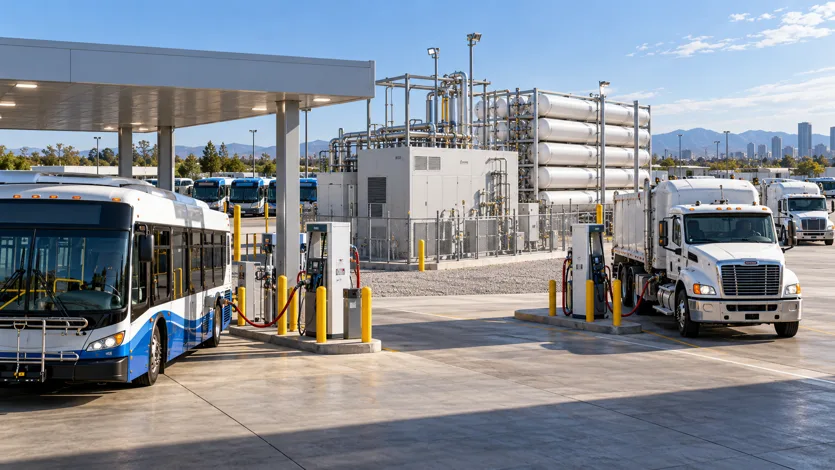
A depot with 100 buses parked for eight hours each night is different from a depot with 100 delivery trucks returning in waves and departing after 20 minutes. Both may buy the same daily amount of gas, but the second may need greater short-period delivery capacity, storage or more dispensing positions.
Prepare a representative busy-day schedule before inviting offers. Show vehicle arrival time, expected fuel required per vehicle, departure deadline and the maximum tolerable queue. Include weekend or seasonal variation if the pattern changes. The number of vehicles that could be fueled simultaneously is not the same as the number that actually arrives together.
For a broader system-selection discussion, see our fleet CNG station guide. This cost guide focuses on how the chosen operating pattern changes capital and operating expenses.
The main capital cost drivers
| Driver | What changes the budget | What to ask in an offer |
|---|---|---|
| Gas source | Pipeline connection, inlet pressure and flow commitment, or delivered CNG interface | Minimum guaranteed inlet pressure and gas-quality specification |
| Compressor package | Capacity, pressure ratio, duty hours, cooling, enclosure and redundancy | Capacity at the minimum inlet pressure and estimated power |
| High-pressure storage | Useful gas available for successive quick fills | Usable capacity under the stated operating sequence |
| Fueling outlets | Time-fill post count, dispenser hoses, metering and access control | Maximum concurrent vehicles and included interfaces |
| Gas treatment | Moisture, particulates and oil removal as required by the gas and equipment | Inlet quality limits and included filters or dryer |
| Controls and safety | Emergency shutdown, alarms, hazardous-area equipment, monitoring | Control narrative, I/O list and applicable design basis |
| Site works | Foundations, traffic lanes, canopy, electrical upgrade, piping and utilities | Battery limits and contractor responsibilities |
| Testing and support | Inspection, commissioning, training, spares and warranty | Document list and after-sales scope |
One offer may include the skid only, while another includes the installation and civil work. Comparing their totals without aligning the scope produces a false conclusion.
Time-fill, fast-fill and combination layouts
Time-fill usually supplies parked vehicles over a long period, often directly from the compressor. It may require many posts and long distribution lines but less high-pressure storage. It can be a good fit for centrally parked fleets with a reliable overnight window. If that window shortens, compressor capacity and site power requirements can rise.
Fast-fill supplies vehicles that need to depart quickly. The compressor charges high-pressure vessels, and the dispenser transfers gas to vehicle tanks. Storage, compressor recovery and the number of dispensers determine how the station handles a queue. A headline nozzle flow rate does not prove that the tenth consecutive truck will receive the same fill time as the first.
Combination fill serves both patterns. A fleet may connect most vehicles overnight while reserving one fast-fill lane for short-turnaround units. It provides operating flexibility but adds controls, distribution and often storage. The supplier should state what happens when both branches demand gas at once.
The least expensive station to purchase may be expensive to operate if its layout forces drivers to wait, requires repeated overtime, or cannot support planned expansion.
Gas pressure and quality can change compressor economics
A compressor quotation must state its inlet-pressure basis. If a pipeline utility guarantees a wide pressure range, the supplier should show flow and electrical demand at the lowest realistic inlet pressure. A low inlet pressure can increase the required compression duty or change the number of machines needed. A higher headline capacity at favorable inlet conditions may not represent actual site performance.
If gas arrives by CNG trailer, trailer pressure changes during unloading. Trailer connection and logistics must be included in the design and cost comparison. “Delivered gas” should be defined as usable gas at the station, not only the quantity loaded upstream.
Gas quality also affects scope. Moisture, contaminants or compressor oil may require treatment or filtration. Ask the gas supplier for composition, water limits and the basis for energy content. Do not assume every gas source needs the same treatment train.
Use clear units: if a proposal states Sm³/h, define the reference temperature and absolute pressure, for example 15°C and 101.325 kPa absolute. Identify all operating pressures as gauge or absolute. A bare “m³/h” figure cannot be compared safely with a differently defined standard-volume rate.
Storage and peak demand: the cost of speed
Fast-fill storage is an energy buffer. It can serve a short surge while compressors continue to run, but it must recover before the next surge. More vessel volume may reduce waiting in one pattern, yet it also adds capital cost, footprint, inspection and maintenance. The economic balance depends on the arrival sequence.
Ask each supplier for an example fueling sequence based on your data: vehicle starting tank pressures, fuel quantity, number of consecutive fills, ambient conditions and acceptable waiting time. Review storage pressure and compressor recovery after the peak. This is more useful than asking only for maximum daily throughput.
Vehicle tank temperature matters too. AFDC notes that a rapid fill can heat gas in the tank, affecting the settled quantity. A procurement specification should define the required delivered fuel under stated conditions and the relevant temperature-compensation approach, rather than equating “full” with a dispenser stopping at a pressure reading.
Site development and utility costs
The equipment package is only one part of an installed station. The site may require foundations, electrical distribution, grounding, gas inlet work, access roads, vehicle turning space, lighting, fire and gas safety systems, communications and local approvals. Existing electrical service may be insufficient for the selected compressor. Construction beside an operating depot may require staged work and temporary traffic arrangements.
Containerizing the compressor and controls can simplify some factory assembly, but does not remove these site responsibilities. Request a general arrangement, weights, dimensions, lifting provisions and utility connection points before estimating freight and installation.
The local authority’s requirements can affect separation distances, ventilation and equipment selection. Suppliers should identify the design standards they use; the buyer and local engineering team must confirm what the project jurisdiction requires. Do not infer certification from a generic product catalogue.
Reliability is a cost decision
For a fleet that must leave the depot every morning, a compressor outage can disrupt routes. A duty/standby compressor arrangement, spare parts package or service contract increases initial spending but may reduce downtime risk. The correct choice depends on whether public fast-fill stations, alternative fuel or spare vehicles provide practical backup.
Ask how long the station can meet demand with one compressor unavailable, how long repairs take and which critical parts are stocked. A storage bank is not a substitute for long-term compressor capacity: once depleted, it must be recharged.
Maintenance cost includes planned service, filter changes, oil or lubricant where applicable, inspections, meter calibration and specialist labor. Clarify who performs these tasks and whether the price includes training.
Illustrative planning example
Assumptions only: A fleet uses 2,400 Sm³ of CNG per day. For this example, Sm³ is gas volume at 15°C and 101.325 kPa absolute. Sixty percent of demand, or 1,440 Sm³, must be transferred in a four-hour evening window. A simple average for that window is 360 Sm³/h. This is a starting point, not the final compressor size.
If the same 1,440 Sm³ must be delivered in two hours, the simple average becomes 720 Sm³/h. The change in fueling window can therefore double the average required transfer rate for that portion of demand, before accounting for simultaneous vehicle connections, storage, compressor availability or design margin. Alternatively, some demand might be shifted to an overnight time-fill period. A combination arrangement could then reduce the fast-fill peak, but it would require more parking posts and a coordinated control strategy.
The example is not an HMZ project or quoted performance. Actual compressor selection needs gas composition, inlet-pressure range, tank and dispenser conditions, storage behavior and a supplier performance model.
Compare the full lifecycle cost
Create one comparison sheet for all bidders. Separate initial equipment, installation, gas supply, and operation and maintenance. Use the same evaluation horizon, gas volume, electricity tariff, utilization rate, maintenance assumptions and currency basis. State whether delivered CNG, utility gas, taxes, duties and freight are inside or outside the comparison.
Cost per unit of fuel dispensed can rise sharply when a station is underused, because much of the installed equipment cost and maintenance remains. But designing exactly for today’s demand can create expensive retrofit work when the fleet grows. Ask suppliers to identify low-cost expansion provisions, such as reserved electrical capacity, space, piping stubs or control I/O, separately from equipment needed on day one.
An old price example can inform a budget discussion only if its location, date, station type and included works are explicit. For a purchasing decision, request a current, itemized, project-specific offer.
RFQ data checklist
- Vehicle types, quantities, tank service pressures and receptacles.
- Daily gas demand plus hourly peak and expected fuel per return.
- Arrival and departure timetable for a busy day.
- Required fueling method, maximum queue and any public access.
- Gas source, minimum and maximum inlet pressure, quality and available flow.
- Site location, utility availability, ambient range, footprint and traffic plan.
- Availability target, redundancy preference and expansion plan.
- Required metering, access control and data integration.
- Required standards, approvals, tests and documentation.
- Commercial boundary: equipment, freight, site work, commissioning, spares and maintenance.
A supplier should return an equipment list, performance assumptions, power estimate, general arrangement, included scope, exclusions and a clear schedule. Without those, a low price may simply represent a narrower package.
FAQ
Is time-fill always cheaper than fast-fill?
No. It often uses less high-pressure storage, but a large number of posts, long pipe runs or a short overnight window can change the result. Compare installed and operating scopes.
Does a bigger storage bank replace a compressor?
It helps with short peaks, but the compressor must recharge it. Storage cannot make up for a sustained capacity deficit.
Can a small fleet use a combination station?
Yes, if some vehicles can park for hours while others need a quick fill. The operating value must justify the additional equipment and controls.
Why do two quotes for the same number of vehicles differ so much?
They may assume different fueling windows, inlet pressures, storage, dispenser counts, standby capacity or construction boundaries. Align the duty and scope before comparing.
Should I use a published station cost range as my budget?
Treat old ranges as background only. Ask for a current quotation based on the site, gas supply, fleet schedule and local requirements.
Request a tailored station concept
Send HMZ your vehicle list, busy-day return schedule, gas source details, site utility information and preferred supply boundary. We can discuss the station layout and prepare a project-specific technical and commercial proposal once the operating basis is clear.
Technical sources
- U.S. Department of Energy, Alternative Fuels Data Center, <i>Compressed Natural Gas Fueling Stations</i>: https://afdc.energy.gov/fuels/natural-gas-cng-stations
- U.S. Department of Energy, <i>Costs Associated With Compressed Natural Gas Vehicle Fueling Infrastructure</i> (2014). Used for cost factors; historical prices are not treated as current quotes: https://afdc.energy.gov/files/u/publication/cng\_infrastructure\_costs.pdf
- U.S. Department of Energy, Alternative Fuels Data Center, <i>Filling CNG Fuel Tanks</i>: https://afdc.energy.gov/vehicles/natural-gas-filling-tanks
Related HMZ CNG solution
Explore the related HMZ CNG product page for a project-specific configuration.
