
Direct answer: The cost of an industrial CNG pressure regulation and metering skid depends on the gas flow range, the highest and lowest trailer inlet pressures, the required outlet pressure, gas temperature and quality, whether heating is necessary, the metering purpose, safety functions and the required uptime. A single “price per skid” is unreliable unless these conditions and the supply boundary are stated. A useful request for quotation gives each supplier the same process data and asks for a priced equipment list, exclusions and performance assumptions.
This article concerns a trailer-fed industrial gas receiving package. It is not a vehicle CNG dispenser or a daughter fueling station. The package accepts high-pressure CNG, reduces and controls pressure, measures gas delivered and supplies a plant gas header. The detailed process may vary: some projects need a heater, parallel regulator trains or custody-transfer metering; others do not. Emerson describes customized pressure-reducing skids as combinations of regulators, valves and meters, showing why “skid” names alone do not define a fixed scope.
Why two apparently similar offers differ
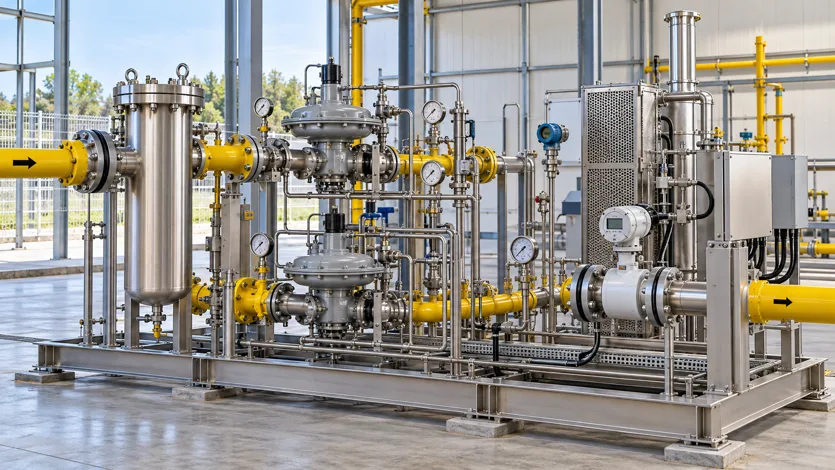
Two vendors can quote the same nominal maximum flow and still design different systems. One may assume a fresh trailer with high inlet pressure; another may guarantee full flow near the end of unloading. One may include a heater sized for winter conditions, while the other assumes the gas will remain warm enough. One may include a calibrated custody-transfer meter and flow computer; the other may include only an indication meter.
The differences are not necessarily quality differences. They may be differences in the customer’s stated duty, local rules or the quoted boundary. The buyer’s task is to normalize the assumptions before comparing totals.
| Cost driver | Lower-scope possibility | More demanding possibility | What to confirm |
|---|---|---|---|
| Flow capacity | Moderate steady demand | High peak and wide turndown | Minimum, normal and peak flow |
| Inlet pressure | Narrow pressure range | Trailer pressure declining over unloading | Minimum and maximum at skid inlet |
| Outlet pressure | One stable setpoint | Tight tolerance or changing demand | Permissible downstream range |
| Heating | Not required by thermal analysis | Controlled preheating needed | Worst-case gas temperature |
| Metering | Process indication | Billing or custody-transfer system | Accuracy and reference basis |
| Reliability | One operating run | Parallel duty/standby runs | Allowed plant interruption |
| Protection | Basic required devices | More complex overpressure/underpressure arrangement | Cause-and-effect and local requirements |
| Integration | Factory skid only | Site piping, electrical and commissioning | Battery limits and deliverables |
The purpose of this table is to reveal scope, not to suggest removing protective devices to reduce price. Safety requirements must come from the project hazard analysis and applicable rules.
Flow range and changing trailer pressure
A receiving station should be sized for the plant’s minimum, normal and maximum hourly gas demand. A single maximum figure is insufficient. A regulator and meter selected only for the highest flow may perform poorly at low load. A boiler that cycles between low fire and high fire may need a wider control range than one that runs steadily.
For trailer-fed supply, inlet pressure changes during unloading. At the beginning, a full trailer may provide substantial pressure differential; near the end, the station has less pressure available. Ask the supplier to state the lowest inlet pressure at which the skid can still meet the required peak flow and outlet pressure. A higher-pressure-rated inlet train and a wider control range may affect component selection and cost.
Label every pressure as gauge or absolute. For example, 20 barg means 20 bar above local atmospheric pressure; 20 bara means 20 bar absolute. These are not the same design input. Suppliers should also state whether quoted pressure values are at the trailer vessels, unloading manifold or actual skid inlet, because hoses and valves introduce pressure losses.
Pressure reduction and temperature
Reducing gas pressure can lower gas temperature. Emerson’s guidance on cold-temperature operation explains why the gas composition and temperature drop need evaluation. A heater is not automatically necessary for every CNG reduction skid. The decision depends on pressure drop, inlet temperature, ambient conditions, gas moisture and hydrocarbon content, flow rate and minimum acceptable downstream temperature.
A heater adds equipment and operating energy. It may also require circulation pumps, temperature controls, power distribution, insulation and extra space, depending on technology. The buyer should request the thermal basis rather than simply asking whether a quoted price “includes a heater.” A supplier should show the worst credible operating case and the outlet-temperature requirement it is designing to meet.
Do not use a generic degrees-per-bar rule as a final design calculation. The actual gas mixture and operating conditions govern the thermal behavior. If water or heavier components are present, quality control may be as important as heat input.
Metering purpose changes the package
A meter used to monitor process consumption has different commercial requirements from one used to invoice gas deliveries. Billing may require a defined accuracy class, calibration evidence, pressure and temperature compensation, a flow computer, data retention and access for both supplier and buyer. An ultrasonic, turbine, rotary or other meter technology can be suitable depending on flow range, line size, gas quality, pressure and installation constraints. A more expensive instrument is not automatically more accurate in the actual operating regime.
Emerson’s gas metering configuration guide asks for minimum, normal and maximum flow, pressure and temperature, as well as gas analysis and meter-run conditions. That is a useful model for an inquiry. The meter’s upstream and downstream straight-run or flow-conditioning needs can change skid length and piping cost.
If proposals state volumetric flow in Sm³/h or Nm³/h, obtain the reference temperature and absolute pressure for each. For illustration, a buyer might define one Sm³ as the volume at 15°C and 101.325 kPa absolute. A different standard condition changes the numerical volume and can affect comparison or billing. Define the gas composition and heating-value basis as well.
Redundancy, protection and availability
A single regulator train may be adequate for a process that can shut down briefly. A plant with continuous production may need parallel runs so one train can operate while another is serviced. Emerson’s fuel-gas supply guidance describes parallel runs, series regulation and slam-shut or other protective arrangements for reliability and overpressure/underpressure control. The specific architecture must be engineered for the plant; these are options to evaluate, not a universal list.
Ask what occurs if the active regulator fails, a filter blocks, the heater trips, power is lost or a trailer changeover is delayed. A second run increases valves, instruments, piping and footprint, but can reduce interruption exposure. Quantify the value of lost production before deciding whether the extra capital cost is justified.
Emergency shutdown and venting arrangements also need a clear boundary. Who supplies the gas detectors, ESD panel and plant interlock? What signals does the skid send to the site control system? Omitting these interfaces from one quotation creates a misleading price advantage.
Installation and documentation costs
The factory skid price may exclude foundations, unloading hose storage, site piping, electrical cabling, grounding, hazardous-area works, shelter, weather protection, lifting, testing and commissioning. A skid that must fit inside an existing building can cost more to package and install than an open outdoor arrangement, even if the process equipment is similar.
Documentation can also be material. Ask for a P&ID, general arrangement, equipment datasheets, design calculations, inspection and test plan, pressure-test records, material certificates where required, operating manuals and a commissioning scope. Confirm the exact standards and local approvals required by the authority having jurisdiction. Do not assume a component certificate means the complete assembled system carries the same approval.
A worked comparison without invented prices
Illustrative assumptions only: An industrial site requires 600 Sm³/h during normal operation and 900 Sm³/h for short peaks. For this example, Sm³ means gas volume at 15°C and 101.325 kPa absolute. The trailer inlet pressure varies from 200 barg when newly connected to 25 barg near the intended changeover. The plant header requires 4 barg, with a limited allowable deviation. Actual project values must come from the client and gas supplier.
Offer A prices one regulator train, a basic process meter and no heater. It states 900 Sm³/h capacity only at 100 barg inlet. Offer B includes two regulator runs, a flow computer and a heater provision, and states capacity across the full 25–200 barg inlet range. The two prices cannot be compared as equivalents. Offer A has not demonstrated the specified peak at the minimum inlet pressure, and the proposals do not cover the same uptime, metering or temperature duty.
The buyer can ask both vendors to reprice the same base scope: 25 barg minimum at the skid inlet, 900 Sm³/h peak for a stated duration, 4 barg outlet, defined gas composition and minimum ambient temperature, and a specified metering and availability requirement. Then price the heater and standby run as separate options if the engineering evaluation has not yet settled them.
A practical evaluation worksheet
Break each proposal into five sections:
- Process equipment: trailer inlet, filters, regulators, meters, protective devices and optional heating.
- Controls and electrical: panels, instruments, hazardous-area components, communication and plant interlocks.
- Mechanical package: piping, skid frame, enclosure, lifting, transport and factory testing.
- Site work: foundations, utility connections, field piping, installation, approval and commissioning.
- Lifecycle: heater energy, inspection, calibration, spare parts, maintenance labor and availability.
State the same supply term, currency, evaluation period and gas throughput for each vendor. Separate mandatory requirements from optional enhancements. The lowest equipment price may be a reasonable choice if it truly meets the duty; a higher price may be justified by lower interruption risk or more complete scope. There is no universal answer without the project’s design basis.
Information to send with an RFQ
Provide gas composition and quality, trailer type and pressure range, minimum/normal/peak flows, required outlet pressure range, minimum ambient temperature, operating hours, allowable interruption, metering purpose, available utilities, site layout and the intended supply boundary. Request a marked-up P&ID and a point-by-point exception list. Specify whether the quotation includes freight, installation, training, commissioning, spares and after-sales service.
The buyer should also ask what data the supplier needs to finalize the heater and protection design. An honest preliminary quotation may leave these as priced options pending a complete gas analysis rather than imply certainty from missing inputs.
FAQ
Is a heater always included in a CNG reduction skid?
No. The need for heating depends on gas composition, moisture, pressure reduction, inlet and ambient temperature, flow and required outlet temperature. Ask for a documented thermal basis.
Does a higher maximum flow always mean a more expensive skid?
Often it changes valve and meter size, but the minimum-flow performance, pressure rating, number of runs and package scope also matter. Compare the complete duty range.
Is a process meter sufficient for billing?
Not automatically. Billing requires an agreed measurement standard, accuracy, correction basis, calibration and data-handling arrangement. Define these in the contract.
Why does minimum trailer pressure matter to price?
It affects whether the skid can maintain the specified outlet pressure and flow late in unloading. A design evaluated only at full trailer pressure may not meet the real duty.
Can the skid price be compared without site work?
Only if both offers clearly exclude the same site work and the buyer separately budgets it. For investment decisions, compare the installed and operating cost as well.
Discuss a project-specific configuration
Send HMZ your gas quality, trailer data, inlet-pressure range, minimum/normal/peak flow, outlet pressure, ambient conditions and metering requirement. We can discuss a preliminary configuration and define the information needed for a project-specific technical and commercial proposal. Final equipment selection and protective design require engineering against the confirmed site conditions.
Technical sources
- Emerson, <i>Tartarini, Fisher and Francel Customized Stations and Skids</i>: https://www.emerson.com/en/final-control/products/tartarini-stations-skids
- Emerson, <i>Cold Temperature Considerations</i>: https://www.emerson.com/documents/automation/cold-temperature-considerations-en-11751644.pdf
- Emerson, <i>Fuel Gas Supply System for Gas Power Plants</i>: https://www.emerson.com/is/content/emerson/pt/final-control/pressure-management/common-applications/natural-gas-pressure-regulators/documents/fuel-gas-supply-system-for-gas-power-plants-white-paper-en-10975562.pdf
- Emerson, <i>Gas Ultrasonic Metering System Configuration Guide</i>: https://www.emerson.com/is/content/emerson/en/measurement-instrumentation/technical/products/flow-ultrasonic/documents/doc-dan-gas-tq-gusm-0213.pdf
Related HMZ CNG solution
Explore the related HMZ CNG product page for a project-specific configuration.
