
Direct answer: Size a CNG daughter station by testing three requirements together: the gas vehicles need each day, the amount they need during the busiest fueling window, and the usable gas that trailers can reliably deliver. Then check compressor performance across the trailer’s falling inlet pressure, storage behavior through consecutive fills, dispenser and traffic capacity, and the continuity plan for trailer changeover. Vehicle count or nominal trailer capacity alone cannot establish a reliable station size.
A daughter station receives compressed natural gas by trailer and supplies CNG vehicles. It may use pressure difference, high-pressure storage, booster compression or a combination according to the design. A containerized package is an equipment arrangement, not a separate sizing method. The U.S. Department of Energy’s Alternative Fuels Data Center (AFDC) notes that compressor and storage choices must match the vehicles and fueling pattern; a manufacturer description of a daughter station shows how trailer unloading and compression can interact.
Start with a clear design basis
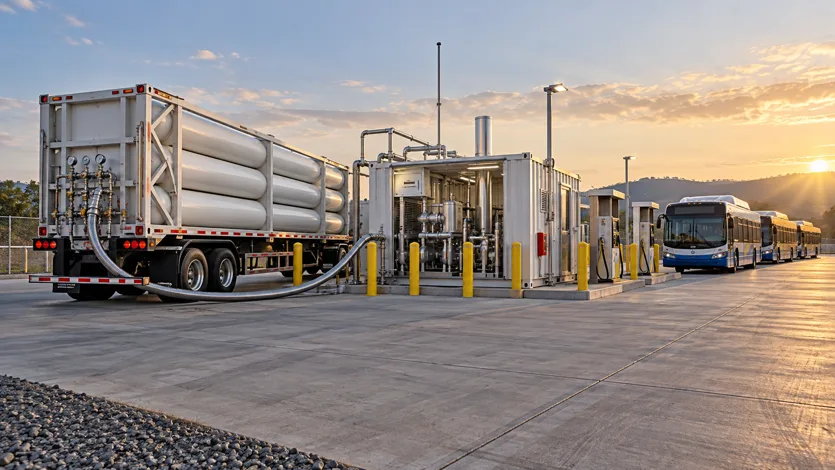
Before calculating anything, define what “capacity” means. A daily throughput number is useful for gas supply contracts, while a peak-hour number affects dispensers, compressor duty and storage. A trailer’s vessel inventory is not necessarily its usable delivered gas. Ask stakeholders to agree on:
- Vehicle types, tank service pressures and receptacles.
- Number of vehicles expected to fuel, amount per fill and starting tank condition.
- Hourly arrivals, fueling-window length and acceptable waiting time.
- Gas composition, quality and temperature range.
- Trailer type, arrival pressure range, changeover pressure and unloading method.
- Minimum, normal and maximum station demand, including future growth.
- Electrical supply, site layout, availability and local design requirements.
Use a common measurement basis. If demand is stated in Sm³, define the reference conditions; one possible contract definition is 15°C and 101.325 kPa absolute. Other contracts use different bases. State all process pressures as gauge or absolute—barg is not bara. Do not convert between GGE, kg and standard cubic metres without the gas composition and agreed energy or density basis.
Step 1: Establish daily demand from operating data
The best estimate comes from actual fleet fuel records or a realistic duty-cycle model. For each vehicle group, multiply the number of fueling events per day by the expected quantity per event, then add the groups. Use a busy representative day, not only an annual average. A station open to multiple operators should consider their schedules together.
This first total is a gas procurement and logistics input. It does not yet size the dispensing system. Two sites consuming the same daily volume can need very different equipment if one site spreads arrivals across 16 hours and the other serves most vehicles in a two-hour shift change.
For fleets, the CNG fueling station selection guide explains how parking and route schedules shape the station concept. A daughter station adds the trailer-supply constraint to that operating question.
Step 2: Build an hourly fueling profile
Make a simple table of arrivals and required gas by hour. Include the busiest normal day and any predictable peak, such as buses returning after a shift. Record the desired service time per vehicle and whether two vehicles can be fueled at once. This reveals the number of dispensing lanes and the quantity needed before a storage bank can recover.
A peak-hour average still may hide a short surge. For example, 500 Sm³ in one hour could arrive evenly or in ten minutes. The latter may need more useful storage, more dispensers or a queueing plan. Ask suppliers to model a sequence of consecutive fills using vehicle starting pressures, tank sizes, ambient conditions and station storage pressure.
AFDC describes fast-fill stations as using high-pressure storage for quick delivery, with compressor and storage sized in combination. At a trailer-fed daughter station, the trailer pressure and unloading configuration also influence what gas is available during that sequence.
Step 3: Convert trailer inventory into usable delivered gas
The gas loaded into a trailer is not always the gas the station can use. Some remains when the trailer reaches a minimum useful pressure. A booster may reduce residual gas, but its ability depends on inlet pressure, outlet requirement and actual machine curve. The gas supplier and equipment vendor should agree on a usable-delivery figure per trailer, its reference conditions and the pressure at which that figure is achieved.
Then calculate the simple number of trailer loads per day:
Daily trailer loads = daily station demand ÷ usable gas delivered per trailer.
Round up for operating planning, then check delivery schedule and reserve. This arithmetic is a starting point, not a fleet-sizing guarantee. Loading time, travel, unloading duration, site queueing, road restrictions and delayed deliveries affect how many physical trailers are needed. If the station must remain open through a trailer swap, specify how continuity is maintained.
A supplier may quote an unloading percentage under particular conditions. Treat that as equipment-specific data, not a universal assumption for all CNG trailers and daughter stations.
Step 4: Check compressor performance at the lowest inlet pressure
As the trailer unloads, its gas pressure falls. A compressor that provides sufficient flow when a fresh trailer is connected may deliver less flow near the agreed changeover pressure. Request a capacity curve or duty table at the minimum, normal and maximum inlet pressures, including estimated power and outlet pressure. Identify where each pressure is measured: trailer vessel, unloading manifold or compressor inlet.
Ask whether pressure-difference transfer can support any part of the fueling cycle without the booster and when the booster starts. The answers affect operating energy, storage strategy and residual gas. If peak vehicle demand occurs just before a trailer change, the station should still meet the required service level or have a defined operating restriction.
Redundancy is another capacity question. One compressor sized exactly for the normal duty provides no compressor capacity during a breakdown or maintenance. If uptime is critical, consider a second machine, a backup fueling route or a defined contingency plan.
Step 5: Size storage for a sequence, not a catalogue number
Storage vessels can help serve a short peak, but only the gas within the useful pressure range is available for fast filling. The total geometric vessel volume is not the same as usable delivered gas. A supplier should show the initial and ending storage pressures during a representative fill sequence, together with compressor recharge.
The design may use cascade groups and priority controls. Its performance depends on vehicle tank starting pressure, target pressure, temperature compensation, dispenser flow and the number of consecutive vehicles. AFDC notes that fill speed and temperature affect the settled amount in a vehicle tank. Define what constitutes an acceptable fill and wait time under stated conditions.
More storage is not a cure for insufficient sustained compressor or trailer supply. It can bridge a surge, but it must be replenished before the next one.
Step 6: Test the physical site and utilities
A station can have enough theoretical gas capacity and still fail operationally because the trailer blocks the vehicle lane, dispensers create a queue, or electrical power is inadequate. Check turning radii, unloading-bay access, hose routes, traffic separation, foundations, ventilation, safety distances and space for future equipment. Ask the equipment supplier for transport dimensions and interface drawings.
Compressor power should be evaluated at the expected duty, not inferred only from a motor nameplate. The site electrical assessment should include starting method, auxiliary loads, controls and any planned redundancy. Local code and authority requirements may change the layout and permitted operating practice.
Illustrative sizing example
Assumptions only: A fleet-fueling daughter station needs 3,600 Sm³ of gas on a busy day. In this example, Sm³ is defined at 15°C and 101.325 kPa absolute. Half of the daily amount, 1,800 Sm³, is requested during a three-hour evening return window. The simple average in that period is 600 Sm³/h. The remaining gas is used during less concentrated hours.
Assume each arriving trailer can deliver 2,400 Sm³ usable before reaching the agreed changeover pressure. The arithmetic minimum is 3,600 ÷ 2,400 = 1.5 trailer loads, so at least two loads are required for the day. That result does not prove that two trailers, or two daily trips by one trailer, can provide reliable service. Dispatch time, road time, unloading time and reserve must be tested.
If two-thirds of evening demand arrives in the first hour, the first-hour demand is 1,200 Sm³. The design must test whether the combination of direct trailer transfer, compressor flow and usable storage can serve that burst while meeting the required vehicle fill and waiting time. A compressor with a nominal 600 Sm³/h rating at high inlet pressure might not meet this case, especially as trailer pressure falls. The supplier must model the full duty and propose the appropriate equipment.
These quantities are an illustration, not an HMZ project reference or product guarantee.
A procurement comparison table
| Input or result | Buyer should state | Supplier should return |
|---|---|---|
| Daily gas demand | Busy-day Sm³ with reference conditions | Supported daily throughput and duty assumptions |
| Peak demand | Hourly profile and worst short surge | Fill sequence, queue and storage recovery |
| Trailer supply | Vessel type, arrival and changeover pressure | Usable delivered gas and residual assumptions |
| Compression | Required minimum inlet pressure and outlet duty | Flow and power across inlet-pressure range |
| Storage | Desired number of consecutive fills | Usable capacity and pressure trajectory |
| Dispensers | Vehicle mix, concurrent fills and service time | Hoses, controls and performance conditions |
| Availability | Allowed outage and changeover time | Redundancy and contingency arrangement |
A bid without the return data may still be a budget estimate, but it should not be treated as a verified final design.
Questions to ask before accepting a quotation
Request the P&ID, equipment list, general arrangement, compressor curves, storage calculation basis, trailer interface, electrical load list and control narrative. Confirm whether the quoted scope includes the trailers, unloading equipment, dispensers, site piping, electrical works, commissioning, training and local approvals. Ask each supplier to identify assumptions and exceptions in writing.
Separate design capacities from commercial forecasts. A station can be physically sized for expansion while initial gas sales remain modest. Conversely, an optimistic daily sales forecast should not substitute for a real peak-hour queue analysis.
FAQ
Can I size a daughter station from the number of vehicles?
No. You also need the gas needed per vehicle, arrival timing, tank conditions, service-time target and trailer supply.
Is one trailer enough if its nominal payload exceeds daily demand?
Not necessarily. The usable delivered quantity may be lower, and delivery delays or trailer changeover can interrupt service. Evaluate the full logistics cycle.
Does a bigger compressor eliminate the need for storage?
Not always. Storage may still be useful for short bursts, while a bigger compressor may be limited by minimum trailer inlet pressure or power availability. Model both together.
What is the most important pressure for compressor selection?
The minimum realistic pressure at the compressor inlet while the required station flow must still be delivered. Also state the maximum pressure and required outlet condition.
Can the final equipment size be chosen from this calculation?
No. The example is only a screening method. Project-specific engineering must check gas composition, pressure, temperature, transient fueling, safety and local requirements.
Request a project-specific concept
Send HMZ your vehicle schedule, busy-day hourly demand, trailer specification and pressure range, gas analysis, site layout, electrical supply and required availability. We can discuss a preliminary daughter-station configuration and identify the remaining data needed for a technical and commercial proposal.
Technical sources
- U.S. Department of Energy, Alternative Fuels Data Center, <i>Compressed Natural Gas Fueling Stations</i>: https://afdc.energy.gov/fuels/natural-gas-cng-stations
- U.S. Department of Energy, <i>Costs Associated With Compressed Natural Gas Vehicle Fueling Infrastructure</i> (2014), especially fleet demand and fueling-window factors: https://afdc.energy.gov/files/u/publication/cng\_infrastructure\_costs.pdf
- U.S. Department of Energy, Alternative Fuels Data Center, <i>Filling CNG Fuel Tanks</i>: https://afdc.energy.gov/vehicles/natural-gas-filling-tanks
- Jereh, <i>CNG Daughter Station</i> product data, an example of defined inlet range and unloading assumptions: https://www.jereh-gas.com/en/product/CNG-Daughter-Station.htm
Related HMZ CNG solution
Explore the related HMZ CNG product page for a project-specific configuration.
