
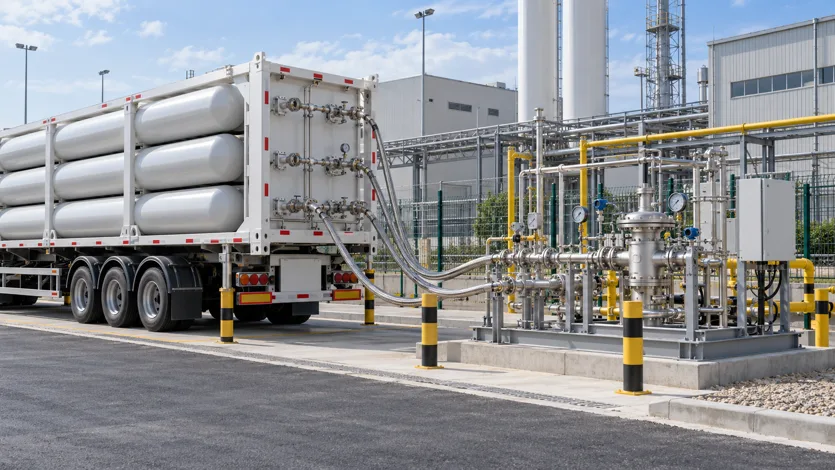
Direct answer: An industrial CNG virtual pipeline moves natural gas by road instead of through a continuous pipe. Gas is compressed at a supply point, loaded into certified transport vessels, delivered by trailer, then connected to an industrial receiving station. The station isolates, filters, optionally heats, reduces pressure, meters and supplies the gas to the plant’s downstream system. Whether it is practical depends on daily and peak demand, trailer payload and turnaround, inlet pressure over the unloading cycle, required outlet pressure, gas quality and the site’s tolerance for supply interruption.
What “virtual pipeline” means for an industrial buyer
A virtual pipeline is a logistics and receiving system, not a pipe hidden inside a container. The term is used for several transport modes, including CNG and LNG. This guide concerns CNG, where natural gas remains gaseous and is carried in high-pressure transport vessels. LNG is cryogenic and requires different storage and vaporization equipment.
The U.S. Department of Energy describes moving compressed or liquefied gas to places without physical pipeline infrastructure as a virtual-pipeline approach. A CNG trailer manufacturer similarly describes multiple-element gas containers mounted on trailers for high-pressure gas transport. At an industrial site, the practical interface is the receiving station and the gas header feeding boilers, furnaces, process heaters or generators. The equipment must be designed for the actual fuel specification and local requirements.
This is different from a vehicle CNG daughter station. Both may receive gas by trailer. A vehicle station ultimately fills vehicle tanks at high pressure; an industrial pressure regulation and metering skid delivers gas at the pressure needed by industrial equipment. If a site needs both uses, it requires an engineered split of the two downstream services.
The supply chain in five steps
1. Source, quality and compression
Gas may come from a pipeline-connected mother station, a gas processing facility or another approved supply source. The upstream operator conditions and compresses it into transport vessels. Before agreeing a supply contract, obtain the expected gas composition, water and contaminant limits, heating value basis and any odorization requirements. Industrial burners and gas engines can have different fuel-quality tolerances.
A buyer should also separate source capacity from delivery capacity. A compression site may produce enough gas over a day but lack loading lanes or trailer availability to meet the receiving site’s peak schedule.
2. Trailer loading and transport
A tube trailer or multiple-element gas container carries the compressed gas to the user. Its usable delivered quantity is not necessarily the total inventory when “full.” Unloading may stop when trailer pressure approaches the pressure needed at the receiving system, unless booster or cascade arrangements extract more gas. The transport operator should state the certified vessel pressure limits, payload basis, dispatch interval, driving time, loading time and return cycle.
Road access, weight limits, hazardous-goods rules and site traffic can govern feasibility. A virtual pipeline replaces a continuous physical connection with a repeatable logistics operation; therefore, a delayed truck becomes an energy-supply risk.
3. Site unloading and isolation
At the industrial site, the trailer connects to a purpose-designed unloading manifold. The arrangement commonly needs compatible connectors, isolation, nonreturn protection where required, pressure indication, emergency shutdown interfaces and safe depressurization provisions. The precise component list depends on the design basis and applicable code.
Parking and unloading positions need adequate access, separation and a safe route for vehicle movement. The plant should state who connects and disconnects the trailer, what checks are made before opening the line, and how a trailer can leave without interrupting other operations.
4. Pressure reduction, possible heating and metering
Trailer gas pressure falls as gas is withdrawn. The downstream plant usually needs a much lower, relatively stable pressure. Regulators reduce the pressure; monitoring or protective devices address credible overpressure and underpressure conditions. Emerson’s regulator guidance explains that a pressure regulator controls delivery pressure, not flow, and should not be treated as an isolation valve.
Pressure reduction can cool the gas. If temperature falls too far, moisture or heavier components can create operating problems. A heater may be needed, but it should not be specified automatically. Engineers must assess gas composition, water content, inlet temperature, maximum and minimum inlet pressure, pressure drop, flow rate and required outlet temperature. The site’s minimum ambient temperature and operating cycle also matter.
A meter records gas delivered to the site, potentially with pressure and temperature correction. A stated standard volumetric flow must identify its reference conditions. For example, a proposal might define Sm³ at 15°C and 101.325 kPa absolute; another contract may use different conditions. Compare supplier offers only after these bases, composition and conversion method are aligned. Pressure values should state barg/psig (gauge) or bara/psia (absolute).
5. Plant distribution and consumption
After the receiving skid, the site gas header distributes fuel to users such as boilers or process equipment. The skid outlet specification must reflect the downstream equipment’s minimum, normal and maximum permissible pressures and any rapid load changes. The buyer must define the battery limits: who supplies downstream piping, local shutoff valves, burner trains, instrumentation, foundations, power and commissioning.
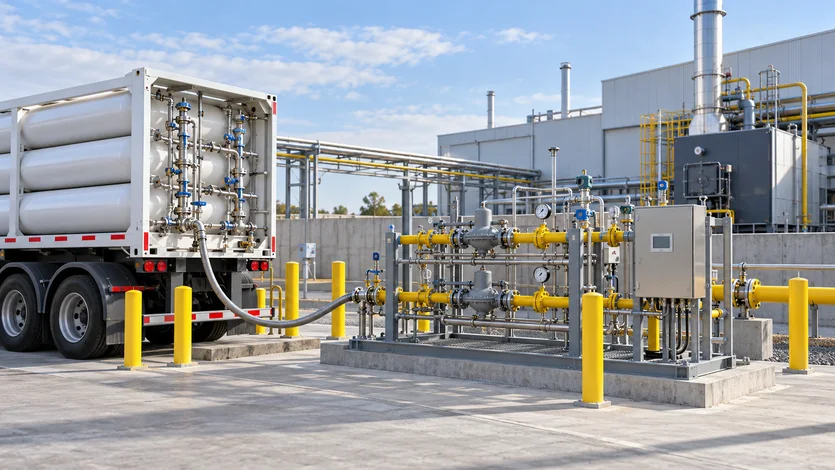
Which equipment belongs in the receiving package?
| Function | Questions for the scope |
|---|---|
| Trailer interface | What vessel and connector types are accepted? Is one or more trailer position required? |
| Isolation and ESD | Where are manual and automatic valves, emergency stops and shutdown boundaries? |
| Gas conditioning | What filtration, moisture control or gas analysis is needed for the agreed gas quality? |
| Temperature control | Is heating required at the worst credible pressure drop and weather condition? |
| Pressure reduction | How many stages and parallel runs are needed? What is the minimum inlet pressure for rated flow? |
| Protection | How are downstream overpressure and underpressure addressed? Where is venting routed? |
| Metering | What quantity, accuracy class, correction basis and data interface are required? |
| Utilities and controls | What electrical supply, hazardous-area classification, communications and alarms apply? |
This is a procurement checklist, not a universal configuration. A vendor should provide a P&ID and a clear list of inclusions and exclusions before final technical acceptance.
Sizing the logistics and the skid together
An industrial project often fails at the interface between transport and process design. Start with the plant’s hourly load profile, not simply an annual gas figure. Record minimum, normal and peak flow, ramp rate, daily operating hours, planned shutdowns and future expansion. Then confirm the gas source’s delivery specification and the plant’s pressure and temperature requirements.
Next, calculate how many trailer deliveries are needed per day from the usable delivered gas per trailer, stated on an agreed reference basis. Allow for loading, travel, unloading, queueing, return and maintenance. A site that uses exactly one nominal trailer payload every 24 hours may still need a second trailer or reserve arrangement because dispatch and consumption are not perfectly synchronized.
Finally, verify skid flow at the lowest realistic trailer pressure. A pressure-reduction skid that works well when a fresh trailer arrives may no longer deliver peak flow near the end of withdrawal. Suppliers should state performance across the full inlet-pressure range and identify residual gas that cannot be delivered without additional equipment.
Illustrative planning example
Assumptions only: A plant consumes 3,600 Sm³ per day, with a peak of 300 Sm³/h. For this example, Sm³ means gas volume at 15°C and 101.325 kPa absolute. Assume a trailer can deliver 2,400 Sm³ <i>usable gas</i> under the project’s unloading pressure limit. The simple average is 1.5 trailer loads per day. That implies at least two daily deliveries in normal operation, before any reserve for delays or a demand peak.
Suppose each trailer round trip, including loading and travel, takes ten hours. One trailer cannot reliably make two complete deliveries during the same 24-hour operating cycle if unloading and waiting add significant time, especially when dispatch times must match plant demand. The logistics provider must therefore validate the trailer count and schedule.
The receiving skid must still be checked at 300 Sm³/h peak, at the lowest guaranteed trailer inlet pressure, with the chosen outlet pressure held within the equipment’s permissible range. Dividing daily demand by 24 hours would give 150 Sm³/h, which would understate this example’s peak requirement by half. None of these illustrative figures is an HMZ project specification or performance claim.
Continuity and safety: questions before purchase
For a plant that cannot tolerate fuel interruption, ask how supply is maintained during trailer changeover. Options may include two unloading positions, a standby trailer, buffer storage, an alternate fuel or a planned operating window. Each has different cost and site implications. Define the required autonomy in hours at normal and peak load, then test it against realistic delivery delays.
Also define what happens during a regulator fault, heater failure, loss of power, gas leak alarm or excessive downstream pressure. Safety devices and shutdown logic must follow the local authority’s requirements and the plant’s hazard assessment. Do not treat a conceptual sketch as a code-approved design.
The commercial contract should separate gas supply responsibilities from equipment supply. Who owns the trailer? Who maintains the receiving skid? Who checks gas quality, calibrates the meter and accepts the transferred quantity? What happens if a trailer arrives at a different pressure, temperature or composition than expected? These questions affect both plant uptime and billing.
CNG virtual pipeline versus a physical gas pipeline
A physical pipeline can provide continuous supply where a connection is feasible, but it may require substantial routing, permissions and construction time. A CNG virtual pipeline can reach a site without that connection and can sometimes support phased demand. It also introduces transport, road access and trailer scheduling costs and risks. There is no reliable blanket claim that one is cheaper. Compare the delivered cost of gas, capital work, equipment maintenance, operating labor, project duration and the value of supply continuity over the expected project life.
FAQ
Is an industrial CNG receiving skid the same as a vehicle fueling station?
No. Industrial receiving equipment reduces and meters gas for plant users. Vehicle stations compress, store and dispense gas into vehicle tanks. Trailer receipt may be common to both, but the downstream service differs.
Does every pressure reduction skid need a heater?
No. Heating is decided from the actual pressure drop, gas quality, inlet temperature, required outlet temperature and ambient conditions. Ask the supplier to show its thermal basis.
Can a trailer supply the full amount of gas it carries?
Not necessarily. The usable quantity depends on the pressure at which unloading must stop and whether any booster or cascade arrangement is provided. State the usable quantity basis in the contract.
What flow unit should be used in a request for quotation?
Use a standard-volume or mass-flow unit with its reference temperature and absolute pressure clearly stated. Include minimum, normal and peak demand and the gas composition. Avoid a bare “m³/h” figure.
What information is needed for a preliminary concept?
Provide the site location, gas composition and quality, daily and hourly demand, trailer design and delivery schedule, inlet-pressure range, downstream pressure requirement, ambient temperature, utilities and required supply autonomy.
Discuss your industrial gas supply concept
If your plant is considering delivered CNG, share the demand profile, gas source and trailer data, site conditions and required outlet pressure. HMZ can review the preliminary equipment scope and identify the information needed for a tailored technical and commercial proposal. Final sizing and protection arrangements require project-specific engineering.
Related HMZ solution
Explore the industrial CNG pressure reduction and metering skid for a project-specific supply concept.
Technical sources
- U.S. Department of Energy, “LNG Trades & Markets,” section on virtual pipelines and stranded gas: https://www.energy.gov/hgeo/articles/lng-trades-markets
- PFC, “Virtual Pipeline – Transport of CNG with MEGC,” manufacturer description of CNG road transport: https://pfc.hr/virtual-pipeline-transport-of-cng-with-megc/
- Emerson, “Basics of Pressure Regulation,” regulator function and limits: https://www.emerson.com/is/content/emerson/en/final-control/flow-controls/documents/debul2008x012.pdf
- Emerson, “Cold Temperature Considerations,” effects of pressure reduction and gas temperature: https://www.emerson.com/documents/automation/cold-temperature-considerations-en-11751644.pdf
- Emerson, “Pressure Regulators in Gas-Fired Power Plant Feed Applications,” reliability and protective arrangement examples: https://www.emerson.com/is/content/emerson/en/final-control/isolation-valves/documents/white-papers-pressure-regulators-in-gas-fired-power-plant-feed-applications-fisher.pdf
