
Direct answer: An industrial CNG meter may report the gas volume passing through it at the pressure and temperature in the pipe. That is operating, flowing, or actual volume. A standard or base volume expresses the same gas quantity at an agreed reference pressure and temperature. The two figures are not interchangeable. Before comparing meter readings, sizing equipment, or agreeing a commercial quantity, specify the reference conditions, whether pressure is absolute or gauge, the gas-property method, and which party owns each measurement point.

Why the distinction matters
Gas expands when pressure falls and contracts when pressure rises. Temperature and real-gas behavior also change its volume. A cubic metre inside a pressurized industrial line therefore represents a different quantity of gas from a cubic metre at near-atmospheric reference conditions. Emerson’s Rosemount 8600 reference manual explicitly distinguishes actual volume at operating conditions from standard or normal volume and notes the strong dependence of gas volume on pressure and temperature.
For a plant, the distinction affects three different decisions. First, the meter body and line must handle the actual flow range at the meter’s operating pressure and temperature. Second, a production report may compare base volume over shifts or months. Third, a purchase or supply agreement may require its own defined quantity, potentially volume, mass, or energy. A readable number in “m³/h” is incomplete without the basis and time period.
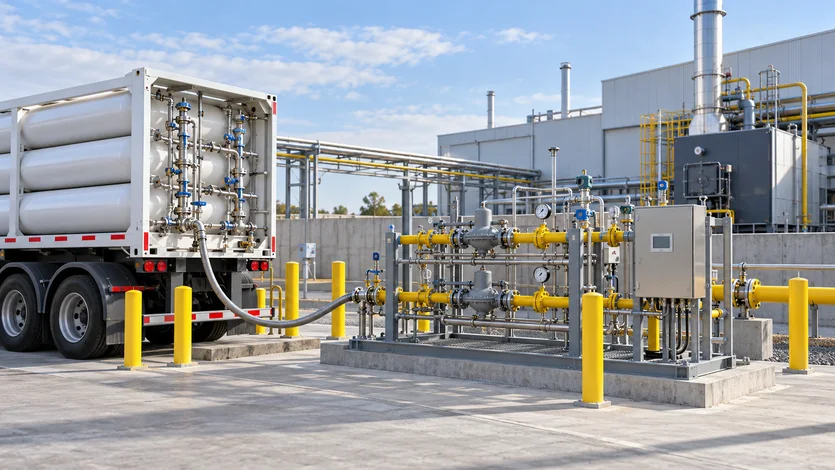
This article concerns an industrial user’s receiving or process metering point, often associated with a pressure-regulating and metering skid. It does not assume the same duty as a CNG daughter station or a vehicle-fuelling dispenser. Those applications have different boundaries, operating cycles, and transaction requirements.
Operating volume, base volume, and energy
Operating volume is the volume at the meter’s flowing pressure and temperature. The meter may directly sense this volume, or derive it from velocity and pipe area. Label it, for example, “actual m³/h at 5 bar(a) and 20 °C” rather than merely “m³/h.”
Base volume is the volume that the same amount of gas would occupy at defined base conditions. The reference must name both temperature and absolute pressure. Different contracts and regional conventions can use different bases. “Sm³,” “Nm³,” and “SCF” are not self-defining unless their reference temperature, pressure, and any composition or dryness basis are written down. Emerson’s vortex manual gives examples of differing standard and normal conventions; it is therefore unsafe to infer a universal basis from the abbreviation alone.
Energy is a separate measure. Two gas streams can have the same base volume and different energy content if their composition differs. Where billing, combustion control, or emissions reporting uses energy, agree the heating-value basis and gas-quality source as well as the volume basis. Emerson’s DeltaV metering paper shows that a flow computation may use gas composition, base and flowing density, compressibility, and heating value as separate inputs or outputs.
A practical conversion model
For the same dry gas quantity, a simplified real-gas relationship is:
Base volume = flowing volume × (flowing absolute pressure ÷ base absolute pressure) × (base absolute temperature ÷ flowing absolute temperature) × (base compressibility factor ÷ flowing compressibility factor).
Here pressure is absolute (bar(a) or kPa(a)); temperature is absolute (kelvin); and the compressibility factors, Z, correspond to the respective conditions and gas composition. Emerson’s April 2025 Rosemount 3410 operations manual presents this same pressure, temperature, and Z relationship for base-condition volume flow. A commercial flow computer or electronic volume corrector must implement the agreed method and use valid live or contractually permitted fixed inputs. The formula is a specification aid, not a substitute for a detailed metering calculation.
Worked example with explicit assumptions
Assume a meter reports 100 actual m³/h at 5.000 bar(a) and 20 °C (293.15 K). The agreed illustrative base is 1.01325 bar(a) and 15 °C (288.15 K). Assume Z at both conditions = 1.000 solely to show the pressure and temperature effect. The calculated base flow is approximately 485 standard m³/h at 15 °C and 1.01325 bar(a).
This does not mean the meter has created gas, and it is not a billing value. It is the same gas expressed at a different reference state. Actual natural-gas Z values need appropriate determination for the selected gas and conditions. If the plant gauge reads 4.0 bar(g), do not insert “4.0” as the flowing absolute pressure; approximately 1.0 bar of atmospheric pressure would first be added for a rough illustration, and the actual atmospheric value and instrument arrangement would need confirmation.
Decide the purpose before choosing a meter
| Purpose | Quantity to agree | Key design questions |
|---|---|---|
| Process monitoring | Actual flow, base flow, mass flow, or a combination | What does the control system require, and what is the lowest stable flow? |
| Internal allocation | Agreed base volume or energy over a reporting interval | Which users and branches are included, and how are discrepancies reconciled? |
| Supplier/customer transfer | Contract quantity and uncertainty target | Where is the transfer boundary, who owns calibration, and which rules apply? |
| Equipment sizing | Actual peak and minimum flow at each equipment location | What are the pressure, temperature, turndown, and pressure-drop limits? |
A process meter can be valuable without being suitable for custody transfer. Emerson’s metering systems catalogue separately lists custody and non-custody applications; its custody-transfer guidance notes that gas exchanged between parties requires close attention to measurement accuracy. Procurement teams should state the intended duty rather than request “a high-accuracy CNG flowmeter” without a defined measurement purpose.
Specify the complete measurement chain
Meter and installation
Provide the expected minimum, normal, and peak actual flow at the proposed meter location, together with normal and extreme pressure and temperature. State whether a supplied flow range is at operating or base conditions. Ask the supplier to show the chosen meter’s usable range, required straight runs or flow conditioning, pressure loss, line size, and maintenance access. Filters, elbows, regulators, and pulsation sources near the meter can change the installation design. Different meter technologies suit different ranges and constraints; a technology label alone is insufficient.
If the receiving pressure changes significantly, the metering location matters. A meter upstream of a regulator sees a different operating volume and perhaps different flow stability from one downstream, even when the mass of gas delivered is the same. A pressure-regulating skid design must therefore locate the meter, sensor taps, shutoff devices, and custody boundary explicitly on the process drawing.
Pressure and temperature inputs
Ask whether the pressure transmitter reads gauge or absolute pressure and how atmospheric pressure is handled in the calculation. Specify pressure and temperature measurement locations so they represent the gas at the meter. Include instrument ranges, accuracy, calibration access, failure alarms, and behavior when a sensor reading is missing or out of range. Emerson’s Rosemount 3410 manual describes base-flow calculation as dependent on pressure, temperature, and compressibility inputs; a displayed base quantity without those valid inputs warrants investigation.
Gas properties and volume correction
Ask what gas-composition data the correction method uses and how often it is updated. Is it a fixed analysis, periodic laboratory result, or online analyzer? What happens when composition changes or data is stale? The required answer depends on the commercial purpose and expected variability. A fixed assumption may be adequate for some internal trending duties but should be explicitly evaluated before any contractual use. Document the algorithm and version, base conditions, Z method, data sources, rounding, and treatment of reverse flow. Keep raw actual volume and corrected base volume identifiable in records.
Records and acceptance
Define the reporting interval and time zone, totalizers, event log, alarm history, data export format, and who may alter configuration. For a transfer point, ask for a documented uncertainty budget and a calibration and verification plan appropriate to the agreement. Factory configuration alone does not prove installed performance. The receiving team should compare instrument tags, configured units, base conditions, calibration certificates where applicable, and actual display values during commissioning.
Common errors to catch before purchase
- Comparing unlike volume bases. A supplier quote in base m³/h cannot be compared directly with a meter’s actual m³/h range.
- Using gauge pressure in an absolute-pressure equation. The resulting corrected volume can be materially wrong.
- Leaving “standard” undefined. Write the numerical base temperature and absolute pressure in the RFQ and in the commercial agreement.
- Assuming a meter alone performs all correction. Verify whether the meter, separate corrector, or control system owns the calculation.
- Ignoring low-flow periods. An industrial process with intermittent demand may spend substantial time near a meter’s minimum flow.
- Treating volume as energy. If the business decision uses heat input, include gas quality and the agreed heating-value basis.
- Moving the measurement boundary in drawings. A regulator, vent, bypass, or branch between the legal boundary and meter can undermine reconciliation.
RFQ information an industrial buyer should send
A useful RFQ includes a simple process drawing with the intended inlet, regulator, meter, outlet, bypasses, branches, and transaction boundary. Attach a flow table covering minimum, normal, and peak demand; state whether each value is actual or at a named base. Give pressure as bar(g) or bar(a), never unqualified “bar”; include normal and design ranges and gas temperature. State expected gas composition or available analysis, moisture and contaminant information if known, required reporting units and interval, power and communications, hazardous-area constraints, and site maintenance expectations. Finally, state whether the meter is for process indication, internal allocation, or supplier/customer transfer.
Ask bidders to return a measurement philosophy, instrument list, layout, pressure-drop estimate, correction method, required calibration and commissioning steps, and every assumption. This makes different offers comparable and exposes gaps before fabrication.
Frequently asked questions
Is “standard cubic metre” the same as “normal cubic metre”?
Not necessarily. Names and abbreviations are used differently across documents. Ask for the exact reference temperature and absolute pressure, and any gas-quality or dryness basis. Compare quantities only after normalizing them to the same basis.
Should I size the pipe for standard m³/h?
No. Hydraulic sizing and meter operating-range checks require the actual flow at the relevant line pressure and temperature. Base flow helps compare gas quantities across changing conditions, but it is not the physical volume moving through the pressurized pipe at that point.
Can a temperature-only correction be sufficient?
It depends on the range of pressure variation and the intended use. If pressure varies or the quantity is contractual, assess full pressure, temperature, and gas-property compensation against the applicable agreement. Do not assume a fixed pressure is acceptable without documenting the resulting uncertainty.
Is an industrial skid meter the same as a dispenser meter?
No. An industrial receiving skid may meter continuous process supply, often alongside pressure regulation. A vehicle dispenser meters intermittent fuelling transactions. A CNG daughter station involves its own high-pressure storage and unloading arrangement. Specify each by its actual duty and commercial boundary.
What if two meters disagree?
First align the time interval and units, then compare base conditions, pressure basis, temperature inputs, gas composition, reverse-flow treatment, low-flow cutoff, and calibration records. A difference does not by itself identify which meter is wrong.
Discuss the metering boundary before the hardware
If you are specifying an industrial CNG pressure-regulating and metering package, share your process drawing, flow range, pressure and temperature envelope, desired reporting basis, and the purpose of the measured quantity. Contact HMZ to discuss an equipment enquiry and the assumptions that need to appear in a comparable quotation.
Technical sources
- Emerson, Rosemount 3410 Series Gas Ultrasonics Flow Meters Operations Manual, April 2025, especially §4.5.7 on base-condition volumetric flow.
- Emerson, Rosemount 8600 Series Vortex Flow Meter Reference Manual, May 2019, operating versus standard or normal gas volume.
- Emerson, Energy and Flow Metering in the DeltaV System, gas composition, base and flowing conditions, density, and heating value.
- Emerson, Metering Systems, applications and system components.
- Emerson, Custody Transfer and Check Metering, transfer measurement purpose.
Related HMZ CNG solution
Explore the related HMZ CNG product page for a project-specific configuration.
