
Direct answer: Design a logistics fleet CNG station around when trucks actually return, how much fuel each needs, and how quickly they must depart again. Daily consumption alone cannot define compressor output, storage, dispenser count, or yard layout. A useful concept design combines a vehicle-by-vehicle arrival and fuel-demand schedule with a gas supply assessment, a queue target, and a clear choice between time-fill, fast-fill, or a hybrid approach.
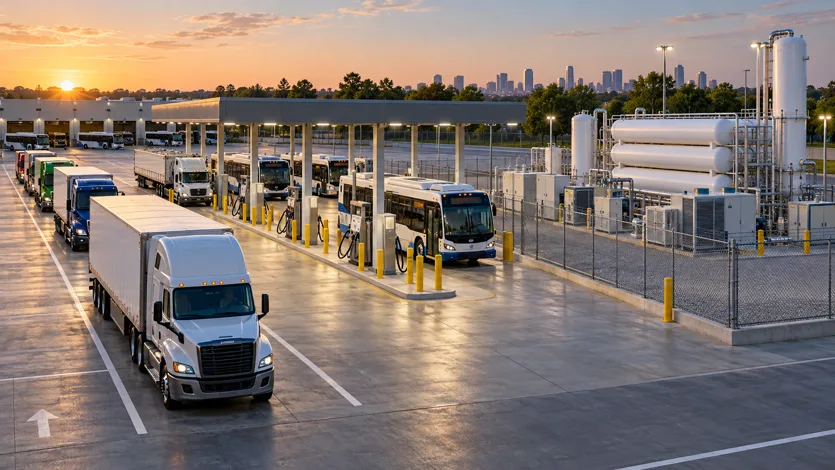
A logistics depot differs from a city-bus yard. Truck arrivals may follow customer loading slots, traffic delays, overnight routes, and weekend surges. Drivers may have little time to park at a fueling position. Some vehicles stay for hours; others leave after a short turnaround. Those operating patterns determine whether slower charging through parking posts, rapid dispensing from high-pressure storage, or both will be practical. The U.S. Department of Energy’s Alternative Fuels Data Center (AFDC) identifies compressor size and storage volume as the principal structural differences among time-fill, fast-fill, and combination CNG stations.
Start with the real dispatch pattern
Build a seven-day timetable, ideally using several representative weeks. For every truck class, record the number of vehicles, return times, next-departure times, typical and high fuel demand, and whether the vehicle can stay connected while parked. Separate scheduled arrivals from a credible peak wave. Note a different schedule for weekends, seasonal freight periods, and disruption days if those materially change the station load.
The peak is often a cluster, not a single hour. A yard might see vehicles returning at 18:00, a second wave after midnight, and early departures beginning at 04:00. A station that meets the 24-hour gas total can still fail if too many trucks need the same dispenser between 18:00 and 20:00. Conversely, designing every compressor for a rare extreme hour may add equipment without solving the real constraint, which could be limited fueling lanes or driver time.
Define a service target: for example, the fraction of vehicles that should complete fueling before a route deadline, the maximum acceptable queue in a normal peak, and how operations continue during a compressor outage. These are project assumptions, not performance promises by a supplier.
Convert operating records into an RFQ table
| Input | Record from the fleet | Why it changes the design |
|---|---|---|
| Truck count by class | Active and planned vehicles | Sets present and expansion demand |
| Fuel per arrival | Typical and high gas quantity per truck, with units | Determines transaction size |
| Return and departure windows | Hourly arrivals and latest departure | Reveals overlapping demand |
| Parking duration | Hours available at a fixed bay | Indicates time-fill suitability |
| Routes and exceptions | Long-haul, local delivery, weekend and delayed returns | Defines credible peak cases |
| Fueling labor | Driver-operated or attended process | Influences lane cycle time |
| Site constraints | Vehicle dimensions, turning paths, queuing area | Limits usable dispensers and positions |
If demand is recorded as standard cubic metres, state the reference temperature and absolute pressure, such as 15 °C and 101.325 kPa(a). If it is recorded as kilograms or gasoline-gallon equivalents, identify that basis too. Do not silently mix standard gas flow with actual flow at a compressor inlet. Supply pressure should be marked bar(g) or bar(a), and the station supplier should use the same basis throughout the calculation.
Choose the fill method by dwell time
Time-fill for predictable, long parking
A time-fill station generally sends compressed gas directly toward vehicles over a longer parking period, with limited buffer storage. AFDC describes it as especially suitable for centrally parked fleets with large tanks and overnight dwell. A logistics operation can use it where trucks return predictably, stay at assigned bays, and are unlikely to be reassigned before fueling is complete.
The key questions are whether every truck can reach a post, whether hoses and vehicle paths can be managed safely, and whether the available hours cover a late-arriving high-demand truck. A site with many trucks but too few suitable parking positions may not benefit from time-fill even when overnight hours exist on paper.
Fast-fill for short, uncertain turnarounds
Fast-fill uses compressed storage and dispensing arrangements designed to transfer fuel more quickly. It fits a fleet where trucks leave again soon, arrival times vary, or a driver needs to refuel on the way into or out of the yard. Compressor capacity, cascade storage, and dispenser throughput must be assessed together. A fast dispenser cannot maintain its initial rate indefinitely if storage pressure falls and the compressor cannot recover between transactions.
Rapid filling also warms the gas in the vehicle tank. AFDC explains that fill rate and temperature affect the final amount stored in a tank. Therefore, an RFQ should state the desired delivered fuel quantity and turnaround target under an agreed ambient-temperature range, rather than claiming a universal number of minutes per truck. Vehicle tank rating and dispenser control strategy must also be compatible.
Combination fill for a mixed fleet
A combination system can use time-fill posts for vehicles parked overnight and a fast-fill lane for short-stay trucks or exceptions. AFDC notes that combination stations may route fast-fill demand through storage while overnight vehicles use compressor supply. A hybrid arrangement can reduce the peak imposed by routine vehicles, but it requires the controls and compressor allocation to be designed for simultaneous loads. Simply adding posts to a fast-fill design does not guarantee both services at once.
Size for the peak sequence, not one headline number
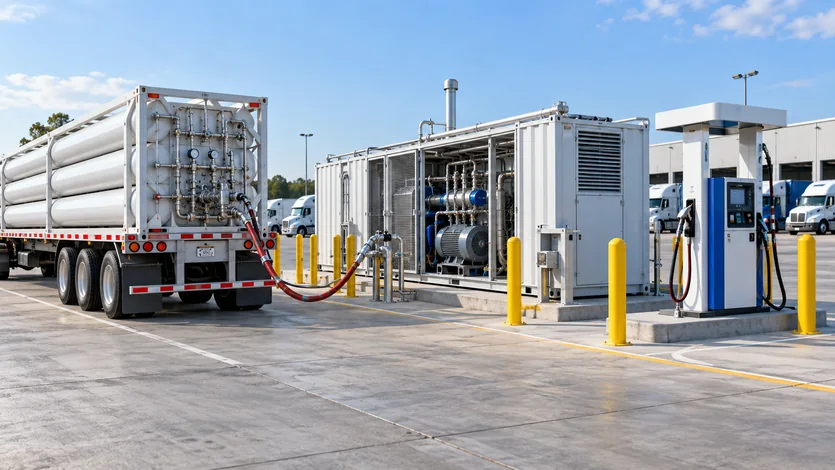
A concept study should model three linked quantities: total fuel needed over the day, fuel needed within each dispatch window, and the recovery time between windows. The compressor provides continuing gas flow, high-pressure storage bridges short peaks, and dispensers determine how many trucks can fuel concurrently. Increasing any one of these without examining the others can leave the bottleneck intact.
Use a time step that is shorter than a typical truck visit. For each step, list arrivals, starting storage inventory, compressor production, gas dispensed, and ending storage inventory. Run at least a normal busy day, a high-demand day, and a credible equipment-unavailable case. Record the queue and the lowest storage state reached. The supplier can then translate this duty into specific equipment selections and control logic.
Illustrative calculation, not a station specification
Assume a depot has 40 trucks. Twenty trucks return in a two-hour evening wave and each requires 60 kg of CNG, so that wave needs 1,200 kg. The other twenty arrive later with the same assumed demand, giving 2,400 kg/day. The evening average is 600 kg/h, but individual arrival times may cluster more tightly. A compressor capable of 100 kg/h would contribute only 200 kg during those two hours if it runs continuously at that actual duty; the remaining 1,000 kg would have to come from usable storage, a longer fueling window, a different dispatch arrangement, or greater compressor output. That is a simple mass balance, not a recommendation for a 1,000 kg storage bank.
Usable storage is less than nameplate gas inventory because dispensing depends on pressure levels, vehicle conditions, controls, and the final vehicle fill target. The quoted compressor rate also needs its inlet-pressure range and gas composition; capacity can change as supply pressure changes. The example intentionally uses kilograms so it does not imply an unstated standard-volume reference condition.
Confirm gas supply and equipment interfaces
Most CNG stations take lower-pressure gas from a utility connection and compress it on site; AFDC advises working with the utility to check available pressure, flow, gas quality, and moisture. A logistics site without a suitable pipeline might instead consider delivered CNG, but the unloading and replenishment pattern then becomes part of peak planning. Delivered CNG does not remove the need to balance peak dispensing against available gas and storage.
The RFQ should identify normal and minimum inlet pressure, pressure basis, guaranteed flow if known, gas quality, and seasonal changes. Request a supply-side drawing showing the connection point, metering, filtration/drying where needed, compressor suction, storage, dispensers, and isolation points. Ask who provides each item and who verifies the interface. For a delivered-gas arrangement, add trailer access, unloading time, and replacement-trailer logistics. These are fleet fueling questions; an industrial pressure-regulating and metering skid serves a different downstream duty and should not be used as a stand-in for vehicle dispensing.
Design the yard for real trucks
Count physical fueling positions only after checking vehicle geometry and traffic circulation. Long trucks need turning radii, pull-through or reversing rules, safe hose reach, and space for a queue that does not block loading docks or emergency access. Place equipment and maintenance access away from routine truck conflicts. Check site-specific separation, ventilation, electrical classification, fire protection, and permitting with the local authority and qualified project team. Requirements vary by jurisdiction; a generic drawing does not establish compliance.
Operating procedures matter as much as geometry. Decide whether a driver fuels before parking, after loading, or on departure; how a late truck enters the queue; and how breakdown or maintenance reroutes traffic. If one dispenser becomes unavailable during a peak, does the second lane have enough accessible space to maintain service? Put these assumptions in the supplier’s design basis.
Compare proposals on the same basis
Ask each bidder to provide a process flow diagram, equipment list, compressor duty across the stated inlet-pressure range, usable storage assumption, simultaneous dispensing basis, estimated time to complete each modeled peak, utility demand, and staged expansion provisions. Require a written list of exclusions, including civil works, pipeline extension, power upgrades, permits, commissioning, and maintenance support. Compare the modeled service result and scope boundaries before comparing price.
A fleet may deliberately phase its rollout: reserve space and electrical capacity for another compressor or lane, even if the initial equipment serves fewer trucks. The supplier should identify which future additions are genuinely possible without rebuilding the site and which need new foundations or utility capacity.
Frequently asked questions
How many dispensers does a truck fleet need?
There is no reliable answer from fleet size alone. The count depends on arrivals per hour, fuel per transaction, dispenser throughput under the actual storage and compressor arrangement, maneuvering time, and the tolerated queue. Model the busiest realistic window.
Is fast-fill always better for logistics?
No. Fast-fill can serve short or uncertain turnarounds, while time-fill may suit trucks with long, predictable parking. A mixed operation may use both. AFDC describes the choice as application-dependent.
Can storage compensate for a small compressor?
Storage can bridge a finite peak but must be recharged before the next peak. If daily compressor production is below daily fuel demand, or recovery time is too short, more storage alone will not solve the balance.
What if trucks return later than planned?
Test a compressed return window as a sensitivity case. The result may call for additional fast-fill capacity, a revised fueling sequence, longer operating hours, or scheduling changes. Treat the late-return case as an agreed design scenario.
Does a containerized station automatically suit a logistics fleet?
Containerization describes how equipment is packaged; logistics fleet fueling describes the service. A containerized package may be part of a solution, but its compressor, storage, dispenser, access, and gas-supply arrangement must still meet truck operations and local site requirements.
Send an operating schedule, not just a truck count
For a comparable CNG station enquiry, send the truck list, return and departure windows, fuel demand per arrival, site plan, gas supply data, and your acceptable queue or turnaround target. Contact HMZ with these inputs and ask for a design basis that makes all key assumptions visible.
Technical sources
- U.S. Department of Energy, Alternative Fuels Data Center: Compressed Natural Gas Fueling Stations, accessed 2026-10-27. Describes fast-fill, time-fill, and combination systems and their compressor and storage differences.
- U.S. Department of Energy, Alternative Fuels Data Center: Filling CNG Fuel Tanks, accessed 2026-10-27. Explains temperature and fill-rate effects on vehicle tank filling.
- U.S. Department of Energy, Alternative Fuels Data Center: Natural Gas Fueling Stations, accessed 2026-10-27. Discusses utility gas supply, quality, moisture, and station design factors.
- U.S. Department of Energy, Costs Associated With Compressed Natural Gas Vehicle Fueling Infrastructure, 2014. Provides foundational station configuration descriptions; this article does not reuse historical prices.
Related HMZ CNG solution
Explore the related HMZ CNG product page for a project-specific configuration.
