
Direct answer: A containerized CNG daughter station is a packaged equipment approach, not a site-ready permit. Before ordering, confirm a safe trailer delivery and unloading route, vehicle fueling circulation, ground and foundation conditions, electrical capacity, gas and vent interfaces, local approval requirements, and who will install and commission each item. The station layout and duty cycle should be developed together: a package that fits on a drawing may still fail when a full trailer, a queuing vehicle, and maintenance access are shown at the same time.
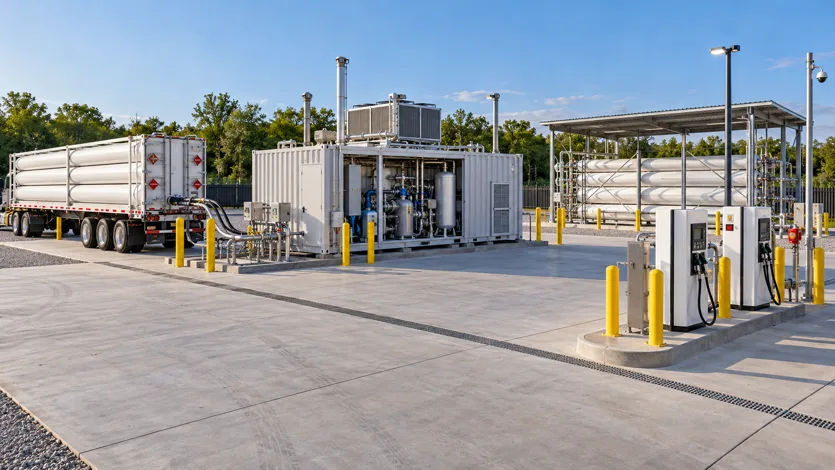
A daughter station normally receives CNG by road trailer rather than relying on a pipeline at the fueling site. Depending on the chosen process, the package may include unloading connections, pressure management, compression or boosting, storage, control equipment, and dispensers. A containerized arrangement can consolidate some equipment and factory work, but civil works, utility upgrades, emergency access, and authority review remain site-specific. The U.S. Department of Energy’s CNG station installation guidance calls for early coordination with the gas utility, site participants, and permitting bodies; its infrastructure cost study also identifies power availability, gas connection location, and site preparation as major installation variables.
Begin with the actual fueling and trailer cycle
A site plan needs more than a desired daily sales or fleet consumption figure. Ask when vehicles arrive, how much fuel they need, and how long they can wait. Then map trailer arrival, parking, unloading, departure, and replacement. If the trailer is the gas source, confirm how long its usable inventory lasts as pressure declines and how a new trailer arrives before the station’s operational reserve is exhausted. A design that assumes uninterrupted gas supply needs an explicit operating method for trailer changeover.
Keep three movements separate on the drawing: fuel-delivery trailers, customer vehicles, and maintenance or emergency access. Their paths may cross on a small site. Test the drawing with the real tractor-trailer length, turning path, gate width, vehicle queues, and any reversing rule. Mark the locations of hoses, barriers, access doors, cable trays, vents, isolation points, and fire-service approach. The equipment footprint alone is not the land requirement.
Site data to collect before requesting a quotation
| Site item | Information to provide | Decision it supports |
|---|---|---|
| Land and boundaries | Dimensioned survey, adjacent uses, existing structures, grade | Equipment position and authority review |
| Access | Gate size, road width, trailer geometry, turning and queuing routes | Delivery and routine trailer exchange |
| Ground | Geotechnical data, flood level, drainage and underground services | Foundation and civil design |
| Climate | Ambient temperature range, wind, rain, dust, corrosion exposure | Enclosure, ventilation and equipment choices |
| Electrical service | Voltage, frequency, available capacity, fault data and distance | Motor start, controls, protection and cable works |
| Operations | Vehicle demand by hour, trailer schedule, staffing | Compressor, storage and dispenser duty |
| Approvals | Local authority, applicable code edition and submission route | Site layout and documentation scope |
State pressure units clearly. Trailer, compressor, and dispenser values should be identified as gauge or absolute, for example bar(g) or bar(a). If gas demand is quoted as standard m³/h, define its reference temperature and absolute pressure, such as 15 °C and 101.325 kPa(a). An “m³/h” figure without the reference basis cannot reliably size a package.
Check where a containerized package can sit
Clearances and hazardous-area review
The project engineer should review applicable national and local rules for CNG vehicle fueling, pressure equipment, electrical equipment, fire access, vents, and neighboring occupancies. The 2024 International Fire Code includes CNG vehicle-fueling provisions and references NFPA 52 in jurisdictions that adopt those documents. This does not make one setback distance universal: legal adoption, edition, occupancy, equipment arrangement, and authority interpretation vary. Ask the local authority and qualified designer to confirm the governing rules before freezing a general arrangement.
A site survey should mark overhead lines, buried utilities, property lines, buildings, drains, entrances, and potential ignition sources. Consider normal ventilation and accidental release paths. Avoid treating the container walls as a substitute for an area-classification study. The enclosure, ventilation openings, gas detectors, shutdown devices, and vent outlets need a coordinated design.
Ground and foundation
A module needs support points and anchors appropriate to its weight, operating loads, wind and seismic design basis where applicable. A trailer unloading bay also needs pavement and drainage suitable for repeated heavy vehicle use. Survey and geotechnical data determine the civil design; the supplier should give support reactions and dimensional drawings early enough for the civil contractor to work from them. Confirm tolerances for level, anchor locations, cable entries, and equipment removal paths.
Flood exposure can change the elevation of electrical and control items. Surface drainage should not direct water toward equipment pits or access points. Before excavating, identify existing utilities. None of these conditions can be confirmed from a standard product picture.
Confirm the electrical supply before choosing equipment
The electrical load depends on the selected process and equipment, especially any compressor or booster, cooling, heating, controls, lighting, and auxiliary systems. A daughter station supplied by road trailer may have a different compressor duty from a pipeline-fed station, and some configurations may not use a booster at all. Ask for a load list showing running, starting, standby, and future loads. Request motor starting method, voltage and frequency, protection requirements, earthing arrangement, emergency-stop interface, and power-quality limits.
Do not assume that an available transformer has enough spare capacity merely because its nameplate rating appears large. The utility or site electrician should verify deliverable capacity, cable route, voltage drop, and fault levels at the proposed connection point. The DOE infrastructure cost study specifically notes that an electrical upgrade may be needed where the site supply is inadequate. Backup power is a separate decision: determine whether it must support safe shutdown, controls and alarms, or actual fueling operation. Those duties have very different capacities.
A simple assumed load check
Suppose a concept package has a 75 kW compressor motor, 8 kW of cooling and ventilation, and 5 kW of controls, lighting and auxiliaries. The arithmetic running total is 88 kW. That figure is only an illustrative connected-load sum; it is not a transformer size or a final electrical design. Motor starting, power factor, diversity, ambient conditions, future expansion, and the utility’s available supply all need checking. The point is to request a supplier load schedule before committing to a site or power connection.
Plan trailer unloading as a routine operation
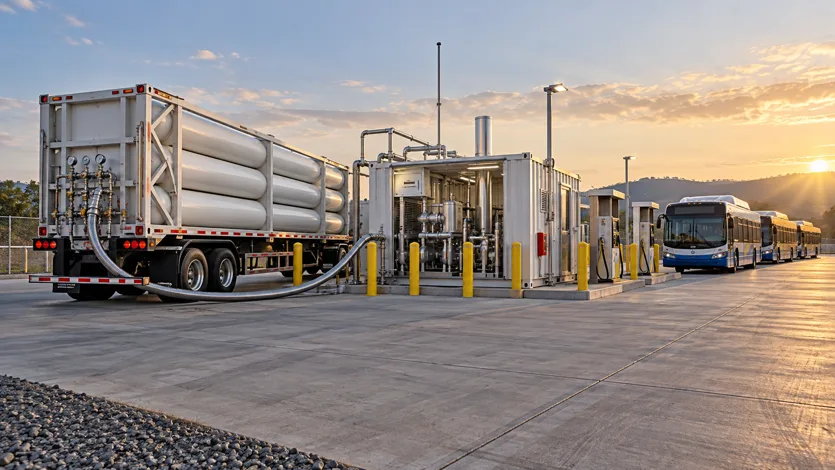
Show the trailer stopping position and whether it remains connected during operation. Define the hose or manifold arrangement, access control, wheel restraints if required by the local procedure, grounding or bonding method where specified, emergency shutdown reach, and how personnel can isolate the system. The trailer supplier and station supplier must agree connection sizes, pressure range, allowable flow, gas quality, and changeover procedure. If multiple trailers are intended, describe whether there is a standby position and how one is switched into service.
A trailer’s declining pressure may affect usable delivery and compressor inlet conditions. The site design therefore needs the minimum expected trailer pressure at the required flow, not merely its initial charge pressure. Storage, compression, or additional trailers may be needed to bridge demand peaks; these are process-sizing questions that should be settled before foundations and electrical works are finalized.
Define the boundaries of supply
The biggest installation disputes often occur at interfaces. Put a responsibility matrix in the RFQ.
| Work item | Common boundary question |
|---|---|
| Package | Which skid or container components are factory assembled and tested? |
| Civil works | Who designs and builds foundations, paving, drainage and barriers? |
| Power | Who supplies transformer, switchgear, cable, trench, earthing and final connection? |
| Trailer interface | Who supplies hose, coupling, manifold, restraints and operating procedure? |
| Dispensers | Are islands, canopies, pipework and communications included? |
| Safety | Who designs site-wide detection, emergency shutdown and fire interfaces? |
| Permits | Who submits drawings, calculations and certificates to the local authority? |
| Commissioning | Who performs pressure tests, instrument checks, trial fueling and training? |
The exact allocation is negotiable. Write it down with battery limits and drawing references. Ask the supplier for packing dimensions and masses, lifting points, shipping split, reassembly steps, and site services needed for commissioning. Containerized equipment may still require external dispensers, storage, or electrical cabinets; “containerized” is a packaging description, not a promise of a single-piece station.
Sequence the project to avoid redesign
A workable sequence starts with site and demand data, followed by a preliminary process concept and site layout. Next, obtain utility and authority feedback, check land and access, and freeze the design basis. Only then finalize equipment selection, civil and electrical details, procurement, delivery, installation, and commissioning. This sequence can run with overlap, but each interface should have an owner and a hold point.
At commissioning, confirm instrument tags and pressure bases, test emergency-stop logic and isolation, verify alarms and communication, inspect grounding and ventilation arrangements, and record trial-fueling results under the agreed operating procedure. An equipment factory test does not replace the site’s integrated checks. Keep as-built drawings, configuration records, operating instructions, and maintenance access information with the handover package.
Frequently asked questions
Does a containerized daughter station need a foundation?
It needs engineered support and anchoring appropriate to its loads and site conditions. Whether that is a slab, individual foundations, or another arrangement depends on the package reactions, ground report, and local design rules. A temporary appearance does not eliminate this check.
How much electrical power should I reserve?
There is no dependable single figure. Request the proposed equipment’s running and starting load schedule, then verify available site capacity and future expansion with the utility or electrical designer. A package without a compressor can differ greatly from one with a substantial booster duty.
Can a station be installed before the trailer supplier is selected?
The concept can progress, but final interface design requires the trailer’s dimensions, connections, pressure range, usable capacity and operating procedure. Otherwise, unloading layout and process performance remain assumptions.
Are permits the equipment supplier’s responsibility?
That depends on the contract and jurisdiction. Assign each drawing, application, test and sign-off explicitly. The local authority determines approval requirements; a vendor’s product information alone does not grant site approval.
Is a daughter station the same as a fleet CNG station?
A daughter station describes a delivered-CNG supply model. A fleet station describes who and how the vehicles are fueled. One site can be both. Industrial CNG pressure-regulating and metering skids serve process gas users and have different downstream boundaries.
Prepare the site brief
For a useful equipment enquiry, send a dimensioned plot, vehicle and trailer movement plan, daily and peak fueling demand, trailer gas data, ambient conditions, available electrical supply, and the local approval route. Contact HMZ with those inputs and ask for a package boundary, preliminary load list, and installation interface matrix.
Technical sources
- U.S. Department of Energy, Planning and Installation Guide: CNG Fueling Stations, accessed 2026-10-27. Site planning and project coordination.
- U.S. Department of Energy, Costs Associated With Compressed Natural Gas Vehicle Fueling Infrastructure, 2014. Site preparation, gas proximity and available power as cost drivers; historical prices are not reused here.
- U.S. Department of Energy, Alternative Fuels Data Center: Compressed Natural Gas Fueling Stations, accessed 2026-10-27. Compressor, storage and dispensing configurations.
- International Code Council, 2024 International Fire Code, Chapter 23, accessed 2026-10-27. Example model-code treatment of vehicle fueling; local adoption must be checked.
Related HMZ CNG solution
Explore the related HMZ CNG product page for a project-specific configuration.
