
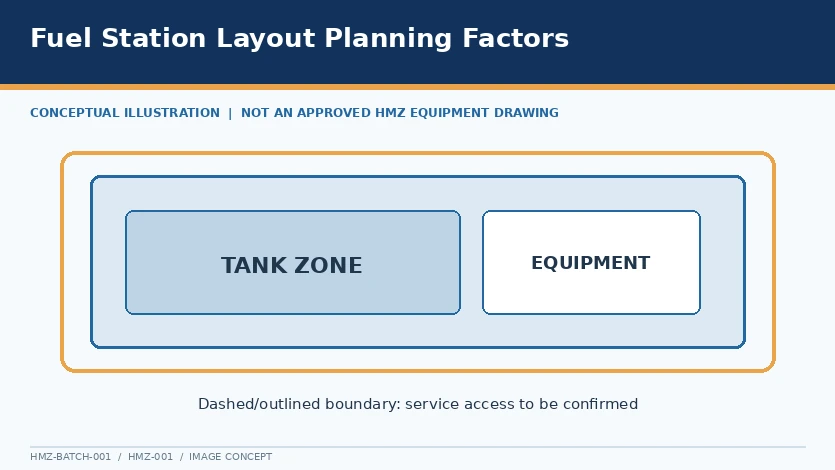
A 40ft container has a longer external envelope than a 20ft container, but that does not establish that a 40ft fuel station holds twice as much fuel. A fuel station is an engineered package: the tank, containment, dispensers, pumps, piping, controls and service access all compete for available space and weight allowance.
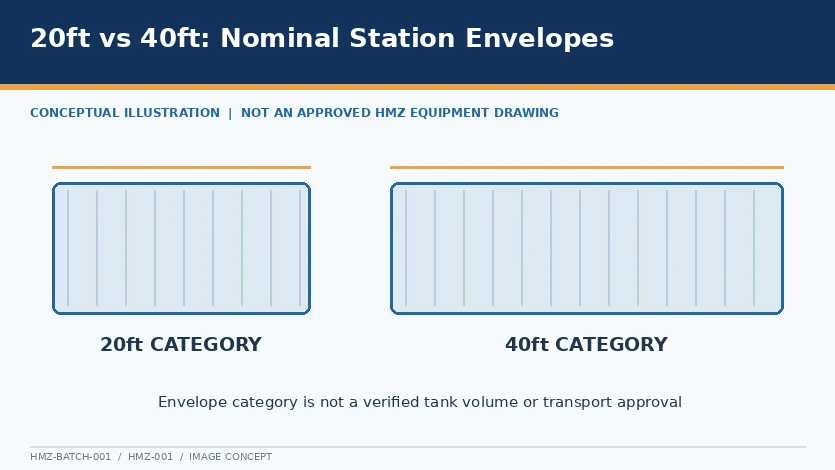
The terms “20ft” and “40ft” may describe nominal container-size categories. They do not, by themselves, confirm the dimensions, certification or transportability of a finished fuel station.
Container dimensions are not fuel capacities
Standard freight containers are commonly described by nominal 20ft and 40ft lengths, with external lengths of approximately 6.06 m and 12.19 m respectively. ISO 668 addresses the classification and dimensions of Series 1 freight containers. These figures should not be copied into a finished fuel-station general arrangement drawing without engineering verification.
Actual tank volume depends on tank shape, equipment clearance, containment arrangements, operating fill limits and structural requirements. Buyers should distinguish nominal tank capacity from usable operating volume. Neither can be reliably calculated from container length alone.
HMZ’s published skid-mounted fuel-station product family describes configurable capacity options in the 10,000–60,000 L range. That is a product-family statement, not a confirmed mapping of 20ft and 40ft packages to particular tank sizes.
Compare the entire shipping and site envelope
| Procurement issue | 20ft category | 40ft category |
|---|---|---|
| Footprint | Shorter nominal length | Longer nominal length |
| Potential equipment arrangement | More constrained layout | More room for alternative layouts |
| Fuel capacity | Must be verified from drawings | Must be verified from drawings |
| Lifting and transport | Requires actual mass and lifting plan | Requires actual mass and lifting plan |
| Site access | Check delivery vehicle, crane and operating clearance | Check delivery vehicle, crane and operating clearance |
Do not assume a skid is an ISO freight container or has CSC approval merely because it has a container-like enclosure. Confirm lifting points, empty and operating masses, transport condition and applicable dangerous-goods requirements. Shipping with fuel inside cannot be presumed permissible.
How should a mining or fleet buyer choose?
Start with daily fuel consumption, delivery frequency, reserve requirements and the number of vehicles needing simultaneous refueling. Then check whether the site can accommodate the unit, delivery equipment and safe operating clearances. A compact station with an appropriate resupply schedule may be preferable to a larger station that is difficult to transport or service.
FAQ
Does a 40ft fuel station always have twice the capacity of a 20ft unit? No. Usable capacity depends on the engineered tank and system layout, not just nominal container length.
Can the station be shipped with fuel inside? Do not assume so. The transport state and applicable carrier and dangerous-goods rules must be confirmed for the specific shipment.
What is the difference between nominal and usable capacity? Nominal capacity describes a designated tank volume; usable operating volume accounts for applicable fill and operating limitations.
Which size is better for a mining fleet? The appropriate option depends on consumption, refueling peaks, replenishment intervals, road access and site restrictions.
Request a project-specific layout
Review HMZ’s configurable skid-mounted fuel station and send your destination country, fuel type, daily consumption, replenishment interval, preferred footprint, number of nozzles and site access constraints. Ask for a project-specific GA drawing, nominal and usable volume, dimensions, masses and defined supply scope before comparing quotations.
