
There is no meaningful single price for every aviation fuel skid. A tank-and-transfer package and a system intended for a more demanding aviation fueling duty can require very different equipment, documentation and quality controls. Buyers should compare the functional scope, not just the quoted equipment total.
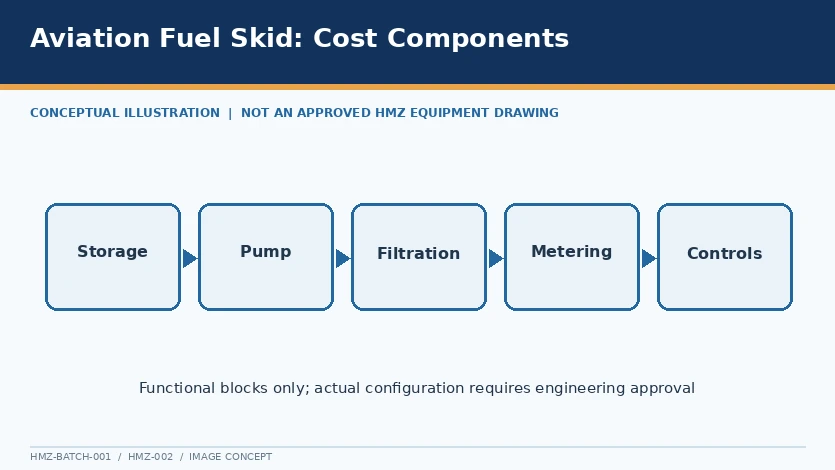
HMZ’s published aviation fuel skid page describes configurable arrangements involving tanks, pumps, filtration or water separation, metering, hoses and controls. Whether a proposed configuration is suitable for a specific aircraft-refueling duty requires separate engineering and operational verification; a marketing description alone is not evidence of that capability.
Main cost drivers
Tank and containment. Capacity, material, internal design, corrosion protection, secondary containment and inspection requirements influence fabrication cost. Clarify whether the quote covers a storage tank, a transfer skid or a combined arrangement.
Pumping duty. Required flow, discharge pressure, suction conditions, duty/standby arrangements and fuel compatibility determine pump selection and controls. A second pump may change the package scope materially.
Filtration and fuel quality. Aviation applications may require specialized filtration, sampling, water detection and documented quality procedures. Specify the fuel grade and the exact filter model and qualification evidence. A filter description such as “aviation grade” is not sufficient technical evidence.
Metering and control. Flow measurement, instrumentation, electrical protection, shutdown functions, bonding and site integration should be listed explicitly. Buyers should identify which components are included and which are optional.
Documentation, inspection and logistics. Factory inspections, test records, drawings, packing, freight, customs, installation and commissioning can change the landed and installed project cost. Ask whether the quoted basis is EXW, FOB, CIF or another agreed Incoterms rule, and check what that rule does and does not cover.
How standards should be interpreted
ASTM D1655 is a specification for aviation turbine fuels. EI 1581 addresses specifications and laboratory qualification procedures for aviation fuel filter/water separators. Neither is a blanket certification of an entire skid. Any compliance statement must identify the relevant component, applicable edition, evidence and project conditions.
Compare quotations on equal terms
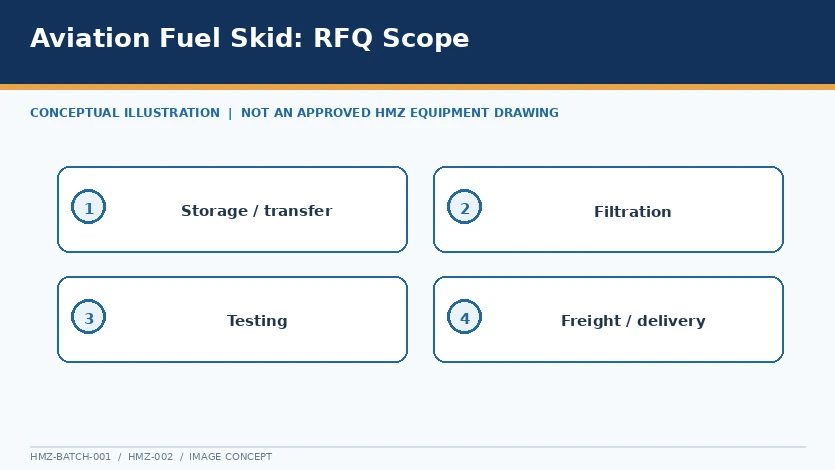
Ask each supplier to separate the tank, pump set, filtration, meter, controls, safety equipment, hoses, testing, documentation, packing, freight and commissioning. A lower initial price may simply exclude equipment or services needed at the destination.
FAQ
How much does an aviation fuel skid cost? It depends on the confirmed design and supply scope. Request a project-specific quotation rather than relying on a generic price.
Why can filtration affect price significantly? Different fuel-handling duties require different filtration and verification arrangements. Compare exact models and documented qualifications.
Does a quoted skid automatically include commissioning? No. Installation, site testing, operator training and commissioning must be explicitly listed if required.
Does ASTM D1655 mean the skid is certified? No. ASTM D1655 concerns aviation turbine fuel specification, not certification of a complete skid.
Request a scope-based quotation
See HMZ’s aviation fuel skid product overview. For a preliminary technical discussion, provide the fuel grade, intended operation (storage, transfer or proposed aircraft fueling), tank volume, flow and pressure, filtration and sampling requirements, site classification, destination, inspection requirements and delivery scope. Suitability for direct aircraft fueling must be assessed separately.
