
Direct answer: A pipeline-fed CNG fleet station takes gas from a utility or private pipeline and normally compresses it on site. A delivered-CNG station receives gas already compressed into transport modules at an upstream loading point and manages trailer unloading, possible boosting, storage and dispensing at the depot. Choose by testing the fleet’s daily and peak fuel demand against pipeline availability and pressure, trailer payload and turnaround, vehicle parking pattern, site access, operating continuity and the full cost of each supply chain. Neither model is inherently best for every depot.
This is a decision about gas supply, not a choice between mutually exclusive fast-fill and time-fill technology. Either supply model can be engineered around vehicle arrivals and station equipment, subject to its pressure and capacity limits. A containerized station is a packaging approach, not a third gas source. The outlet here is vehicle fueling; a trailer-fed industrial pressure regulation skid for boilers is a different end use.
How the two supply paths work
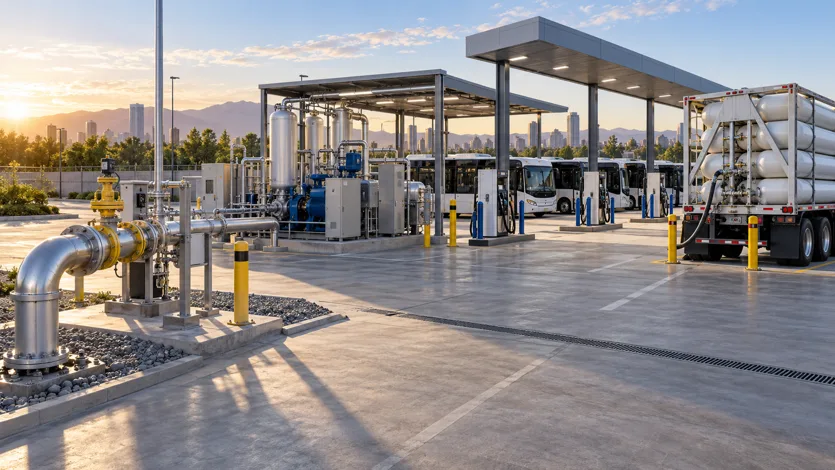
For a pipeline-fed depot, gas enters at an agreed service connection and pressure. The station conditions and compresses it, then may feed time-fill posts, high-pressure storage or fast-fill dispensers. The utility connection’s delivered pressure and available hourly flow are part of the station design basis. DOE’s Alternative Fuels Data Center describes a time-fill example in which utility gas enters at relatively low pressure before on-site compression, and it distinguishes time-fill from fast-fill equipment arrangements.
For delivered CNG, gas is compressed at a mother station or other approved source, loaded into tube trailers or gas transport modules, driven to the depot and connected to a daughter receiving system. Depending on the design, gas may be transferred directly at high trailer pressure for part of the cycle and boosted later. The station still needs appropriate vehicle-fueling controls and dispensers. A DOE Clean Cities briefing identifies transport modules and mother–daughter arrangements as a way to serve CNG stations without a pipeline connection.
The practical difference is continuity. A pipeline is a fixed feed whose capacity and availability depend on its operator. Delivered CNG adds dispatch, traffic, loading, trailer maintenance and changeover. But it may reach a fleet site where no suitable pipeline is available or where extending one would be difficult. Both options need a credible backup or interruption plan for fleets that cannot miss service.
Begin with the fleet’s fuel schedule
List vehicles by type, daily distance or fuel use, parking location and return time. Record minimum, normal and peak demand in a consistent unit. If a proposal uses Sm³, state the reference temperature and absolute pressure; if it uses GGE or mass, define the conversion and gas-energy basis. In the example below, one Sm³ means gas volume at 15°C and 101.325 kPa absolute. Do not compare an unspecified “standard” cubic metre with another vendor’s different reference basis.
Daily volume alone does not set station capacity. A bus depot may have a predictable overnight parking window; a logistics fleet may return in waves and require quick fills before departure. Estimate the largest credible overlapping refueling demand and the hours available to replenish any storage. Check whether routes and vehicle tanks allow an incomplete fill, or whether a full target fill before a fixed departure is essential.
Fueling temperature affects the amount placed in a vehicle tank. AFDC explains that gas heats during fast filling and that dispensers may compensate. A supply model that nominally delivers enough gas per day may still fail the fleet if it cannot complete fills within the operating window. Ask for a vehicle-by-vehicle fueling simulation when schedules are tight.
Test the pipeline option
Obtain a written utility or pipeline statement of connection point, minimum and maximum service pressure, maximum hourly and daily deliverable flow, gas quality and expected outage conditions. Mark pressure values as barg/psig (gauge) or bara/psia (absolute). A compressor selected at the nominal line pressure may move less gas when suction pressure falls; request performance at the guaranteed minimum service condition.
A pipeline can simplify fuel logistics but can introduce connection works, easements, meters, pressure regulation, service fees and a construction schedule. Ask who pays for the extension and who owns it afterward. At some sites, the utility may provide sufficient volume but at a pressure that changes the compressor power or equipment choice. At others, the nearest pipe is not a usable high-capacity service. A map showing a line near the depot does not establish connectability.
Define outage tolerance. If the utility can interrupt service or if site compression is a single point of failure, the fleet may need redundant compression, stored gas, an alternate fuel arrangement or a contingency station. The best solution depends on how many vehicles must leave on schedule and how quickly maintenance can be completed.
Test the delivered-CNG option
Ask the gas supplier for usable delivered quantity per trailer at the planned unloading cutoff, not only the amount loaded at the mother station. As trailer pressure falls, its ability to feed the station changes. A daughter design may use a booster to recover more gas or maintain fueling, but the supplier must show compressor capacity at the low suction end of the cycle. The trailer vessel rating alone does not tell you the inlet pressure at the station after hose and valve losses.
A delivered-CNG model also needs a route plan. Document distance, driving and loading times, unloading duration, available trailer fleet, delivery windows and local restrictions. Consider a late truck, an unavailable loading bay and a trailer under maintenance. If a depot consumes nearly one usable trailer load per day, exactly one daily delivery leaves little room for delays. The operator should state a reserve policy in gas volume or hours of fleet operation.
Site layout can decide feasibility before equipment is priced. A loaded trailer needs turning space, a safe parking and unloading position, a compatible connection, protection from vehicle movements and a workable changeover procedure. A compact containerized process unit cannot make a trailer fit on a constrained depot. The battery limit should name who supplies unloading hoses, paving, power, fencing, fire interfaces and permits.
Compare the two on one basis
| Decision item | Pipeline-fed CNG | Trailer-delivered CNG | Data to request |
|---|---|---|---|
| Source | Utility or private pipeline | Remote compression and loading point | Guaranteed quality, pressure and capacity |
| On-site process | Usually compression from line pressure | Receiving, transfer and possibly boosting | Performance at limiting inlet conditions |
| Fuel logistics | Fixed connection | Trailer fleet and dispatch | Outage or delivery-delay plan |
| Site works | Service connection and piping | Trailer apron and unloading interface | Layout, route and permits |
| Expansion | Subject to service and compressor capacity | Subject to trailers, loading and station capacity | Future peak-demand scenario |
| Commercial basis | Connection charges, tariff and station operation | Gas purchase, loading, transport and station operation | Same energy basis and evaluation period |
| Continuity | Utility plus on-site equipment reliability | Dispatch plus on-site equipment reliability | Required reserve hours |
No row proves one model cheaper. Compare delivered energy cost at the vehicle, including gas, compression, transport, trailer ownership or rental, equipment maintenance, electricity, site works and losses. Avoid quoting a universal price or assuming that a low initial equipment price means a low life-cycle cost.
Illustrative planning example
Assumptions only, not an HMZ project or quotation: A depot uses 2,400 Sm³ per day, where Sm³ refers to 15°C and 101.325 kPa absolute. The fleet consumes 1,200 Sm³ during a four-hour evening return period and the rest over the following 20 hours. The evening average is 300 Sm³/h, while the 24-hour average is 100 Sm³/h. A design based only on daily average would miss this demand concentration.
For the pipeline route, assume the utility has not yet confirmed a minimum pressure or peak hourly quantity. The project cannot select compressor capacity from an informal statement that “gas is available.” Request a written service envelope and price for the intended connection. The compressor must be evaluated at the minimum guaranteed gauge or absolute inlet pressure stated by the utility, as applicable.
For delivered CNG, suppose each trailer can provide 1,600 Sm³ of usable gas to the daughter site after allowing for the planned changeover limit. The arithmetic demand is 2,400 ÷ 1,600 = 1.5 usable trailer loads per day. That means at least two deliveries on a typical day, before adding a delay reserve. If unloading, loading and round-trip travel consume most of the operating day, the transporter may need multiple trailers and staggered dispatch. The skid still must serve the evening fueling window as trailer pressure declines. These illustrative figures do not specify vehicle-fill rate, storage, compressor size or actual trailer count; those require schedules and vendor data.
Reliability, safety and local approval
Both models use high-pressure vehicle-fueling equipment downstream. The project team must follow the rules applicable at the installation site. AFDC notes that CNG station design and installation are governed by safety requirements, including NFPA 52 in the U.S.; other jurisdictions may impose different or additional requirements. Do not treat a U.S. reference as automatic approval elsewhere.
For pipeline supply, map service interruption, compressor trip, power loss and meter or dryer faults. For delivered CNG, add traffic delay, unavailable trailer, connector leak and failed changeover. Set a measurable continuity target such as the number of fueling hours or vehicle departures that must be protected, then ask each proposer how its design meets it. This turns a vague “reliable station” claim into a reviewable requirement.
Procurement questions to send both teams
- What is the fleet’s daily gas use, peak-hour demand and required refueling window?
- What gas quality and energy basis will the supplier guarantee?
- For a pipeline, what are the minimum and maximum service pressure and guaranteed hourly flow at the connection?
- For delivered CNG, what is the usable gas per trailer at the changeover pressure and how many loaded trailers can be dispatched?
- How will the station operate during a compressor trip, power outage or supply interruption?
- Which party supplies site piping, unloading works, storage, dispensers, electrical services and local approvals?
- What growth case should the first installation reserve for?
Ask bidders to show the same demand scenario, supply boundary, cost basis and project horizon. A comparison is only as sound as its shared assumptions.
Frequently asked questions
Is delivered CNG always a temporary solution?
No. It can be an ongoing supply model where a pipeline connection is unavailable or unattractive, provided logistics, capacity and continuity are viable. Reassess it if fleet demand grows or a suitable pipeline becomes available.
Does pipeline gas eliminate on-site compression?
Usually not for vehicle CNG fueling. Pipeline service pressure is normally below vehicle storage pressure, so a compressor is commonly part of the station. The exact arrangement depends on the confirmed service and vehicle duty.
Does trailer gas eliminate on-site equipment?
No. A daughter station still needs unloading, control, protection and dispensing equipment, and may need boosting or high-pressure storage. Scope varies by design.
Can the same station serve buses and trucks?
Potentially, but only after checking each vehicle’s pressure class, nozzle compatibility, arrival pattern, target fill and lane geometry. The supply model alone does not establish compatibility.
Which number should a buyer verify first?
Verify the fleet’s daily use and peak refueling schedule. Then obtain the pipeline service envelope or delivered-trailer logistics data needed to test that schedule.
Discuss the supply model with HMZ
Share the fleet list, vehicle-fueling window, depot layout, available pipeline information, possible trailer route and continuity target through HMZ’s contact page. Request two comparable concepts where both supply routes are feasible, with explicit performance assumptions, site interfaces and exclusions.
Technical sources
- U.S. DOE Alternative Fuels Data Center, Compressed Natural Gas Fueling Stations: time-fill and fast-fill arrangements.
- U.S. DOE Clean Cities, Status and Issues for Natural Gas in the United States: transport modules and mother–daughter supply.
- U.S. DOE Alternative Fuels Data Center, Natural Gas Distribution: gas supply context.
- U.S. DOE Alternative Fuels Data Center, Filling CNG Fuel Tanks: fueling temperature and completed fills.
- U.S. DOE Alternative Fuels Data Center, Natural Gas Fueling Stations: station safety context.
Related HMZ CNG solution
Explore the related HMZ CNG product page for a project-specific configuration.
