
Direct answer: An industrial CNG pressure regulation and metering skid should be defined by its functions and battery limits. A typical trailer-fed receiving package may include an inlet connection and isolation, filtration, temperature monitoring or heating where required, one or more pressure-reduction stages, independent protection, a meter with pressure and temperature inputs, controls and outlet instrumentation. The exact bill of materials depends on gas quality, flow range, inlet pressure over trailer unloading, outlet requirements, measurement purpose and local rules. Ask for a P&ID and itemized inclusion list before accepting the word “complete.”
This is an industrial gas-supply package delivering gas to a plant header, boiler train or other process user. It is not a vehicle CNG daughter station or fleet dispenser system. A vehicle station ultimately manages high-pressure fills into vehicles. An industrial receiving skid normally reduces trailer-delivered gas to the plant’s required lower pressure and measures delivered quantity; it does not automatically include a compressor or vehicle dispenser.
Draw the boundary from trailer to plant
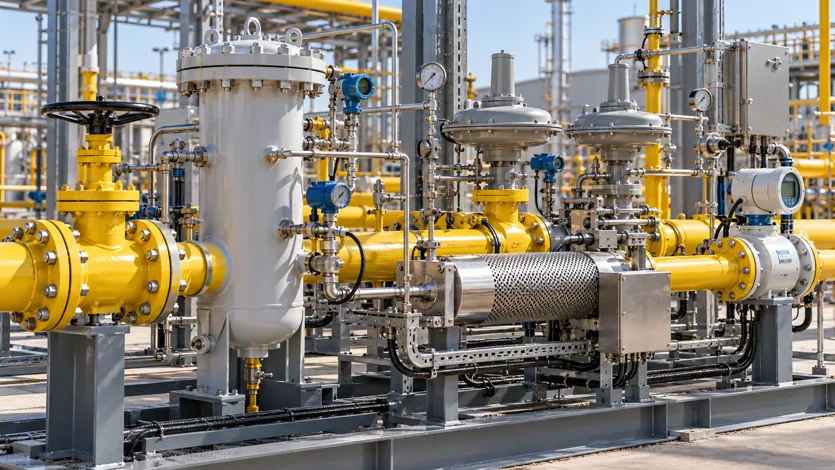
A useful starting sketch shows a trailer connection, manual and automatic isolation as applicable, gas conditioning, heating if needed, pressure control, protection, metering and the outlet to the plant distribution system. The trailer, unloading hose, foundations, electrical feeds, downstream piping and burner equipment may be supplied by different parties. Each interface needs an owner.
Emerson describes customized pressure-reducing skids as assemblies that may combine regulators, valves, meters, filters, slam-shut devices and heaters. That manufacturer description illustrates possible functions, not a mandatory configuration for every site. A buyer should therefore ask what is inside the quoted skid, what arrives loose for field installation and what is excluded.
The supply point matters for performance. A nominal trailer pressure is not the same as pressure at the regulator inlet after losses through hoses, filters and valves. A long discharge hose or a dirty filter can reduce available pressure at high flow. Ask the supplier to state the minimum pressure at the skid inlet and the pressure-drop budget used in the design.
Receiving, isolation and filtration
The receiving interface begins with compatible trailer fittings and a safe connection procedure. Confirm connector standard, hose pressure rating, maximum gas temperature, unloading positions, depressurization arrangement and the responsibilities of the transport operator. If the site needs to change trailers without stopping the plant, one connection point may be inadequate unless another supply path provides continuity.
Inlet isolation should allow normal operation and maintenance; emergency isolation must respond to a defined cause-and-effect plan. A check valve, breakaway device or other protection may be required by the particular arrangement. Do not presume that every possible device belongs in every skid. Ask where isolation occurs relative to the trailer and who controls the shutdown signal.
Filtration protects downstream regulators and meters from particles or liquids within the specified gas quality. Its size should be evaluated at maximum flow and the relevant gas condition. Request clean and dirty differential-pressure assumptions, element replacement access, drains and disposal responsibilities. A “filter included” line tells little about maintenance or pressure drop. If gas quality is uncertain, define the supplier’s assumed contaminant and moisture limits and the party responsible for meeting them.
Heating and temperature management
Pressure reduction can cool natural gas. Depending on inlet temperature, gas composition and pressure drop, cold operation can affect regulators, seals and instrumentation or encourage freezing and condensation. Heating is therefore a calculated decision rather than a standard checkbox. Emerson’s cold-temperature technical guidance explains the issue, while its skid catalog shows heaters as one available component.
Ask for the coldest credible gas and ambient temperatures, the highest pressure drop, expected water and hydrocarbon content, and the minimum acceptable downstream temperature. The vendor should identify where temperature is measured and whether the calculation covers start-up, normal operation and changing trailer pressure. A heater might be upstream of the regulating stages, between stages or elsewhere in a project-specific design.
If a heater is proposed, its supply boundary includes more than the exchanger. Confirm heating medium, utility load, circulation equipment, control valves, temperature alarms, insulation, drainage, failure response and commissioning. If it is omitted, ask for the thermal basis for omission. A generic “degrees per bar” shortcut is insufficient for final selection because real-gas composition and operating conditions matter.
Pressure-reduction stages and control
The regulator train must hold an outlet pressure suitable for the downstream users while flow changes. Obtain minimum, normal and peak flow, the outlet setpoint and allowable pressure variation. Standard volumetric flow must state its reference conditions. For example, a project might define Sm³ at 15°C and 101.325 kPa absolute; that is an example basis, not an inherent meaning of Sm³. Every pressure should be labeled gauge (barg) or absolute (bara).
A single-stage regulator may be suitable for some duties; large reductions, tight outlet control or changing inlet pressure may call for stages, parallel runs or different control devices. Those are engineering options. Ask for regulating-capacity calculations at the lowest guaranteed inlet pressure and peak demand, plus stable control at minimum demand and highest inlet pressure. A regulator’s failed-wide-open flow is not its normal regulating capacity. Emerson’s selection guidance explicitly separates those values.
The outlet-pressure sensing point also matters. If the setpoint is held at the skid flange, pressure may still fall at a distant burner during a peak because the plant pipe loses pressure. Agree on the sensing location and responsibility for downstream pressure loss. For rapid load steps, request the allowed transient deviation and recovery behavior rather than relying on a steady-state curve alone.
Independent protection and venting
Pressure control and overpressure protection are related but distinct. A regulator can fail or leak; the downstream equipment has a maximum allowable pressure. Depending on the hazard assessment and local requirements, protection might include an independent monitor regulator, slam-shut device, relief device or engineered combination. Emerson identifies slam-shut valves that cut gas flow on overpressure or underpressure, and its skid examples include overpressure-protection functions. The chosen arrangement must be sized and approved for the actual site.
Ask bidders to show setpoints, independence, sensing points, reset procedure and consequences of each trip. An underpressure trip can protect certain processes but may also stop production during a trailer changeover. Relief devices need a documented discharge destination and capacity basis. A skid drawing that shows a relief symbol without a safe vent route or design calculation leaves a major site interface unresolved.
Emergency shutdown should also be integrated with plant alarms, gas detection where specified, fire signals and loss of power. Require a cause-and-effect table that states which valves close, what remains energized and what the operator must do to restart. The fact that a component is rated or certified does not by itself establish compliance of the complete assembled installation.
Metering and data
A process meter used to trend fuel consumption and a custody-transfer system used for billing have different requirements. Define the quantity to be reported: flowing volume, standardized volume, mass or energy. Standard-volume reporting needs agreed reference absolute pressure and temperature, gas composition or compressibility method, and measured operating pressure and temperature. Emerson’s gas metering literature describes transmitters, gas analysis and flow computers as parts of a corrected measurement system.
Meter performance must cover minimum continuous, normal and peak flow, not just a maximum label. Ask for the selected meter’s accuracy at the actual operating pressure and temperature, installation straight-run requirements, calibration method, data logging and communications. If gas is billed by energy, specify the heating-value determination and reconciliation procedure. A meter located before a major leak or vent point may not represent gas delivered to the plant; clarify the custody or accounting boundary.
Controls, structure and site interfaces
The skid may need a local panel, pressure and temperature transmitters, alarms, valve actuation and a communication link to plant control. Confirm electrical voltage and frequency, hazardous-area classification, instrument-air needs, network protocol and backup-power policy. The supplier should list factory-tested functions and field tests that require the trailer, plant piping or site utilities to be present.
Mechanical scope includes piping class, valves, frame, lifting points, weather protection, maintenance clearance and transport limits. A compact skid can still require space around filters, heaters and meters for service. Ask for an arrangement drawing showing flow direction, access and removal envelopes. If the project uses a container, ventilation, access, heat rejection and electrical classification must be considered; “containerized” does not erase the site engineering.
The downstream battery limit is usually a named outlet flange or connection. The plant header, burner trains, local shutoff valves and pressure controls may be outside it. Site foundations, unloading apron, electrical trench, vent stack, permits, installation and training can also sit outside the factory price. A good quote labels each item as included, optional or by others.
Package comparison checklist
| Function | Evidence to request | Boundary question |
|---|---|---|
| Trailer interface | Connector and unloading P&ID | Who supplies hose and trailer? |
| Filtration | Gas-quality basis and filter pressure drop | Who replaces elements and handles drains? |
| Temperature management | Cold-case calculation and heater duty if needed | Who supplies heating utility? |
| Pressure control | Capacity at low inlet/peak flow and high inlet/minimum flow | Where is outlet pressure guaranteed? |
| Protection | Setpoints, cause-and-effect and relief or isolation calculations | Who routes vents and connects ESD? |
| Metering | Range, correction basis and calibration scope | Is the meter for process use or billing? |
| Integration | Drawings, FAT plan and field-test list | What site works remain? |
Illustrative scope example
Assumptions only, not an HMZ design or rating: A plant uses 600 Sm³/h normally and 900 Sm³/h for short simultaneous peaks. Here Sm³ means gas volume at 15°C and 101.325 kPa absolute. Suppose the trailer connection can present 200 barg when full, while the minimum guaranteed pressure at the skid inlet before changeover is 25 barg. The plant requires 4 barg at the skid outlet. The gas analysis, minimum ambient temperature and load-step tolerance remain open.
The buyer should require the regulator schedule to show 900 Sm³/h at 25 barg inlet and 4 barg outlet and to check low-flow operation at the highest inlet pressure. The 200 barg case is relevant to component ratings and thermal analysis; it does not prove capacity at 25 barg. The metering proposal should state its minimum reliable flow, which might be far below 600 Sm³/h if the plant cycles down overnight. Heating cannot be accepted or rejected until gas composition and temperature inputs are known.
Offer A might include one regulator run, a process meter and no heater. Offer B might include parallel runs, a billing meter and heating. Neither is inherently the correct “complete skid.” The buyer should first settle required uptime, accounting purpose and cold-weather duty, then ask both suppliers to quote the same base scope with clearly priced options.
Frequently asked questions
Is a heater included in every industrial CNG skid?
No. Its need follows a thermal assessment of gas quality, inlet temperature, pressure reduction and downstream temperature limits. Ask for the calculation either way.
Can the skid raise pressure when a trailer is nearly empty?
A pressure-reduction skid cannot boost pressure. If trailer pressure falls below what the plant needs after losses, a different operating limit or additional equipment is required.
Does one meter measure billable gas automatically?
No. Commercial settlement requires agreed measurement basis, accuracy, calibration, pressure and temperature correction, and often gas-quality data. Define these in the supply contract.
Is a slam-shut valve the only overpressure protection option?
No. Protection architecture is project-specific. Ask the supplier and local engineer to document the selected layers, failure cases and setpoints.
What makes two quotations comparable?
Give both bidders the same gas data, flow range, inlet and outlet pressures, thermal conditions, metering purpose and battery limits. Compare their P&IDs and exclusions before comparing totals.
Request a defined industrial package
Send your gas analysis, trailer unloading plan, minimum/normal/peak flow, inlet-pressure range, outlet-pressure requirement, measurement purpose and site utilities to HMZ. Ask for an itemized skid scope, assumptions and interface drawing so the project team can review the proposal with the local engineer and gas supplier.
Technical sources
- Emerson, Customized Stations and Skids: examples of integrated regulating, protection, heating and metering equipment.
- Emerson, Selecting and Sizing Pressure Reducing Regulators: pressure, flow, regulating capacity and overpressure protection.
- Emerson, Cold Temperature Considerations: gas cooling and temperature management.
- Emerson, Fisher OSE Slam-Shut Valve: overpressure and underpressure isolation function.
- Emerson, Gas Ultrasonic Metering System: corrected gas measurement components.
Related HMZ CNG solution
Explore the related HMZ CNG product page for a project-specific configuration.
