
Direct answer: A trailer-fed CNG daughter station does not see one constant gas pressure. A newly arrived tube trailer can provide much higher pressure than it does near the planned unloading cutoff. The compressor or booster must be selected for the range of suction pressures actually available at its inlet, while meeting the required vehicle-fueling flow and discharge duty. Ask for capacity, power, temperature and operating limits at several inlet points. A headline flow quoted at a favorable pressure cannot establish performance through the whole trailer cycle.
This article addresses a daughter station that receives compressed gas by road and dispenses it into vehicles. It is distinct from a pipeline-fed fleet station, where utility service pressure and line capacity govern the compressor inlet, and from an industrial pressure regulation and metering skid, whose normal duty is to reduce pressure for plant equipment. An industrial regulator skid cannot be assumed to perform the daughter station’s boosting task.
Follow the pressure from vessel to compressor
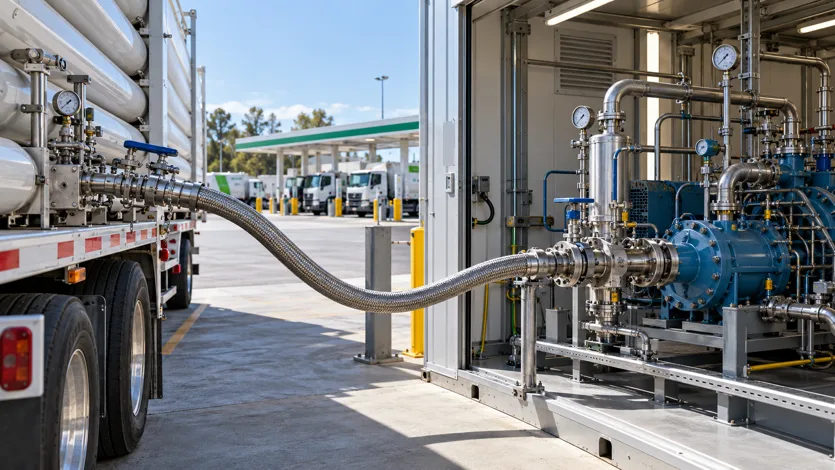
The trailer operator may give a maximum vessel pressure and an expected empty-return pressure. Neither is automatically the compressor suction pressure. Gas passes through hose, couplings, unloading manifold, isolation valves, filters and piping. Each can create a pressure loss that increases with flow or contamination. Request pressure values at a named point, preferably the compressor suction flange, for full, middle and near-changeover conditions.
Label pressure as gauge (barg or psig) or absolute (bara or psia). Compression ratio is discharge absolute pressure divided by suction absolute pressure for the relevant stage; using gauge numbers in that ratio gives the wrong result. For example, a conceptual 6 bara suction and 60 bara discharge give a 10:1 absolute ratio. That arithmetic is a teaching example, not a suitable single-stage design or an HMZ equipment rating. The actual multistage arrangement, temperatures and allowable ratio are the compressor manufacturer’s work.
Ariel, a reciprocating-compressor manufacturer, defines compression ratio using absolute discharge and suction pressure. It also documents performance calculations for flow, power, temperature and rod loads. Those are reasons to request a manufacturer-generated operating map, not to extrapolate a simple rule from two pressures.
Why capacity changes as the trailer empties
As trailer pressure declines, the amount of gas entering a fixed compressor cylinder on each cycle can change. The required pressure increase also changes. A particular machine’s delivered standard-volume flow, shaft power and discharge temperature depend on its stages, speed, clearances, valves, gas composition, cooling and control devices. There is no universal percentage drop per bar of suction-pressure decline.
At a high inlet pressure, a station may be able to transfer gas directly into storage or another path for part of the cycle, depending on the pressure relationship and control design. Later, a booster may be needed to reach the vehicle-fueling storage or dispenser system. The transition needs a documented P&ID and logic. Ask the supplier when each mode starts and stops and whether any interruption or pressure fluctuation occurs during changeover.
At the lowest intended inlet pressure, the compressor may be limited by capacity, discharge temperature, stage ratio, driver power or other mechanical constraints. Ariel’s application documentation identifies suction and discharge conditions, temperature, power and component loading as inputs to performance calculations. A project bid should state which limit governs each operating point and how much usable gas remains in the trailer when operation stops.
Define the right outlet duty
The outlet is not merely “high pressure.” The supplier needs the storage-bank operating range, priority-panel logic, dispenser requirements, vehicle pressure class and expected fill sequence. The U.S. Department of Energy’s Alternative Fuels Data Center explains that station design must match pressure, storage and vehicle types. A compressor delivering enough gas over 24 hours may still fail a concentrated fueling window unless storage bridges the peak.
State minimum, normal and peak demand in an agreed unit. If using Sm³/h, define the reference conditions. In the planning example below, Sm³ means gas volume at 15°C and 101.325 kPa absolute. Another project may use a different base temperature or pressure. Do not compare a “standard cubic metre” capacity against fleet fuel use until the bases and gas composition are aligned.
For fast-fill service, account for vehicles arriving back to back. For time-fill service, account for how many vehicles are connected, when they arrive and how long the compressor has to operate. AFDC distinguishes these arrangements. The compressor’s useful capacity is the one that supports the intended fueling schedule after any storage or direct transfer is considered.
What the vendor performance table should show
| Operating point | Input to specify | Output to request |
|---|---|---|
| Fresh trailer | Highest credible suction pressure, gas temperature and composition | Flow, power, cooling and control mode |
| Mid-cycle trailer | Representative suction pressure and required discharge condition | Flow, power and stage temperatures |
| Planned cutoff | Lowest guaranteed suction pressure at compressor flange | Flow, power, thermal and mechanical limits |
| Peak fueling | Simultaneous demand and storage state | Ability to sustain or recover after peak |
| Low demand | Minimum continuous draw or idle period | Unloading, recycle and start-stop strategy |
| Fault or changeover | Trailer switch, blocked filter or compressor trip | Shutdown sequence and fleet fuel reserve |
Request both normal operation and limiting cases. A quoted maximum may apply only at a fresh trailer, favorable ambient temperature or a discharge pressure below what the station actually needs. The performance table should state each assumption and whether figures are guaranteed, calculated or preliminary.
Usable trailer gas versus nominal payload
A trailer’s nominal full inventory is not the same as gas the station can use before changeover. The usable amount depends on starting pressure and temperature, minimum suction pressure, gas composition and any booster capability. The remaining pressure at cutoff can leave substantial gas aboard; how much cannot be stated from a pressure ratio alone without vessel volume and real-gas properties.
Ask the logistics operator for the payload on a clearly defined reference basis and the station supplier for expected gas recovery at the agreed return pressure. Then link that to dispatch frequency and reserve. A compressor that extracts more gas may reduce trailer movements, but it can add power, maintenance or longer unloading time. Evaluate the whole supply chain, not just compressor purchase price.
Also check whether the trailer is allowed to remain connected while vehicles fuel and how many trailer parking positions are available. If the station requires continuous gas but the only trailer leaves for reloading, high-pressure storage or another loaded trailer may have to bridge the gap. This is a supply-continuity question, not a compressor nameplate question.
A worked planning example
Illustrative assumptions only; no HMZ case or product rating is implied. A vehicle site requires 1,800 Sm³/day, where Sm³ is at 15°C and 101.325 kPa absolute. The fleet’s peak two-hour window requires 450 Sm³/h, while the remaining 900 Sm³ is consumed over the other 22 hours, an average of about 41 Sm³/h. That wide difference means the compressor and storage arrangement need a peak-window test and a low-load operating strategy.
Suppose a trailer arrives at a station manifold at 200 barg and the operation plans to switch trailers when the compressor suction reaches 20 barg. These are hypothetical gauge values at different points; pressure losses between the manifold and compressor must be measured or allowed for. Ask vendors to quote a performance table at representative suction pressures, for example 150, 80, 40 and 20 barg at the compressor flange, with the same gas composition, discharge duty and temperature basis. Those points are inquiry inputs, not evidence that a particular machine can or should operate at all of them.
If a bid states 500 Sm³/h at 80 barg suction but only 320 Sm³/h at the 20 barg cutoff, it cannot alone sustain a 450 Sm³/h peak at that end point. The arithmetic gap is 130 Sm³/h. For a two-hour window, a preliminary storage contribution would be 260 Sm³, before accounting for the usable storage pressure range, temperature, simultaneous direct transfer and compressor recovery. That calculation does not size vessels or prove filling performance. Ask the vendor to simulate the actual arrival sequence and show storage state before and after the peak.
Alternatively, the operator might switch trailers earlier, increase compressor capacity, add a second train or change fleet fueling times. Each has logistics, electrical and capital consequences. The comparison should quantify delivered gas and vehicle service, not merely the highest flow number.
Power, heat and gas quality
Lower suction conditions can change compressor load and temperatures; the exact direction and magnitude at a given station point depend on machine design and controls. Ask for driver power across the full operating map, including start-up and worst-case electrical demand. The site must provide suitable voltage, frequency, starting arrangement, cooling and ventilation. An apparently compact containerized unit may still need significant electrical and heat-rejection infrastructure.
Provide a gas analysis with expected methane content, heavier components, moisture and contaminants. Inlet temperature, filtration and drying influence compressor reliability and downstream vehicle fuel quality. Request limits for liquid carryover, filtration differential pressure and maintenance intervals. A general statement that the gas is “pipeline quality” may be insufficient without the actual supply specification.
Ariel’s capacity-control guidance says compressor operation must be assessed under changing process flow, suction or discharge pressure and driver load, including partial-load conditions. A proposal should therefore explain recycle or unloading devices and how the machine avoids excessive starts during uneven fleet demand. The supplier should document required sensors and trip settings.
Reliability and site integration
Decide whether the fleet can tolerate a compressor outage during a peak window. If not, request a continuity case: standby compression, usable storage, an alternate fueling point or a dispatch plan. Redundancy has value only when power, controls and gas supply also support it. A second compressor sharing a single unavailable trailer connection may not solve the whole problem.
The proposal should include a P&ID, compressor datasheets, performance map, storage and dispenser interface, motor and utility schedule, cause-and-effect, site layout, testing plan and clear exclusions. Ask which performance points will be checked at factory acceptance and which require site operation with real gas and trailers. The local engineer and authority should review the final design and safety measures.
Frequently asked questions
Should I select the compressor from the full trailer pressure?
No. Full-trailer pressure is one operating point. The minimum intended suction pressure is often the demanding capacity case; the maximum pressure and temperature also affect ratings and control.
Can a daughter station work without a compressor?
Some transfer arrangements may exploit trailer pressure for part of operation, but whether they meet vehicle filling through the full cycle is project-specific. Require a pressure and flow analysis rather than assuming one answer.
Is low return pressure always desirable?
Recovering more gas can improve trailer utilization, but may require more compression work, time or equipment. Optimize delivered gas, power, logistics and fleet service together.
Why is compressor power not one fixed number?
Gas conditions and operating controls change across the trailer cycle. Request power and temperature at each specified point, plus site electrical requirements.
What is the most useful question for a first RFQ?
Ask: “What guaranteed flow and power will the compressor deliver at our minimum suction pressure at its inlet, our required discharge condition and our gas composition?” Then request the full operating table.
Request a pressure-based proposal
Send trailer pressure and temperature data, gas composition, unloading connection, daily and peak vehicle demand, storage concept, vehicle fill requirements and site power details through HMZ’s contact page. Request a compressor performance schedule across the intended unloading range and a clear account of usable trailer gas and supply boundaries.
Technical sources
- Ariel, Compression Ratio: absolute-pressure ratio definition and compressor implications.
- Ariel, Calculation Method: flow, power, temperature and mechanical application calculations.
- Ariel, Capacity and Load Control: changing flow and pressure conditions.
- U.S. DOE Alternative Fuels Data Center, Compressed Natural Gas Fueling Stations: pressure, storage and fueling arrangement context.
- U.S. DOE Alternative Fuels Data Center, Costs Associated With CNG Vehicle Fueling Infrastructure: compressor and storage balance in station design.
Related HMZ CNG solution
Explore the related HMZ CNG product page for a project-specific configuration.
