
Direct answer: Choose the number of pressure-reduction stages from the gas and plant duty, not from a fixed pressure-ratio rule. A single regulating stage may be workable when one device can safely control the full inlet-pressure and flow range while keeping outlet pressure and temperature within limits. Two or more stages can distribute a large reduction, create an intermediate control point and help meet a particular thermal, control or protection requirement. They also add valves, instrumentation, footprint and maintenance. Ask bidders to demonstrate both concepts against the same operating cases before treating stage count as a quality grade.
This article concerns a trailer-fed industrial CNG receiving skid supplying a factory gas header, boiler or process equipment. It is not about a daughter station compressor raising pressure for vehicle dispensers. “Two stages” here means pressure is reduced in sequence through two control points. Two parallel regulator trains are different: parallel paths can add capacity or availability, but they do not necessarily split one pressure drop.
Begin with the operating envelope
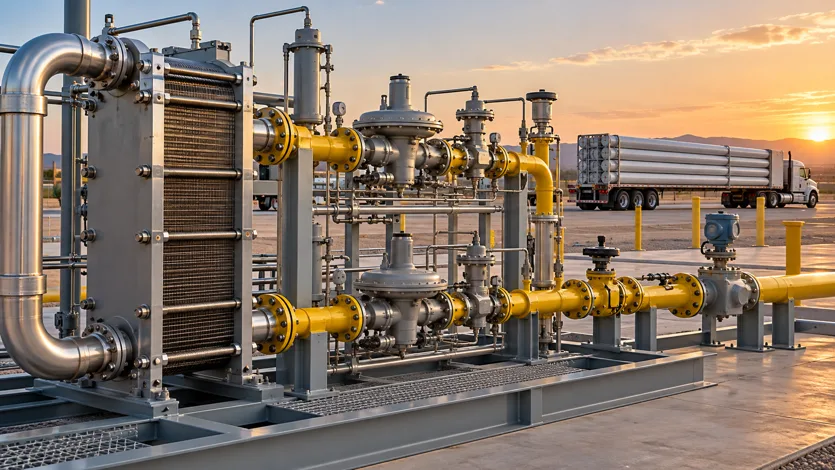
The trailer pressure is highest when a full transport module connects and declines during unloading. The actual skid inlet is lower than trailer-vessel pressure if hose, manifold and filter losses occur. State the maximum and minimum at the named skid inlet point. Mark each as barg or psig (gauge), or bara or psia (absolute). The regulator’s mechanical pressure rating, capacity and pressure-drop calculation require consistent units and locations.
Next define the plant outlet pressure and allowable deviation at a named point, along with minimum, normal and peak flow. Standard volumetric flow must carry reference conditions. In this guide’s illustrative example, Sm³ is volume at 15°C and 101.325 kPa absolute. Other contracts may define a different base. Give the supplier gas composition, minimum inlet temperature, ambient range and moisture limits. Those inputs affect flow sizing and predicted temperature after pressure reduction.
Emerson’s regulator sizing guidance stresses sizing at minimum inlet pressure for required capacity and checking maximum inlet and outlet pressure ratings. It also distinguishes normal regulating capacity from a failed-wide-open flow used for protection sizing. A one-stage proposal and a two-stage proposal should both present regulating-capacity evidence at the limiting inlet and load conditions.
What a single-stage arrangement can do
In a single-stage concept, one regulator controls from high-pressure inlet to the specified lower plant pressure. Fewer major control elements can mean a simpler P&ID, shorter package and fewer maintenance items. That can be attractive where the regulator has a suitable pressure rating, capacity and stable control range and where temperature management is resolved.
“Simpler” does not mean unprotected. The system still needs an engineered overpressure approach and appropriate isolation, instrumentation and site interlocks. A regulating valve is not automatically the independent safety barrier for its own failure. Ask where the protective device senses pressure, what it does on a trip and how the downstream equipment’s pressure limit is respected.
Single-stage performance should be tested at two very different corners: high inlet pressure with minimum plant draw and minimum inlet pressure with peak plant draw. The first case can expose control or lockup concerns; the second can expose insufficient capacity. The temperature case may occur at the largest pressure reduction combined with a cold gas inlet, though the supplier must model the actual gas and operating sequence. A single product’s broad brochure pressure range is not proof that the complete duty has been met.
What additional stages may solve
A two-stage concept first reduces pressure to a controlled intermediate point, then reduces it to the final plant outlet. Emerson offers natural-gas-capable double-stage regulators, demonstrating that staged control is an established option; a specific model’s ratings cannot be generalized to every industrial skid. A two-stage skid may also use two distinct regulator assemblies with an intermediate pipe, instruments and possibly heating.
An intermediate pressure can make it easier to allocate pressure drop or choose components for the final low-pressure control duty. It can create a convenient point for heating, filtration or pressure monitoring. It may help control performance when inlet pressure varies widely, but that benefit must be shown through selected regulator curves and dynamics. Two stages do not guarantee tighter outlet pressure by themselves, and they do not remove the need for independent protection.
The first stage’s outlet setpoint must leave enough pressure for the second stage at the trailer’s minimum inlet condition. Otherwise the first stage can starve the second near changeover. Conversely, high upstream pressure and low flow must not overpressure the intermediate section. Each stage’s body, trim, sensing line, setpoint and downstream pressure rating need review. The intermediate equipment can become another place to inspect, maintain and protect.
Thermal behavior and heater placement
Natural gas often cools as pressure falls through a regulator. The temperature response depends on composition, initial temperature, pressure change and heat exchange with surroundings. Emerson’s cold-temperature guidance describes freezing risks and heating approaches. It does not support selecting a heater from a universal temperature-drop-per-bar rule for every gas mixture.
Splitting a pressure drop can change where the cold points occur, but it does not make the overall thermal effect vanish. For example, if gas is reduced to an intermediate pressure, reheated, then reduced again, the second-stage inlet temperature can be controlled. Whether that is better than preheating once or using one regulator depends on the calculated outlet temperatures, gas quality and utility availability. A two-stage design without heating can still be too cold.
Ask suppliers for a temperature profile at the maximum and minimum relevant inlet pressures, at normal and peak flow, and at the coldest credible ambient and gas-inlet conditions. Record temperatures before and after each regulator, at the meter and at the plant battery limit. Specify where instruments alarm or trip. If heating is proposed, include the heat source, control, utility load, failure response, maintenance and supply boundary. If no heater is proposed, require the thermal basis for that decision.
Control range and load changes
An industrial plant might operate one small pilot burner overnight and several large users during production. A regulator chosen only at peak flow may have poor control at minimum demand, regardless of stage count. Ask for droop, lockup pressure, setpoint range and response to the plant’s largest credible load step. State allowable transient pressure deviation and recovery time at the plant connection.
A second stage can sometimes serve as a dedicated final control device, but its upstream pressure must remain within its designed operating range. If the first stage drifts or trips, the second stage’s behavior must be understood. If a pilot-operated regulator is used, the pilot supply and sensing lines must be included in inspection and failure analysis. Emerson’s natural-gas regulator guidance describes how direct- and pilot-operated devices differ in control and capacity; selection remains application-specific.
Metering should be checked independently. Its installation point may be at intermediate or final pressure, depending on the design. Actual line-volume flow and meter range change with operating pressure and temperature even when standard-volume throughput is the same. A gas bill or plant balance should specify the volume reference conditions and correction method. Stage count alone does not determine measurement quality.
Stage count, parallel trains and protection are separate choices
These concepts are often confused in quotations:
| Architecture question | What it changes | What it does not establish |
|---|---|---|
| One vs. two sequential stages | Number and location of pressure reductions | Uptime or spare capacity |
| One vs. two parallel runs | Capacity split or maintenance availability | Number of reductions in each run |
| Monitor regulator or slam-shut | Overpressure response or containment | Normal process capacity |
| Heater before or between stages | Gas temperature entering a reduction | Need for independent protection |
| Meter location | Flowing conditions and battery limit | Accuracy without calibration and correction |
A plant may use two stages in one run, one stage in each of two parallel runs or another arrangement. Ask the bidder to draw the exact path and show which parts are duty, standby, monitor or protective. Do not interpret an unlabeled “2 × 100%” note as two stages.
Illustrative comparison
Planning assumptions only; no HMZ product rating or final design is implied. A plant requires 600 Sm³/h normally and 900 Sm³/h for short peaks. Sm³ means gas volume at 15°C and 101.325 kPa absolute. Assume the skid inlet varies from 200 barg when a trailer is newly connected to a guaranteed 25 barg before changeover, while the plant outlet must be held at 4 barg. Gas composition, low ambient temperature, minimum flow and allowable outlet deviation still need confirmation.
At 25 barg inlet and 4 barg outlet, a one-stage candidate must demonstrate 900 Sm³/h at the required outlet tolerance after allowance for piping loss. A two-stage concept might select an intermediate pressure, but that setting must remain below the available inlet at the end of unloading and above the second stage’s needed inlet, with margin for losses and control. An arbitrary 20 barg intermediate setpoint leaves very little apparent margin when the inlet is 25 barg; no buyer should assume it will work without a capacity calculation.
At 200 barg inlet and low flow, both concepts need temperature, pressure-rating, control and protection checks. One stage may need preheating; two stages may need heating at one or more points. Neither outcome follows from the pressure numbers alone. Ask both bidders to provide gas-specific thermal profiles and to identify their most limiting case.
Suppose Offer A quotes one regulator and a heater, while Offer B quotes two regulators and no heater. The lower component count or the higher stage count does not decide the award. Compare guaranteed outlet pressure and temperature across the full duty, protective architecture, maintenance, energy use and battery limits. Where thermal data remain uncertain, require clearly priced options and an agreed design hold point.
RFQ checklist for a useful stage comparison
Give each supplier the same inlet-pressure envelope at the skid, gas analysis and moisture specification, minimum/normal/peak flow, reference volume conditions, required outlet pressure and tolerance, transient demand and cold-weather conditions. Ask for:
- A P&ID identifying each regulating stage, heater, meter and protective device.
- Capacity evidence at minimum inlet pressure and peak demand.
- Low-flow control and lockup evidence at maximum inlet pressure.
- Intermediate pressure range and ratings, if staged regulation is proposed.
- Gas temperature before and after each reduction at the critical cases.
- Control and protective setpoints, sensing locations and failure sequence.
- Meter range and correction basis at its selected line conditions.
- Utility load, maintenance access, testing plan and named supply exclusions.
The proposal should state which checks are calculated, guaranteed or still subject to final gas analysis. This makes the selection reviewable without pretending that one architecture is universally superior.
Frequently asked questions
Does a large pressure ratio always require two stages?
No universal ratio alone settles the question. Regulator capability, gas composition, cold-end temperature, flow range, outlet tolerance and protection must be checked together.
Does two-stage reduction eliminate the need for a heater?
No. Staging changes the locations and magnitudes of individual pressure drops. Gas-specific temperature calculations determine whether and where heating is required.
Are two parallel regulators the same as two stages?
No. Parallel trains provide separate flow paths; sequential stages reduce pressure one after the other in the same path.
Can the first stage also provide overpressure protection?
Do not assume so. The protective concept must address credible regulator failure and downstream pressure limits with the required independence under local rules.
Where should the meter be placed?
At a location that meets the selected meter’s pressure, temperature, flow-range and installation requirements and the agreed accounting boundary. Request the reasoning on the P&ID.
Discuss your gas-reduction duty
Send the trailer inlet-pressure range, gas analysis, plant minimum/normal/peak demand, required outlet pressure and low-temperature conditions through HMZ’s contact page. Ask for a comparison of suitable pressure-reduction arrangements with performance, thermal and protection assumptions clearly stated.
Technical sources
- Emerson, Selecting and Sizing Pressure Reducing Regulators: sizing, pressure ratings, capacity and control considerations.
- Emerson, Cold Temperature Considerations: gas cooling and freeze-risk context.
- Emerson, Tartarini R Series Double-Stage Pressure Reducing Regulators: natural-gas-capable double-stage product example.
- Emerson, Natural Gas Pressure Regulators: regulator functions and control approaches.
- Emerson, Customized Stations and Skids: integration of regulators, heaters, protection and meters.
Related HMZ CNG solution
Explore the related HMZ CNG product page for a project-specific configuration.
