
Direct answer: A CNG bus depot should be sized around when buses return, where they park and when they must depart, not only around the number of vehicles. Overnight parking can make time-fill attractive because connected buses can receive gas over several hours. Buses with short turnarounds, variable routes or daytime relief service may also need fast-fill or a combination arrangement. The buyer should model the busiest realistic operating day, confirm gas supply and station capacity, and show that every required bus reaches its departure fuel target before its route begins.
This article is about vehicle fueling at a central bus depot. A trailer-fed CNG daughter station can be one supply architecture; a pipeline-fed depot is another. A containerized process unit is one way to package equipment. Neither the gas source nor the package form tells you whether time-fill, fast-fill or a hybrid arrangement meets the timetable. An industrial pressure regulation skid serving boilers has a different outlet and should not be confused with a bus station.
Turn the bus timetable into a fuel schedule
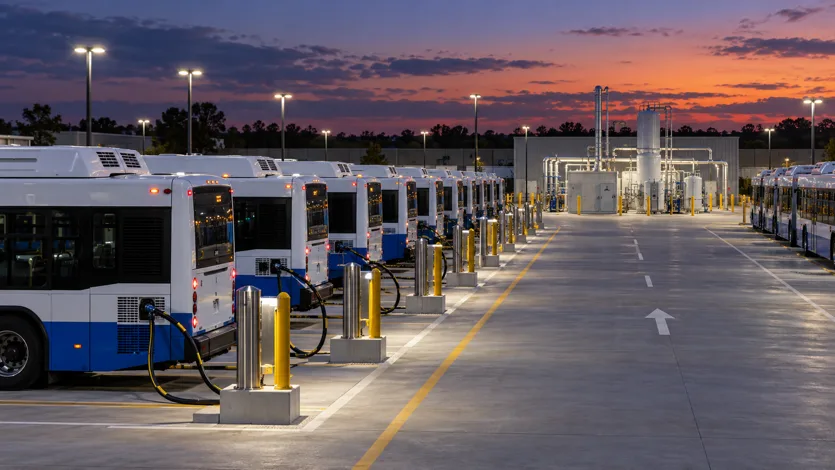
Start with the dispatch plan for a normal weekday, weekend, seasonal peak and special-event day. For each bus, record route distance or measured gas use, tank capacity and pressure class, return time, next departure, parking bay and expected fuel deficit. Some buses may run one shift and sit all night; others return briefly between morning and evening routes. A vehicle count alone hides this variation.
Use measured consumption where possible. If the fleet is new, state planning assumptions and obtain a sensitivity range rather than presenting a single unverified “gas per bus” number. Express demand consistently. When proposals quote standard cubic metres per hour, define the reference temperature and absolute pressure. In the example below, Sm³ means volume at 15°C and 101.325 kPa absolute. A vendor using a different standard condition must convert before the capacities are compared. Also check whether energy or mass is the contractual fuel unit.
The key operational deadline is morning dispatch. Work backward from it: bus parking, connection, inspection, fueling completion, disconnection and pre-trip checks all consume time. Keep a margin for late arrivals and a vehicle that requires a larger refill than average. A design that delivers enough gas over 24 hours can still leave a bus short of fuel at 05:30 if too much capacity is scheduled after that departure.
Time-fill, fast-fill or both?
The U.S. Department of Energy’s Alternative Fuels Data Center describes time-fill as useful for centrally parked fleets with overnight dwell. Vehicles are usually connected to posts and filled more slowly from a compressor. The agency also describes fast-fill stations that use higher throughput and storage to support short fueling stops, and combination-fill stations with both arrangements.
For a bus depot, time-fill can spread demand across the night and reduce a concentrated queue. It requires enough posts and a parking layout that lets buses connect safely without blocking others. The compressor must deliver the total fuel required within the available hours, allowing for its actual duty cycle and gas-supply conditions. A small buffer vessel, where provided, is not automatically a full fast-fill storage bank.
Fast-fill can suit buses that have little dwell time or need a midday top-up. It puts more demand on dispenser lanes, storage recovery and queue management. The nominal “minutes per bus” must be tested against real vehicle tank size, initial fill state, gas temperature and arrivals. AFDC notes that CNG temperature and fill speed affect the amount ultimately stored in the tank. A quick stop is useful only if the bus receives enough usable fuel for its next route.
Combination-fill can serve long-parked buses overnight and provide a fast-fill option for relief buses or exceptions. It can increase flexibility but also adds equipment and operational complexity. The buyer should specify exactly which vehicles use each mode, how priority is assigned if both draw on the same compressor, and what happens when a vehicle misses its assigned slot.
Size the overnight window, not just the daily total
Build a time chart in half-hour or hourly blocks. For each bus, show expected arrival, connection time, fuel required and earliest departure. Sum only the gas that must be supplied before each deadline. Check the most demanding overlap, not merely total daily use divided by 24. A compressor could have 10 overnight hours but only six hours between the last high-consumption arrival and the first departure.
For a preliminary calculation, divide required overnight standard-volume gas by the effective fueling hours. Effective hours account for connection, changes in compressor output, maintenance and planned downtime. Then ask the station supplier to simulate fills at actual vehicle and station pressures. The minimum gas pressure available from a pipeline or trailer-fed daughter system can affect compressor output; request performance at that limiting inlet condition.
If expansion is planned, show an initial fleet and a future fleet separately. It may be sensible to reserve electrical space, a pipe corridor and additional parking posts now, while adding compressor capacity later. Do not pay for unsupported equipment capacity or place new posts where future depot circulation cannot work.
Parking geometry is part of capacity
A time-fill post is only useful if a bus can reach and occupy it for the required period. Map the nightly parking plan: nose-in or pull-through bays, turning radii, reversing restrictions, emergency access, pedestrian routes and cleaning or maintenance movements. The fueling hose must reach the vehicle receptacle without creating a trip or collision hazard. Different bus models may place the receptacle in different positions.
A fast-fill lane needs a queue area that does not block depot exits or buses returning from service. Ask how long a bus spends at the dispenser including approach, authorization, nozzle connection and departure, not only the gas-transfer interval. If the busiest wave includes late buses, a second lane may be more valuable than an oversized compressor on one blocked island.
Fueling can interact with washing, inspection and maintenance. If a bus must be washed before parking, its available fueling window begins later than its route return. If maintenance staff move buses during the night, a connected hose may be incompatible with that workflow. Depot operations should review the proposed general arrangement before equipment is ordered.
Gas supply and resilience
For a pipeline-fed station, obtain the utility’s guaranteed minimum and maximum inlet pressure, deliverable flow and gas-quality specification. Pressure figures must identify gauge or absolute basis. The compressor selection must use the actual minimum inlet condition, not a favorable nominal number. For a trailer-fed daughter station, model trailer changeover, usable delivered quantity and declining suction pressure. The downstream bus schedule remains the same, but the supply risks differ.
Define the consequence of a compressor fault, power outage or delayed trailer. A transit operator may need all scheduled buses available even if the station has a one-hour interruption. Ask how much usable gas is in storage, which buses can use a backup dispenser or nearby station, and whether planned maintenance can fit outside the critical nighttime window. A “redundant compressor” helps only if gas supply, power, controls and dispensing paths also support it.
The U.S. AFDC has documented real bus fleet examples using overnight fueling, but those published cases are not HMZ references and their equipment capacities should not be copied into another depot specification. Use them to see how timetable and site conditions shape choices, then model the buyer’s own fleet data.
Worked scheduling example
Illustrative assumptions only; not an HMZ case or design rating. Suppose a depot has 40 CNG buses. Each needs an average of 45 Sm³ after its route, so the planning-day total is 1,800 Sm³, with Sm³ at 15°C and 101.325 kPa absolute. Assume 30 buses return by 20:00 and depart from 06:00, giving a nominal 10-hour parking window. Ten buses return at 23:00 and depart at 05:00, giving only six hours.
If all 40 buses had the same deficit, the later ten require 450 Sm³ within six hours, or an arithmetic average of 75 Sm³/h allocated to them. The earlier 30 require 1,350 Sm³ across ten hours, or 135 Sm³/h. During the six hours when both groups are connected, a naive sum is 210 Sm³/h. That is a preliminary throughput screen, not the compressor size: filling rates are not uniform, bus tank pressures differ and control priorities matter.
Suppose the station supplier proposes a time-fill compressor nominally rated at 220 Sm³/h. Ask whether that is available at the minimum guaranteed gas inlet pressure and relevant temperature, whether maintenance or defrost periods reduce effective hours, and whether the last ten buses receive priority before 05:00. A useful simulation should show each bus’s final fuel target, not just 1,800 Sm³ delivered by the following evening. If it cannot meet the 05:00 deadline, options include earlier fueling of late-return buses at fast-fill, staggered dispatch, additional compressor capacity or a different routing plan.
Procurement comparison table
| Input or design item | What to verify | Why it matters |
|---|---|---|
| Routes and departures | Daily, peak and exception timetable | Determines real fueling deadline |
| Per-bus fuel deficit | Measured or stated planning range | Prevents average bus from hiding heavy routes |
| Parking bays | Reachable posts and vehicle movement plan | Converts nominal posts into usable positions |
| Gas supply | Minimum inlet pressure and available flow | Governs compressor performance |
| Time-fill equipment | Number of posts, controls and effective hours | Shows how many buses can finish overnight |
| Fast-fill equipment | Lanes, storage recovery and queue plan | Covers short turnarounds and exceptions |
| Continuity | Failure response and reserve | Protects morning service |
| Scope | Civil, power, piping, approvals and training | Makes proposals comparable |
Request a schedule model, equipment layout, utility load list and responsibility matrix from each bidder. A compressor rating alone is not a bus-depot solution.
Frequently asked questions
Is time-fill always best for buses?
It works well when buses return to a central depot and remain parked long enough. Short dwell, irregular routes or midday relief work may justify fast-fill or a combination system.
Does one post per bus mean enough station capacity?
No. The posts must be accessible, and the compressor and gas supply must deliver each bus’s required gas before its departure.
Can storage solve a late-arrival wave?
Usable storage can help short peaks, but its amount depends on pressure, temperature and the fill sequence. It must be replenished before later demand. Ask for a simulation.
What if bus routes change after installation?
Design against a reasonable growth and schedule sensitivity case. Preserve space and electrical capacity where justified, and identify what future expansion would require.
Which figure matters most in a first enquiry?
Send the route-return and next-departure schedule together with estimated gas needed by each bus. Those reveal the real fueling window.
Plan a bus depot station with HMZ
Share the bus list, route and parking schedule, fuel deficits, gas source, site plan and desired continuity level through HMZ’s contact page. Request a time-based fueling concept, a marked depot layout and a clear list of equipment and site-work boundaries.
Technical sources
- U.S. DOE Alternative Fuels Data Center, Compressed Natural Gas Fueling Stations: time-fill, fast-fill and combination arrangements.
- U.S. DOE Alternative Fuels Data Center, Natural Gas Fueling Stations: application-based station choice.
- U.S. DOE Alternative Fuels Data Center, Filling CNG Fuel Tanks: fill temperature and final gas quantity.
- U.S. DOE Alternative Fuels Data Center, Costs Associated With CNG Vehicle Fueling Infrastructure: fleet duty and station configuration.
Related HMZ CNG solution
Explore the related HMZ CNG product page for a project-specific configuration.
