
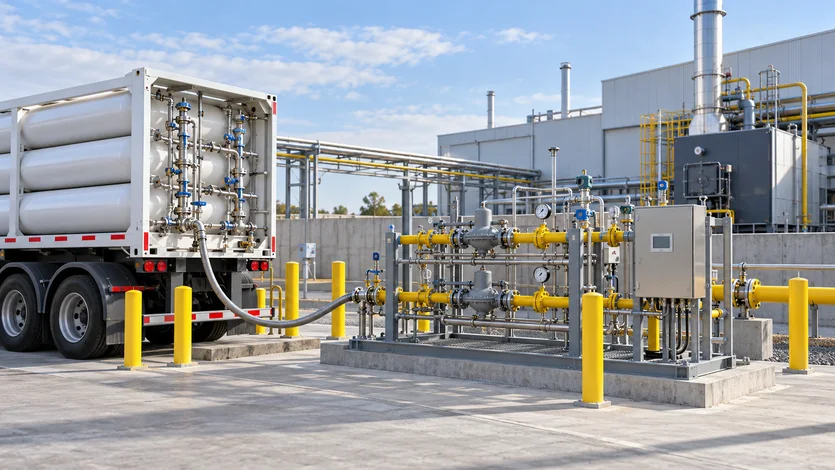
A CNG pressure regulation and metering skid receives high-pressure compressed natural gas, reduces and controls its pressure, measures the delivered gas, and supplies it at conditions suitable for an industrial user’s downstream system. It is typically one part of a delivered-gas project: the trailer, unloading interface, skid, site piping, and gas-consuming equipment must be engineered as a connected system.
For a factory evaluating gas supply without a pipeline connection, the first question is not simply “What pressure can the skid reduce?” The useful questions are how much gas the plant needs over time, what pressure remains in the trailer as it empties, what the downstream equipment requires, and who provides each interface.
Where the skid fits in the gas supply chain
In a common delivered-CNG arrangement, gas is compressed and loaded at a supply location, transported in a tube trailer, connected at an industrial site, and then delivered through a receiving and pressure-reduction system. The skid controls and measures the gas before it enters the plant distribution header. This is often described as a virtual pipeline, but the precise equipment boundary varies by project.
Typical path: CNG supply and loading → road transport → trailer unloading and isolation → pressure reduction, protection and metering → plant gas header → boilers, furnaces or other approved users.
The HMZ industrial CNG pressure reduction and metering skid is a project-specific package for this pressure-control and measurement duty. A containerized CNG daughter station serves a different primary purpose: supplying CNG to vehicles. A fleet CNG fueling station is likewise planned around vehicle refueling windows. Similar gas-supply components may appear in these projects, but the final outlets, operating sequence and scope differ.
What may be included in the package?
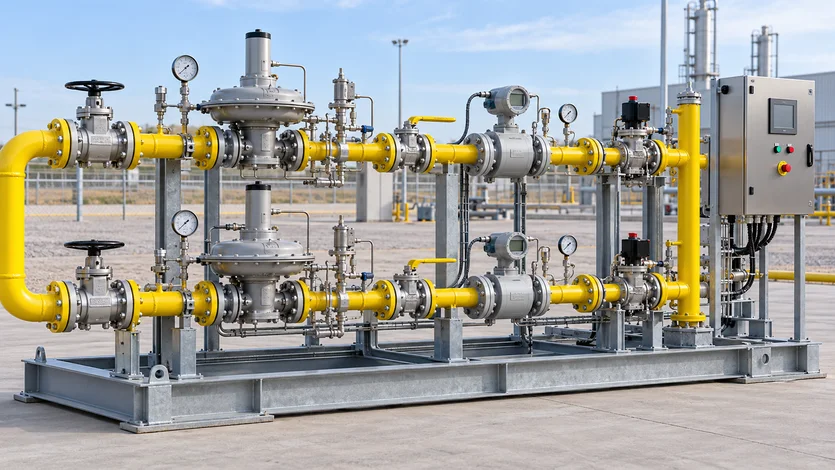
An industrial skid is assembled to a defined project scope. The table below describes functions to clarify with a supplier, rather than a fixed bill of materials for every installation.
| Function | Typical equipment or interface | What the buyer should confirm |
|---|---|---|
| Receiving and isolation | Inlet connection, valves, filtration and instrumentation | Trailer connection, pressure range, gas quality and responsibility for unloading hoses |
| Pressure control | One or more regulating stages, possibly parallel trains | Required outlet pressure and control across minimum and maximum flow |
| Temperature management | Temperature monitoring and heating when required | Predicted temperature after reduction, ambient conditions and gas composition |
| Protection | Independent shutoff, relief and emergency interfaces as specified | Set points, vent routing, site integration and local approval requirements |
| Metering | Meter, pressure/temperature instruments and flow computer where needed | Billing or process use, units, reference conditions and data output |
| Site integration | Outlet flange, controls, power and communications | Downstream header, utility supply, installation and commissioning boundary |
Neither “skid-mounted” nor “integrated” means that the trailer, foundations, entire plant distribution network and local permits are included. Request a marked layout and scope matrix before comparing quotations.
Why inlet pressure is a range, not a single number
A tube trailer’s pressure changes during unloading. The pressure at the skid inlet also depends on upstream piping losses and the way trailers are changed over. A quotation based only on the full trailer’s initial pressure may miss the low-pressure end of the useful unloading cycle.
State minimum, normal and maximum inlet pressures, and identify whether each value is gauge pressure (barg) or absolute pressure (bara). The distinction matters for calculations. Ask the supplier to show the permitted operating range and the minimum trailer pressure at which the skid can still maintain the required outlet flow and pressure. If continued gas delivery below that condition requires a different system, identify it explicitly instead of assuming the regulating skid can recover pressure.
How pressure reduction, temperature and heating interact
Reducing natural gas pressure can lower gas temperature. The resulting temperature depends on the gas composition, inlet temperature, pressure drop and operating sequence. A heater may be needed to protect the equipment or maintain downstream conditions, but it is not a standard item to assume for every project.
The supplier should evaluate the coldest credible operating condition, including the low ambient temperature, available trailer pressure and maximum expected flow. Gas quality and possible moisture or liquids affect the design. If heating is specified, confirm its energy source, control logic, utility demand, safety interfaces and whether it is included in the skid boundary. Emerson describes preheating as one method of managing cooling during gas pressure reduction; its presence and capacity still require a project calculation.
What does the meter actually measure?
The meter may serve process monitoring, inventory reconciliation or a contractual custody-transfer purpose. These uses impose different requirements. A measured volume at operating pressure and temperature is not automatically the same as a standardized volume. When a proposal states flow in standard cubic metres per hour, ask for the reference absolute pressure, reference temperature, gas composition or compressibility method, and the calculation basis. If settlement is by mass or energy, confirm the conversion and gas-quality data required.
Also clarify the specified flow range: minimum stable flow, normal operating flow and peak flow. An attractive maximum rating is not enough if the plant spends most of its time at a lower load. Meter selection, control stability and accuracy must be checked across the useful range; do not infer contractual accuracy from a generic instrument brochure.
Start sizing with the industrial load
Collect the connected equipment list and actual operating schedule. For each boiler, furnace or process user, record minimum, normal and peak consumption, required inlet pressure, hours of operation and whether multiple users run together. A plant’s sum of equipment nameplate ratings can differ substantially from its realistic coincident peak.
Next, compare that demand profile with the usable gas available from each trailer and the delivery interval. Consider changeover time, a delayed delivery, planned shutdown and the minimum pressure at which useful gas can still flow. The pressure-reduction skid does not create gas supply; its rated capacity must be assessed together with the trailer logistics and the plant’s continuity requirement.
Illustrative planning example only: suppose a factory normally uses 600 standard cubic metres per hour and reaches 900 standard cubic metres per hour when a second furnace starts. Those numbers cannot be used for final selection until the reference conditions are defined and the overlap duration, inlet pressure range, outlet pressure and gas composition are known. A supplier should confirm performance at both the normal and peak points, especially near the end of trailer unloading. This example is not an HMZ project rating.
Questions to resolve before requesting a quotation
- What are the project country, installation location, ambient temperature and site altitude?
- What is the gas composition, moisture specification and required gas-quality documentation?
- What are the minimum, normal and maximum inlet pressures, clearly marked barg or bara?
- What are the minimum, normal and peak demands, with units and volume reference conditions?
- What outlet pressure range and stability does each downstream user require?
- How many trailers are available, what is their usable capacity, and how will changeover work?
- Is metering for operating records, billing or custody transfer? What data must be transmitted?
- Which party supplies unloading connections, foundations, electrical power, heating utilities, outlet piping, installation, commissioning and local approvals?
These answers allow suppliers to define a comparable package. Where an input remains unknown, request a clearly stated preliminary assumption and keep it open for engineering confirmation.
Frequently asked questions
Is an industrial CNG regulating skid a compressor?
No. Its primary function is to reduce and control pressure while measuring gas. If the project needs to recover pressure or use more of the gas remaining in a low-pressure trailer, that is a separate engineering question and may require additional equipment.
Does every skid include a heater?
No. Heating depends on the calculated temperature after pressure reduction, gas quality, ambient conditions and downstream limits. Confirm it from project data.
Can one skid supply several boilers?
Potentially, provided the simultaneous demand, pressure requirements, control range and downstream distribution network are designed accordingly. A common header does not eliminate the need to assess each user.
Is metering always suitable for commercial settlement?
No. Define whether the meter is for process monitoring or contractual settlement, then specify the required accuracy, calibration, reference conditions and local requirements.
What information is most important for a first quotation?
Provide inlet pressure range, outlet pressure, minimum/normal/peak flow, gas composition, ambient conditions, operating hours and supply boundary. Clarify the units and pressure basis.
Discuss an industrial CNG supply project with HMZ
Share your gas data, industrial load profile, trailer delivery plan and required equipment boundary with HMZ. We can use those inputs to develop a project-specific pressure regulation and metering package and identify assumptions that need local engineering confirmation.
Technical reading
- Emerson: natural gas pressure regulators — regulator function and pressure control.
- Emerson: customized pressure-reducing skids — example of integrated regulator, valve and meter systems.
- Emerson: heat exchangers for gas pressure reduction — temperature management and Joule–Thomson cooling.
