
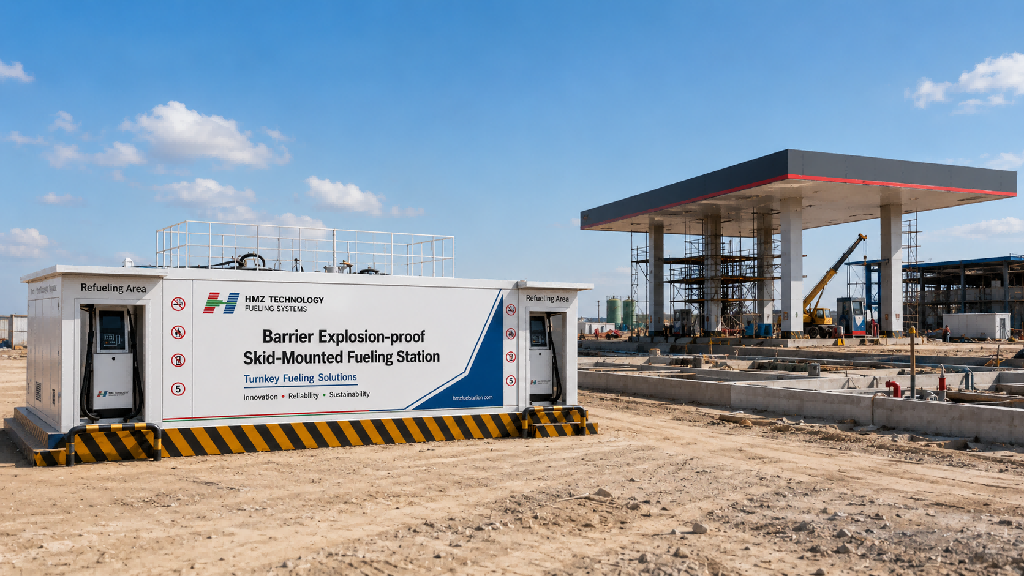
Choosing the right fuel station solution is an important decision for mining companies, construction contractors, logistics operators, oil and gas projects, farms, and remote industrial facilities.
For many years, traditional fuel stations were the standard solution for fuel storage and dispensing. However, as industrial projects become more mobile, time-sensitive, and cost-focused, skid-mounted fuel stations are becoming a more practical option for many project owners.
So, what is the difference between a skid-mounted fuel station and a traditional fuel station?
More importantly, which one is right for your project?
In this article, we compare skid-mounted fuel stations and traditional fuel stations from installation time, construction cost, mobility, safety, flexibility, maintenance, and application scenarios.
What Is a Skid-Mounted Fuel Station?
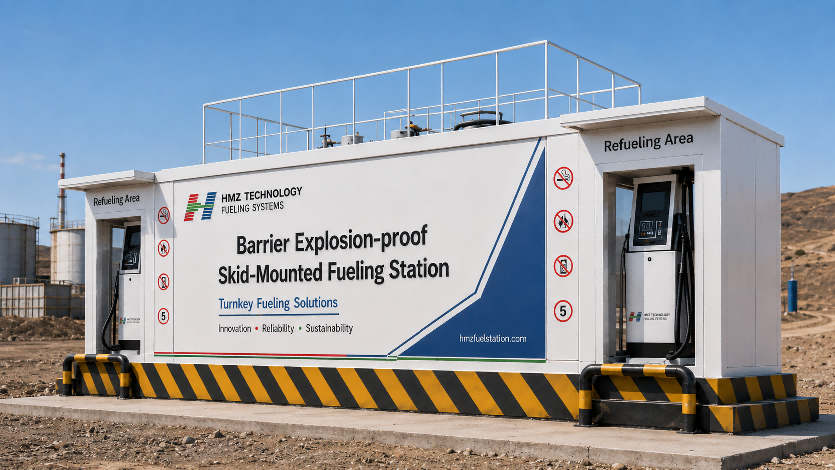
A skid-mounted fuel station is a modular fuel storage and dispensing system built on a steel skid or containerized structure.
It typically integrates the fuel tank, fuel dispenser, pump system, piping, control cabinet, safety protection system, and optional fuel management system into a single, complete unit.
Because the system is pre-assembled before delivery, it can be transported to the project site and installed with less civil construction work.
Skid-mounted fuel stations are commonly used in mining sites, construction projects, remote industrial areas, oil and gas fields, agricultural operations, logistics yards, and temporary project locations.
What Is a Skid-Mounted Fuel Station and How Does It Work?
What Is a Traditional Fuel Station?
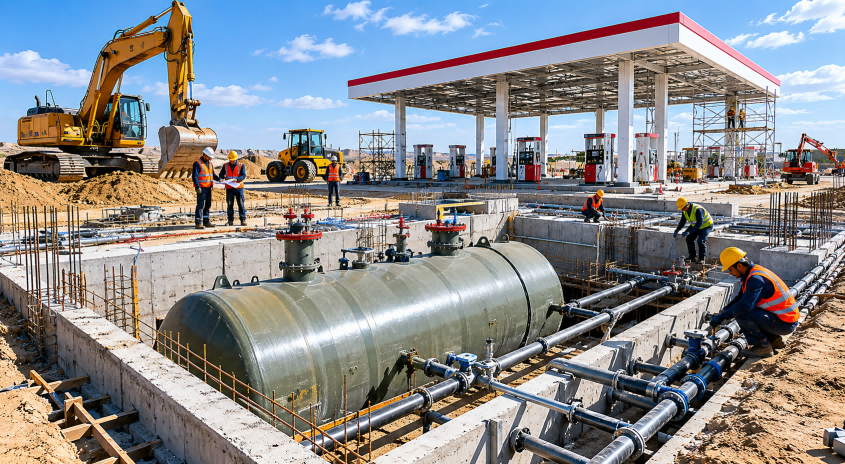
A traditional fuel station is usually a permanent fueling facility built on a fixed site.
It often requires underground or fixed fuel storage tanks, concrete foundations, civil construction, piping systems, electrical rooms, canopy structures, drainage systems, safety approvals, and long-term site planning.
Traditional fuel stations are commonly used for public retail fueling, city fuel stations, highway service stations, and permanent commercial fueling locations.
They are suitable for locations with stable traffic, long-term operation, and fixed land use.
Main Difference Between Skid-Mounted and Traditional Fuel Stations
The biggest difference is not only the equipment structure. It is the project logic behind the solution.
A traditional fuel station is designed as a permanent infrastructure project.
A skid-mounted fuel station is designed as a modular and flexible fueling solution.
For public fuel retail, a traditional fuel station may be more suitable. However, for mining, construction, oilfield, agricultural, logistics, and remote industrial projects, a skid-mounted fuel station can often provide faster deployment, lower construction costs, and greater flexibility.
1. Installation Time
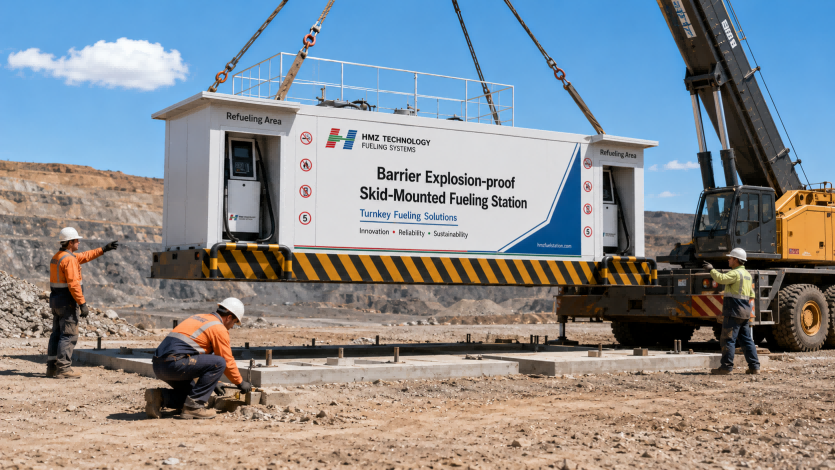
Installation time is one of the most important differences.
A traditional fuel station may require land preparation, foundation construction, underground tank installation, piping, electrical work, canopy construction, and multiple inspections. This process can take weeks or even months, depending on local requirements and project complexity.
A skid-mounted fuel station is much faster to install.
Because most components are integrated before delivery, the on-site work is usually simpler. The project owner mainly needs to prepare the installation area, connect the power supply if required, and complete necessary safety checks.
For time-sensitive projects, such as mining operations, temporary construction camps, emergency fuel supply, or remote industrial sites, a skid-mounted fuel station can help the project start fueling operations much sooner.
2. Construction Cost
Traditional fuel stations usually require higher civil construction investment.
Costs may include land preparation, underground storage tanks, concrete foundations, drainage systems, separate equipment rooms, pipelines, canopy structures, and more complicated installation work.
A skid-mounted fuel station can reduce many of these costs.
Its modular structure means less civil construction, fewer separate equipment foundations, and simpler site preparation. For industrial projects that do not need a full public retail fuel station, this can significantly reduce the initial investment.
This is one reason why skid-mounted fuel stations are popular for mining, construction, farming, and remote projects.
3. Mobility and Relocation
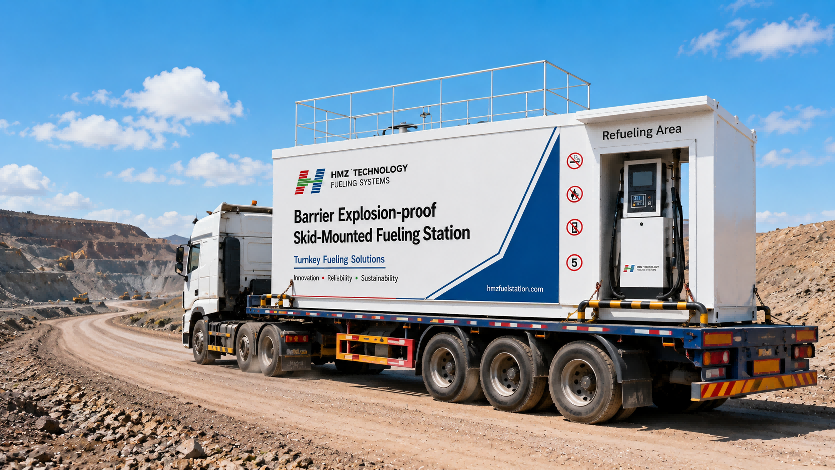
Traditional fuel stations are fixed facilities. Once built, they are difficult and expensive to relocate.
This is not a problem for public fuel stations in cities or on highways because they are designed for long-term operation in one location.
However, many industrial projects are not fixed forever.
Construction projects move. Mining operations expand. Oilfield service areas change. Agricultural fueling needs may vary by season. Temporary camps may be removed after a project is completed.
A skid-mounted fuel station is much more flexible.
It can be transported and relocated when project requirements change. This makes it suitable for companies that need fuel support across different sites.
4. Site Requirements
A traditional fuel station usually needs more space, more construction work, and more permanent infrastructure.
It may also require underground tank areas, drainage systems, canopy structures, vehicle circulation planning, safety distance control, and public access design.
A skid-mounted fuel station usually has simpler site requirements.
It can be installed on a prepared ground area or foundation, depending on the project design. The integrated structure reduces the need for multiple separate facilities.
For remote areas where land preparation is difficult or expensive, this simpler site requirement is a major advantage.
5. Fuel Storage Capacity
Traditional fuel stations are often designed with large storage capacity for high daily traffic and long-term public fueling demand.
Skid-mounted fuel stations can also be designed with different tank capacities, but their advantage is flexibility.
A project owner can choose the tank capacity according to daily fuel consumption, delivery schedule, available space, and equipment demand.
For example, a small construction site may need a compact system. A mining project may need a larger tank with multiple dispensers. A logistics yard may require fuel management and operator control.
This makes skid-mounted fuel stations easier to match with specific project needs.
6. Safety Design
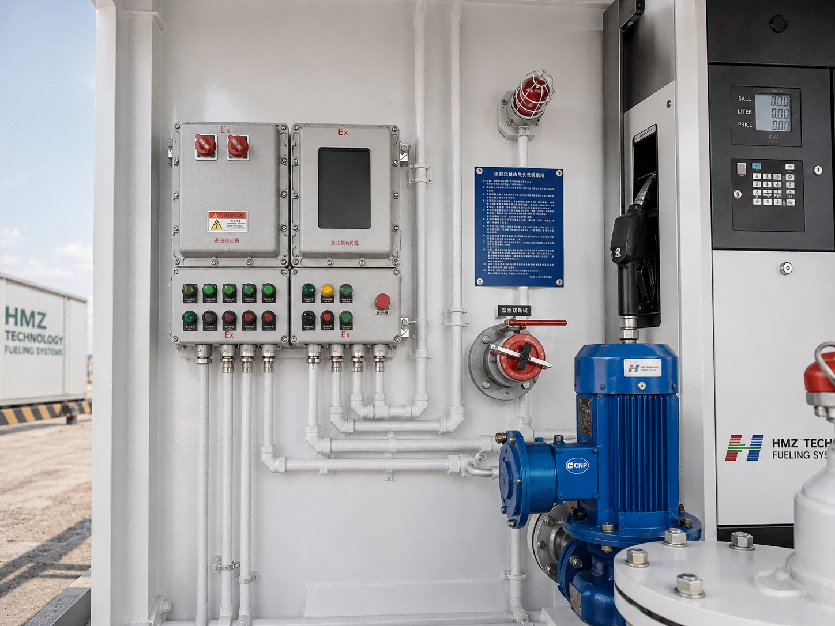
Both traditional fuel stations and skid-mounted fuel stations must be designed with safety in mind.
Traditional fuel stations usually follow local fuel station construction codes and are built as permanent, regulated facilities.
Skid-mounted fuel stations can also include professional safety systems, especially when used in industrial or hazardous environments.
Common safety options may include:
- Explosion-proof electrical components
- Emergency shut-off system
- Leak detection system
- Fire protection system
- Ventilation design
- Anti-static grounding
- Overfill protection
- Safety valves
- Control cabinet protection
For mining sites, oil and gas fields, and industrial locations, explosion-proof design and emergency protection are especially important.
The key point is that a skid-mounted fuel station should not be treated as a simple fuel tank. It should be designed as a complete fuel storage and dispensing system with proper safety protection.
7. Operation and Fuel Management
Traditional fuel stations are usually designed for daily public or commercial operation. They may include payment systems, retail management, canopy lighting, customer access, and high-traffic vehicle flow.
Skid-mounted fuel stations are usually designed for internal project operation.
They can be equipped with fuel management systems to help control refueling records, operator access, fuel dispensing quantity, and inventory monitoring.
For industrial companies with fleets, generators, and heavy machinery, this can help reduce fuel waste, unauthorized fuel use, and poor fuel tracking.
This makes skid-mounted systems especially useful for mining companies, logistics yards, large farms, and construction contractors.
8. Maintenance Requirements
Traditional fuel stations may involve more complex civil facilities and underground systems. Maintenance may include tanks, pipelines, dispensers, drainage systems, electrical systems, canopy structures, and site infrastructure.
Skid-mounted fuel stations are more compact and integrated.
Because the main components are arranged in one modular unit, inspection and maintenance can be more convenient for project operators. The system can be designed for easier access to the tank, pump, dispenser, control cabinet, and piping.
For remote projects, easier maintenance is very important because service resources may be limited.
9. Application Scenarios
Traditional fuel stations are more suitable for:
- Public fuel retail
- City fuel stations
- Highway service stations
- Permanent commercial fueling locations
- High-traffic consumer fueling
Skid-mounted fuel stations are more suitable for:
- Mining sites
- Construction projects
- Oil and gas operations
- Farms and agricultural projects
- Logistics and transport yards
- Remote industrial areas
- Temporary project camps
- Emergency fuel supply
- Remote power generation sites
- Industrial fleet fueling
The right choice depends on whether your project needs a permanent public station or a flexible industrial fueling solution.
10. Long-Term Flexibility
A traditional fuel station may be better for a fixed business location with long-term retail fuel demand.
However, it is less flexible when the project changes.
A skid-mounted fuel station gives project owners more flexibility. It can be customized, moved, expanded, or reconfigured according to project development.
For example, a company may start with one skid-mounted unit and later add a larger tank, additional dispenser, fuel management system, or another fueling point.
This flexibility is valuable for growing industrial projects.
Comparison Table: Skid-Mounted Fuel Station vs Traditional Fuel Station
| Comparison Item | Skid Mounted Fuel Station | Traditional Fuel Station |
|---|---|---|
| Installation Time | Faster installation | Longer construction period |
| Civil Construction | Less civil work | More civil work required |
| Mobility | Can be relocated | Fixed location |
| Initial Investment | Usually lower for industrial projects | Usually higher due to permanent infrastructure |
| Application | Industrial, remote, temporary, project-based fueling | Public retail and permanent fueling |
| Customization | Flexible configuration | More fixed infrastructure design |
| Maintenance | Compact and integrated | More complex site infrastructure |
| Fuel Management | Suitable for internal fleet/project control | Suitable for public commercial operation |
| Expansion | Modular and scalable | Expansion may require more construction |
| Best For | Mining, construction, oilfield, farms, logistics, remote areas | City stations, highway stations, public fuel retail |
Top benefits of skid-mounted fuel stations
Which Fuel Station Solution Should You Choose?
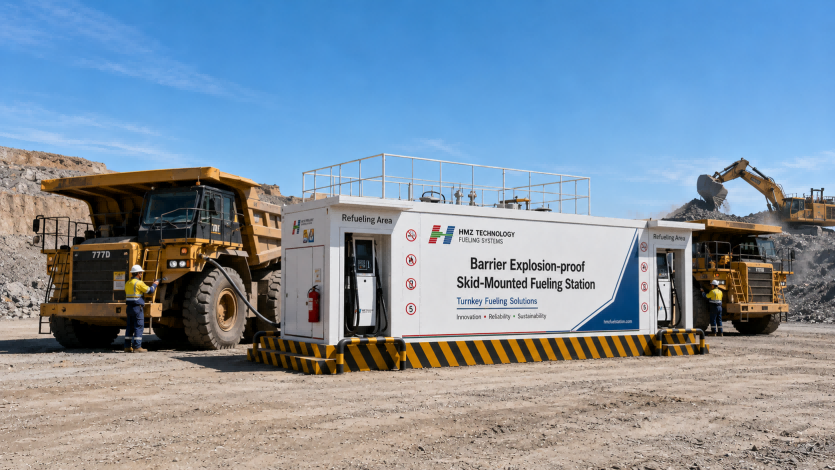
You should consider a traditional fuel station if your project is a permanent public fueling business with stable traffic, long-term land use, and retail fuel sales.
You should consider a skid-mounted fuel station if your project needs:
- Faster installation
- Lower construction work
- Flexible relocation
- Industrial fuel storage and dispensing
- Remote-area fueling support
- Custom tank capacity
- Explosion-proof safety design
- Internal fleet or project fuel management
For many industrial and remote projects, the skid-mounted option is more practical because it solves the real problem: how to provide a safe, reliable, and flexible fuel supply without building a full traditional fuel station.
Why Choose HMZ Skid-Mounted Fuel Stations?
HMZ Technology provides customized skid-mounted fuel station solutions for industrial, mining, construction, oil and gas, logistics, and remote-area applications.
Our systems can be designed according to your project requirements, including fuel tank capacity, dispenser configuration, pump system, explosion-proof components, control system, safety protection, and fuel management options.
Whether your project needs a compact diesel station for a construction site or a larger modular fuel station for mining and industrial operations, HMZ can help design a suitable fueling solution.
Conclusion
Skid-mounted fuel stations and traditional fuel stations serve different purposes.
A traditional fuel station is suitable for permanent public fuel retail. A skid-mounted fuel station is more suitable for industrial projects that need fast deployment, lower civil construction, mobility, safety, and flexible fuel supply.
For mining sites, construction projects, oil and gas fields, agricultural operations, logistics yards, and remote industrial facilities, skid-mounted fuel stations can provide a practical and cost-effective alternative to traditional fuel station construction.
If you are planning a project and need a reliable fuel storage and dispensing solution, HMZ Technology can help you evaluate your site conditions, fuel demand, safety requirements, and equipment configuration.
Contact HMZ Technology today to request a customized skid-mounted fuel station solution for your project.
