
Direct answer: Size an industrial CNG pressure regulation skid from a duty envelope, not a single flow figure. Specify minimum, normal and peak gas demand; the inlet pressure at the skid across a trailer’s unloading cycle; the outlet pressure and allowable variation required by the plant; gas composition and temperature; and the speed of load changes. Then ask the supplier to demonstrate regulation, metering and protection at the limiting combinations. A nominal maximum flow without its inlet and outlet conditions is not a usable sizing guarantee.
This guide concerns a trailer-fed industrial gas receiving and pressure-reduction skid supplying boilers, furnaces, engines or a plant header. A CNG daughter station feeds vehicle dispensers and may need compression and high-pressure storage. A fleet fueling station is planned around vehicle refueling windows. Those projects can share components, but their delivery pressures, operating schedules and sizing tests differ.
Start with the plant’s actual load envelope
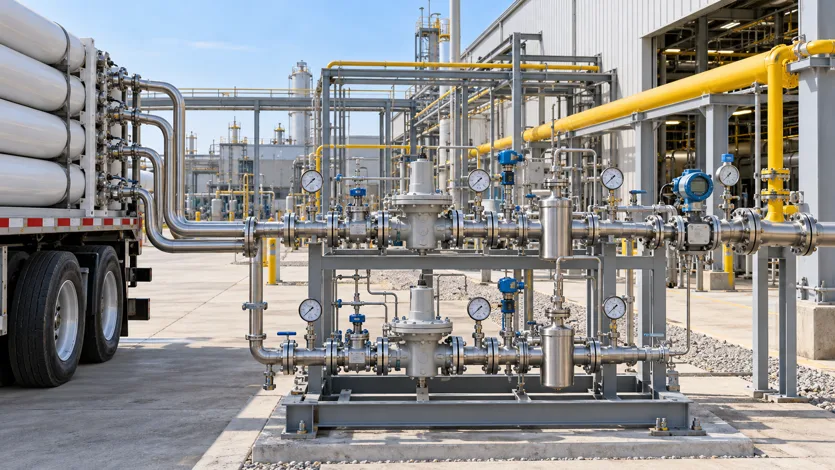
Build an hourly demand profile from the equipment that can run together. Record each consumer’s minimum stable firing rate, normal rate, maximum rate, start-up sequence and required gas pressure at its own inlet. The coincident plant peak may be lower than the sum of all nameplates, but it can also be much higher than the daily average. Ask operations whether a second furnace starts while the first is at high fire, whether shift changes create a step load, and whether future equipment must fit within the first skid.
Use one agreed gas-volume reference throughout. In the illustrative numbers below, Sm³ means a cubic metre of gas at 15°C and 101.325 kPa absolute. Another contract might use different standard conditions; that changes the numeric volume. State gas composition or heating-value basis when converting energy demand to standard volume. A meter’s actual flowing cubic metres per hour at line pressure and temperature are not the same number as Sm³/h.
The flow schedule should include a low-load or pilot-only case. A regulator able to pass the peak may not give acceptable control at the smallest continuous draw. Meter rangeability is also a separate check: the process could be stable while the proposed meter is below its reliable measurement range. For commercial settlement, define accuracy and correction requirements rather than accepting a generic “meter included” description.
Define pressure at the correct locations
A trailer’s vessel pressure declines as gas is withdrawn. That does not mean the regulator sees the same pressure: unloading hoses, filters, valves and pipework consume pressure, especially at high flow. Ask for minimum, normal and maximum pressure at the actual skid or regulator inlet, including allowances for upstream losses. Emerson’s regulator sizing guidance specifically warns that pressure measured upstream of the regulator can overstate the pressure available at its inlet.
Mark every pressure as gauge (barg or psig) or absolute (bara or psia). Gauge pressure is relative to local atmosphere; absolute pressure is referenced to vacuum. Convert consistently before gas-flow calculations. The highest credible inlet pressure governs pressure-rating and protection questions, while the lowest credible inlet pressure is often the critical capacity case. Emerson advises sizing a regulator’s regulating capacity at minimum inlet pressure and separately checking maximum inlet and outlet pressure ratings.
The outlet duty also needs a location. “4 barg outlet” might mean at the skid flange, the plant header or a burner train after a long pipeline. State the target pressure, acceptable range and maximum downstream pipe loss at peak load. If a burner needs at least 3.5 barg at its inlet and the intervening piping can lose 0.3 bar at peak, a 3.5 barg skid outlet would not meet that requirement. The buyer must reconcile the individual users’ limits and the downstream design before fixing a setpoint.
Test the combinations that govern selection
A practical supplier review checks more than one extreme. The matrix below frames the duty without pretending that every combination is physically simultaneous.
| Operating case | Flow and inlet condition to verify | Design question |
|---|---|---|
| Fresh trailer, low plant draw | Minimum flow at high inlet pressure | Can control remain stable and stay within outlet limits? |
| Normal production | Normal flow across typical inlet pressure | Is outlet accuracy acceptable during routine operation? |
| Peak near trailer changeover | Coincident peak flow at minimum guaranteed skid inlet pressure | Can the regulator still pass the required flow and hold outlet pressure? |
| Rapid equipment start | Defined step from low to high demand | How far and for how long may outlet pressure dip? |
| Shutdown or no flow | Zero or very low flow with high upstream pressure | What are lockup, isolation and overpressure-protection arrangements? |
| Winter or cold gas | Credible pressure drop, gas quality and minimum inlet temperature | Is heating or another temperature-management measure required? |
The supplier should give a capacity curve or calculation for the selected regulator and trim, not just a body size. The pressure difference and gas properties affect capacity; so do the regulator’s setpoint and allowable droop. The regulating capacity is the relevant normal-duty figure. A wide-open or failed-open flow figure serves a different protection calculation and must not be presented as normal controlled throughput. Emerson makes this distinction in its regulator sizing handbook.
Account for changing load and control response
Pressure regulation is a control function: as plant draw changes, the regulator adjusts to maintain a downstream pressure. Its behavior is not fully described by maximum flow. Ask for permissible steady-state droop from low to high load, transient pressure deviation after a specified load step, recovery time and lockup pressure at no flow. State where the pressure sensor or pilot senses pressure. A remote sensing line may help control the header, but its arrangement and failure behavior need engineering review.
One large regulator is not always the best way to cover a very wide operating range. Depending on the duty, a supplier may propose a different trim, staged regulation, parallel runs or a separate small-load line. These are design options, not automatic requirements. Ask the supplier to show which run operates at each flow and how changeover occurs without an unacceptable pressure excursion. Also ask how filter blockage, pilot failure, heater trip and loss of utilities are detected.
Do not assume that adding parallel equipment doubles usable capacity at every inlet pressure. The pressure losses, control interaction and metering range must be checked for the actual piping arrangement. If production cannot tolerate interruption, define the required continuity during maintenance and trailer changeover so the proposed duty/standby or other arrangement can be evaluated against a measurable target.
Include temperature and gas quality in the sizing basis
A large natural-gas pressure reduction can cool the gas. The outcome depends on composition, initial gas temperature, pressure drop and ambient conditions. Water and heavier hydrocarbons can affect freezing or condensation risk. Emerson’s cold-temperature guidance discusses these problems and heating options, but its simplified examples are not a substitute for a project thermal calculation.
Request the gas supplier’s composition and moisture specification, and state the coldest credible gas and site temperatures. Have the skid supplier check temperature at relevant stages and instruments across the pressure range, including a fresh high-pressure trailer and winter operation. If heating is required, define the required downstream temperature, heating medium or electrical supply, turndown, failure response and power consumption. A heater may be unnecessary for one well-characterized dry-gas duty and essential for another. Do not treat it as a universal line item.
Meter selection also depends on composition, line pressure, temperature and flow range. Emerson’s gas metering documentation describes pressure and temperature transmitters, composition inputs and flow computers for corrected gas quantity. A process-indication meter and a custody-transfer system have different obligations. Ask which quantity is reported—actual volume, standard volume, mass or energy—and what calibration and data records are required.
Worked planning example: find the limiting point
Illustrative assumptions only; these are not HMZ product ratings or a completed design. Suppose a factory normally consumes 600 Sm³/h, can fall to 90 Sm³/h overnight and peaks at 900 Sm³/h for one hour when two users overlap. Sm³ uses 15°C and 101.325 kPa absolute. Assume the trailer supply can present 200 barg at the skid inlet when newly connected and falls to a guaranteed 25 barg at the skid inlet at the planned changeover. The plant header requires 4 barg at the skid outlet, with a project-defined permissible deviation. Gas composition, inlet temperature and downstream losses remain to be confirmed.
The simple peak-to-minimum flow ratio is 900 ÷ 90 = 10:1. That is a required operating range to test; it is not proof that a particular regulator or meter has 10:1 certified performance. The normal-to-peak ratio is 900 ÷ 600 = 1.5. If a buyer supplied only 600 Sm³/h, the proposed skid could be undersized by 300 Sm³/h during that one-hour overlap. If the buyer supplied only 900 Sm³/h, the proposal might overlook the 90 Sm³/h low-load control and metering case.
Ask the supplier to demonstrate 900 Sm³/h at 25 barg inlet and 4 barg outlet, including the specified outlet tolerance and available upstream pressure loss allowance. Then test 90 Sm³/h with the high inlet condition and no-flow lockup. The 200 barg value is also a design-pressure input; capacity at 200 barg alone does not demonstrate capacity at 25 barg. If actual trailer pressure at the skid inlet drops below the guaranteed minimum, the skid may need a different changeover point or a separate means of supply. A pressure-reduction skid cannot raise pressure.
No regulator or heater size follows from these four figures alone. The missing gas analysis, temperatures, pressure drops, transient limits, meter duty and site requirements must be supplied before vendor selection. That is the useful outcome of a preliminary example: it identifies what must be verified rather than creating false precision.
RFQ data that makes proposals comparable
| Provide to every bidder | Why it matters |
|---|---|
| Gas composition, quality limits and heating-value basis | Regulator, seals, thermal calculation and meter correction |
| Minimum, normal and maximum Sm³/h with explicit reference conditions | Control and measurement range |
| Load-step size, duration and allowable pressure deviation | Regulator response and downstream stability |
| Minimum and maximum inlet pressure at the skid in barg or bara | Capacity, rating and pressure protection |
| Required outlet pressure and tolerance at a named point | Setpoint and downstream piping interface |
| Minimum gas and ambient temperatures | Cold-end and heater assessment |
| Meter purpose and reporting unit | Meter type, correction and records |
| Trailer changeover method and continuity target | Number of receiving positions or standby runs |
| Battery limits, utilities, approvals and deliverables | Comparable equipment and site scope |
Ask bidders to list calculated performance at the critical cases, drawings, operating assumptions, exclusions and open inputs. A quoted maximum flow should identify the inlet pressure, outlet pressure, gas basis and temperature at which it applies.
Frequently asked questions
Should the skid be sized from daily consumption?
Daily consumption helps plan trailer logistics, but the regulator must meet the required hourly peak and operate acceptably at minimum flow. Divide-by-24 averages can hide a short high-load period.
Is the minimum trailer pressure the same as the minimum skid inlet pressure?
Not necessarily. Hoses, filtration, valves and piping can reduce pressure before the regulator. Specify the minimum at the point used in the vendor’s capacity calculation.
Can a regulator compensate when trailer pressure falls below plant pressure?
No. A pressure-reduction regulator cannot boost gas. Define the minimum usable trailer pressure and changeover plan; any pressure recovery would require a different engineered arrangement.
Does every industrial skid need two regulator runs?
No. The decision depends on uptime, maintenance strategy, control range and the plant’s tolerance for interruption. Request an explicit availability case rather than assuming either one or two runs.
Does a larger meter cover both low and peak flow?
Only if its specified accuracy and operating range cover both under the actual pressure, temperature and gas composition. A meter sized for peak alone may not meet a low-load billing requirement.
Send HMZ a usable design basis
For an industrial CNG receiving project, send the equipment load schedule, gas analysis, trailer inlet-pressure range, required outlet pressure, temperature limits, metering purpose and desired supply boundary through HMZ’s contact page. Ask for a proposed duty envelope and list of assumptions to confirm with the local engineer and gas supplier.
Technical sources
- Emerson, <i>Selecting and Sizing Pressure Reducing Regulators</i>: minimum-inlet sizing, regulating versus wide-open capacity, droop and inlet pressure location.
- Emerson, <i>Cold Temperature Considerations</i>: pressure-reduction cooling and cold-operation considerations.
- Emerson, <i>Natural Gas Pressure Regulators</i>: regulator behavior and selection inputs.
- Emerson, <i>Gas Ultrasonic Metering System</i>: measurement inputs, gas composition and flow-computer context.
Related HMZ CNG solution
Explore the related HMZ CNG product page for a project-specific configuration.
